
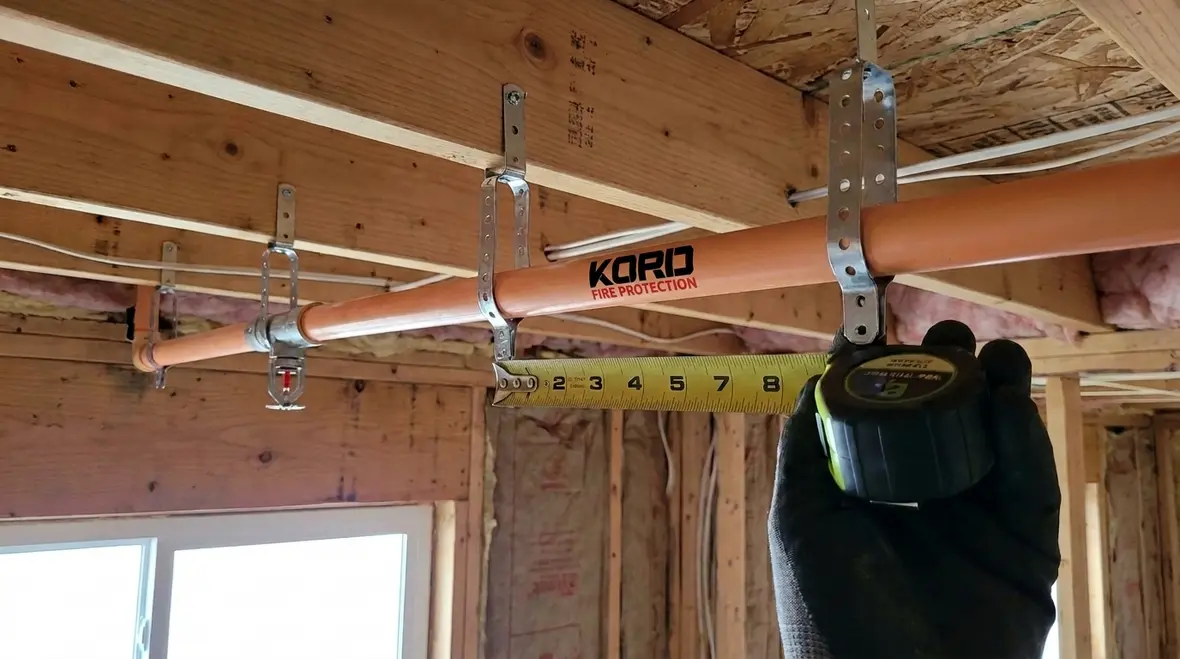
NFPA 13D Section 7.4: Pipe Hanger and Support Spacing for Residential Sprinkler Piping
Quick Answer: NFPA 13D Section 7.4 sets requirements for pipe hangers, braces, and support spacing for residential sprinkler piping to limit stress, prevent misalignment, and maintain system operability. Compliance depends on pipe size, routing, and the type and placement of supports.
If you are reviewing installation details across a larger property or mixed-use project, Kord Fire Protection’s fire sprinkler system service page gives helpful context on how compliance, maintenance, and inspection readiness fit together in the field.
What NFPA 13D Section 7.4 Requires for Support Spacing
NFPA 13D Section 7.4 pipe hanger support spacing residential sprinkler piping installation is a structural and operational requirement, not a convenience guideline. Proper support spacing keeps sprinkler piping stable during installation, during water discharge, and through service life conditions such as vibration, thermal expansion, and building movement. When supports are too far apart, the piping can sag, bow, or shift. Those failures can cause sprinkler head misalignment, impaired drainage, and increased stress at joints and fittings. For commercial facilities and commercial contractors installing residential sprinkler systems, these problems still matter because the system must function reliably, pass inspection, and remain serviceable after occupancy.
For a broader baseline on how NFPA 13 series concepts connect to whole system installation practices, see Kord Fire Protection’s NFPA 13 overview of automatic sprinkler system installation.
Why Support Spacing Impacts Sprinkler Performance
1) Structural stability and stress control
Sprinkler piping is not only a conveyance. It also experiences mechanical loads from its own weight, water loading, and dynamic forces during discharge. Supports distribute these loads into the building structure. If spacing exceeds the limits in NFPA 13D Section 7.4, the pipe can experience excessive bending moments, which increases the risk of leaks at threaded joints, couplings, and solvent weld connections.
2) Correct alignment for sprinkler discharge
Sprinklers must be positioned correctly to discharge in the intended spray pattern. Unsupported sections can move after ceiling access is closed, after maintenance traffic, or due to thermal cycling. Even small misalignments can create coverage gaps or result in interference with ceilings, storage shelving, or lighting fixtures in commercial and retail spaces that sometimes receive residential system layouts.
3) Valve, drain, and inspector accessibility
Support design influences where pipe sections run, where drains discharge, and whether inspectors can access test connections. Poor support placement can force piping to route around obstructions with excessive offsets, which can conflict with inspection and maintenance workflows.
How Supports Are Typically Arranged in Residential System Runs
NFPA 13D Section 7.4 focuses on hanger and support spacing, but in practice, crews must apply those limits with consistent support types and installation mechanics. The goal is to prevent movement and maintain straight, properly sloped runs where required.
Common support components and their job
- Hangers support the bottom of the pipe and transfer vertical load to the building structure.
- Straps, clamps, and U-bolts create secure attachment points while limiting rotation and pipe walk.
- Braces prevent lateral movement, especially at direction changes or near concentrated loads.
- Guides manage thermal expansion in certain configurations to reduce stress on joints.
Installation practices that prevent recurring failures
- Support placement at fittings avoids concentration of load at elbows, tees, and transitions.
- Consistent spacing prevents “accordion” piping that sags between supports and shifts at connection points.
- Correct fasteners and anchors support the hanger securely in the building material. Substandard anchors can loosen over time.
- Protection of piping coatings supports corrosion resistance and maintains the intended pipe life.
Commercial and industrial maintenance teams often see the same pattern during inspections: supports were installed during initial construction, then later modifications added penetrations, rerouted lines, or concealed access. Without a controlled change process, the system can end up out of compliance with spacing requirements even when the original layout was correct.
Compliance Challenges During Real Installations
Ceiling obstructions and retrofit constraints
Residential-style sprinkler routing frequently travels through spaces that can differ from plan submittals. Lighting, ductwork, security cabling, and fire alarm devices can reduce the available path and push pipe runs off the intended centerline. When crews field-adjust alignment, they may stretch between supports to avoid delays. That increases the risk of noncompliance with NFPA 13D Section 7.4 spacing rules.
Commercial facility coordination and inspection readiness
In retail, warehouses, and mixed-use properties, systems may be installed under complex project schedules. Inspectors typically verify the pipe support arrangement visually and by measurement during rough-in. If hanger locations are hidden behind ductwork or future finishes, verification becomes harder and rework cost increases.
Kord Fire Protection supports commercial facility stakeholders with compliance-focused installation review, testing preparation, and post-install documentation support. This approach reduces last-minute field changes that can inadvertently break spacing and support requirements.
Maintenance and service life issues
Support spacing compliance must survive the system’s operational timeline. During maintenance, technicians may replace sections, adjust sprinklers for obstructions, or open ceilings for unrelated repairs. If maintenance crews alter the piping without preserving hanger spacing, the system can become susceptible to stress and misalignment. A documented maintenance procedure helps protect compliance.
For additional context on fire pump and water supply interdependencies that affect operating conditions, see this fire pump water supply guide.
Field Verification and Inspection Readiness Checklist
When teams validate installation prior to inspection, they should treat hanger spacing as a controlled measurement, not an estimate. Use this checklist to reduce rework and improve acceptance.
- Measure support spacing between hangers along straight runs and confirm it matches NFPA 13D Section 7.4 requirements for the installed pipe configuration.
- Verify support type and attachment matches the piping material and building structure. Confirm no hardware substitutions that reduce holding capacity.
- Check near fittings for added support where required by the system’s mechanical behavior, especially around elbows and tees.
- Confirm alignment of sprinkler drops and branch lines so sprinkler escutcheons and heads sit correctly.
- Inspect for pipe sag during rough-in and after ceiling closing to identify spacing or anchoring problems early.
- Document changes if routing is modified. Update drawings and reconcile spacing impacts before final signoff.
These checks align with the same compliance mindset Kord Fire Protection applies when supporting commercial, industrial, and retail facilities with ongoing fire sprinkler system testing and maintenance.
Frequently Asked Questions
Call Kord Fire Protection for Compliance Support
Support spacing drives reliability. If your residential sprinkler piping runs sit within commercial, industrial, or retail occupancies, Kord Fire Protection can help you validate installation details, prepare for inspection readiness, and maintain ongoing compliance through testing and service. Contact Kord Fire Protection today to schedule a system review focused on NFPA requirements, hangers, bracing, and practical field documentation.

Join Our Newsletter!
Get the latest fire safety tips delivered straight to your inbox From our Newsletter.



