
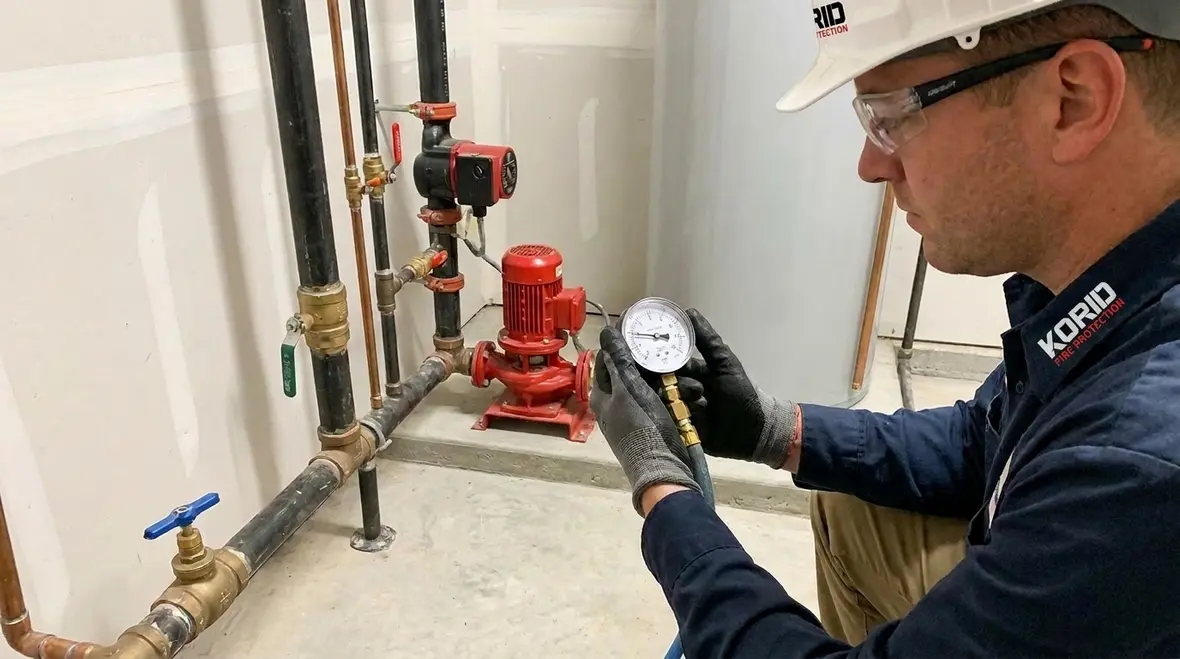
NFPA 13D Section 6.1: Water Supply Capacity Requirements for Residential Sprinkler Systems
Quick Answer: NFPA 13D Section 6.1 sets the minimum water supply capacity needed for residential sprinkler systems to deliver effective fire flow at the required pressure and duration. Compliance depends on the available water, system design demand, and verified pressure performance, including pump and tank provisions where applicable.
If you’re reviewing system readiness in a real building environment, Kord Fire Protection’s fire sprinkler service and maintenance support is a useful reference point for how inspections, repairs, testing, and ongoing compliance work together in the field.
What NFPA 13D Section 6.1 is trying to solve
NFPA 13D Section 6.1 water supply capacity requirements residential sprinkler systems focuses on a practical question: can the water supply deliver the needed flow rate and pressure under fire conditions without unacceptable impairment? For installers and facility owners, the risk is not only undersizing. The bigger problem shows up in commissioning, inspections, and real operational performance when static pressure, residual pressure, and available flow mismatch the design assumptions.
In commercial and retail environments that include residential style occupancies (or mixed-use sites), compliance challenges tend to increase. Water mains may share capacity, fire pumps may be controlled by building systems, and maintenance history can be inconsistent. This is where a service partner with documented testing procedures and reliable inspection workflows matters.
Scope and how Section 6.1 interacts with the system design
Section 6.1 does not exist in isolation. It connects the water supply capabilities to the sprinkler system demand calculated elsewhere in NFPA 13D. Designers determine the system’s required flow and pressure, then compare those requirements to what the water supply can deliver at the system connection.
In practice, NFPA 13D water supply capacity decisions typically drive:
- Whether the installation can rely on municipal or on site supply without augmentation
- Whether a pump, storage tank, or other water supply equipment must be sized and arranged
- How the system will be tested and accepted based on measurable performance
- How ongoing impairment management is handled for the water supply components
To understand the installation context and common system components that affect water supply performance, review this overview of automatic sprinkler system installation: NFPA 13 overview for automatic fire sprinkler system installation.
How water supply capacity gets verified during design and acceptance
NFPA 13D Section 6.1 water supply capacity requirements residential sprinkler systems relies on verified available performance. That means the system design must reflect realistic supply conditions, not worst case “paper values.” Key verification steps commonly include:
1) Establish baseline municipal supply performance
When the system depends on a municipal main, the available flow at required pressure must be based on measured fire flow or hydrant testing data. Designers and contractors need a clear understanding of:
- Static pressure at the time of test
- Residual pressure at the flow rates relevant to design
- Whether the supply is shared with other loads
Common failure point: tests done under favorable conditions that do not represent the conditions during a significant demand event.
2) Confirm on site supply capabilities when pumps and tanks apply
When municipal supply cannot meet demand, NFPA 13D requires on site augmentation where needed. Pump and tank systems must be sized to deliver the required flow and pressure for the intended operational period. Commissioning must verify the pump’s performance curve alignment, control response, and actual system discharge.
Common failure point: pumps that start reliably but deliver insufficient flow once system friction losses are accounted for, or valves and controllers that do not behave as designed.
3) Validate friction losses and system piping effects
The water supply connection can look adequate in terms of static pressure, but the real test is residual pressure after all losses are applied. That includes:
- Pipe length and diameter assumptions
- Fittings and offsets
- Elevational changes across the sprinkler system
- Any accessory piping required by design
Common failure point: design models that do not match as built piping or that miss field changes during installation.
4) Document acceptance tests for field readiness
Acceptance and verification efforts should confirm that the measured performance aligns with the designed demand under the expected configuration. Facilities that treat this as a one time event often see degradation later due to maintenance gaps, valve position issues, or pump controller changes.
Operational pressure, duration, and performance under fire scenarios
Water supply capacity is not only about achieving a flow rate once. The system must perform during the time frame that the fire scenario demands. For residential sprinkler systems, the operational logic still depends on pressure remaining within the effective range for sprinkler activation and water delivery.
In commercial, industrial, and retail settings, the same operational concepts influence sprinkler performance even when the occupancy classification differs. Facility managers should treat water supply performance as an ongoing operational asset, not a static utility.
Three performance areas deserve special attention:
- Residual pressure stability: Verify that pressure does not collapse under expected flow. A supply that looks acceptable at low flow can fail at design flow.
- Supply component reliability: Pumps, check valves, pressure switches, and controls must operate correctly. Controller behavior and wiring verification matter.
- System readiness through maintenance: Impaired valves, blocked strainers, and unnoticed changes in pipe layout can reduce effective water delivery.
For additional context on fire pump systems, testing concepts, and field considerations, see this fire pump testing requirements guide.
Common compliance and field failure points tied to Section 6.1
NFPA 13D Section 6.1 water supply capacity requirements residential sprinkler systems often fails in the field due to mismatches between design assumptions and real operational conditions. The following issues show up repeatedly during commissioning reviews and inspection findings.
Municipal supply uncertainty
Hydrant testing may be limited to a single point or may not cover the flow and pressure combinations required. Shared connections, line breaks, and seasonal demand changes can alter performance. Without a verified basis, the system may not achieve required residual pressure.
Pump system configuration problems
Even when pumps are sized, operational reliability can be compromised by:
- Incorrect controller settings or alarm thresholds
- Valves left in the wrong position after service
- Check valve failures that cause unwanted loss or backflow constraints
As built piping deviations
Small changes in routing and fittings can noticeably increase friction losses. If field modifications were not captured in the design calculations, the final system may draw more residual pressure than expected.
Maintenance and impairment management gaps
For ongoing compliance, commercial and multi use facilities should expect formal procedures when impairments occur. Even short duration water supply impairment can degrade readiness. Maintenance should include documented testing and valve position verification, not just visual inspection.
As a service partner, Kord Fire Protection supports ongoing compliance by aligning testing, inspection, and maintenance workflows with how systems actually perform in operation. That includes field verification approaches that help prevent design to as built performance drift over time.
What good ongoing maintenance looks like for water supply capacity
NFPA 13D acceptance is only the start. Water supply capacity requirements depend on components staying healthy and correctly configured. A robust maintenance program should focus on the items that most directly affect flow and pressure delivery.
Maintenance focus areas
- Water supply equipment status: verify pump operation, controls, and ready to run conditions
- Check and isolation valves: confirm correct positions and ensure valves are not obstructed
- Strainers and filters: inspect and clean as required to prevent flow restriction
- System acceptance data continuity: maintain documentation so future changes do not erase the verified baseline
Why it matters for mixed-use and commercial operations
In commercial, industrial, and retail facilities, water supplies may serve multiple life safety systems and non fire loads. That increases the need for disciplined impairment management, scheduling, and coordination across trades. Kord Fire Protection helps teams keep water supply capacity aligned with the installed design intent through repeatable testing and maintenance records.
Frequently Asked Questions
Conclusion and call to action
NFPA 13D Section 6.1 water supply capacity requirements residential sprinkler systems demand more than design calculations. Effective compliance requires verified supply performance, accurate friction loss accounting, and disciplined maintenance and impairment management. If your project involves municipal supply uncertainty or on site pumping and storage, engage Kord Fire Protection early for testing, commissioning support, and ongoing service documentation. That approach reduces risk during inspections and helps ensure the system can deliver the required flow and pressure when it matters.

Join Our Newsletter!
Get the latest fire safety tips delivered straight to your inbox From our Newsletter.



