
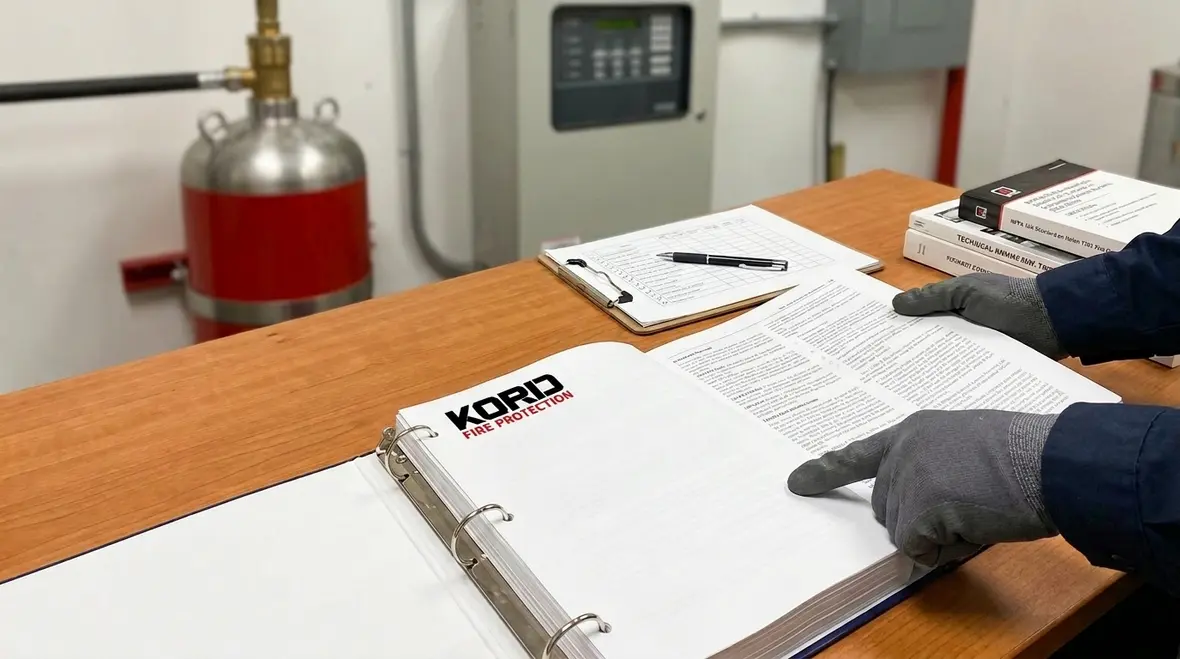
NFPA 12A Section 2.3: Non-NFPA Publications Cited in the Halon 1301 Standard
Quick Answer
NFPA 12A Section 2.3 identifies non-NFPA documents that the Halon 1301 standard relies on for technical details, definitions, and testing expectations. For commercial facilities, the citations affect system design verification, installation acceptance, inspection scope, and ongoing maintenance records.
If you are reviewing legacy clean agent systems, it also helps to understand the broader commercial fire suppression systems and services context, since inspection, testing, and maintenance habits tend to reveal compliance gaps long before an AHJ or insurer does.
Why Section 2.3 Matters for Halon 1301 Compliance
NFPA standards often reference other authoritative sources to define technical parameters that exceed a single document’s scope. In NFPA 12A, Section 2.3 is the key doorway to those supplemental requirements. Compliance teams typically focus on the main code text, but the real-world work happens where the standard says, in effect, “follow these referenced procedures and criteria.”
For facilities operating or managing heritage Halon 1301 systems, the non-NFPA publications referenced in NFPA 12A become practical requirements during engineering review, acceptance testing, and recurring inspection cycles. Missing a referenced test method, using outdated edition versions, or failing to capture proof-of-acceptance documentation can trigger inspection findings, insurance concerns, and operational risk.
What “Non-NFPA Publications” Usually Cover
Section 2.3 does not exist for decoration. Non-NFPA publications referenced in NFPA 12A generally support four operational areas:
Definitions and technical terminology used to interpret system performance claims and test results.
Installation and acceptance methodology such as measurement practices, documentation expectations, and acceptance test structure.
Equipment performance verification for components like valves, release mechanisms, detection interfaces, and actuation sequences.
Inspection and maintenance guidance that shapes how technicians validate continuing reliability over time.
Commercial, industrial, and retail owners feel these impacts most during contract-driven maintenance cycles, insurer audits, and tenant space turnovers where documentation continuity becomes a compliance requirement.
How Referenced Documents Influence Design and Acceptance Testing
The Halon 1301 system life cycle has a repeating pattern: design intent must become installed reality, then installed reality must become repeatable performance. When NFPA 12A points to non-NFPA publications referenced in NFPA 12A, it sets the expectation that acceptance testing will use the referenced methods rather than a generic “field check.”
Operational procedures that commonly depend on referenced methods
Release device and actuation validation: technicians typically confirm timing characteristics and functional performance to the referenced criteria, not just “it released.”
Agent quantity and distribution verification: measurements and acceptance logic can depend on specific calculation or test structures described outside the NFPA text.
System interface behavior: alarm, abort, supervisory, and initiating circuit behavior must align with the referenced criteria for behavior under simulated conditions.
Documentation format and traceability: inspectors and AHJs often expect the proof package to show that tests ran under the correct method.
Common failure points during acceptance and later inspections
Edition mismatch: facilities sometimes follow an older edition of a referenced non-NFPA publication, creating a gap between what the system was tested to and what the current compliance intent expects.
Incomplete test records: reports that list “tested” without method details can fail review even if the equipment performed.
Component drift: release hardware, detection electronics, and interface relays may degrade, and maintenance steps that skip referenced checks reduce reliability.
Inconsistent scoping: some facilities cover only what is visible. Referenced guidance often expects a broader scope, including supervisory signals and abort logic.
Commercial service partners help by building a documentation workflow that captures method-specific evidence, not just pass or fail outcomes. That reduces rework during insurer or AHJ spot checks.
Inspection and Maintenance: Where Referenced Criteria Become Routine
In practice, maintenance compliance is where referenced publications become “real.” The system sits in a building environment where construction changes, humidity, dust, and electrical noise can degrade performance. The referenced documents often shape what technicians must verify to prove continuing capability.
Typical continuing reliability activities affected by referenced guidance
Periodic functional testing that checks that detection and control logic behaves correctly under controlled simulation.
Hardware condition checks for corrosion, mechanical binding, seal condition, and reliable continuity paths.
Agent system readiness verifying that the system remains configured as designed and that no unauthorized changes occurred.
Recordkeeping and traceability for test parameters, technician identifiers, and evidence artifacts used for compliance verification.
Commercial compliance challenges the service plan must address
Tenant and operational disruption constraints: retail and multi-tenant industrial sites may limit system downtime. Maintenance planning must align with functional test expectations and documentation needs.
Legacy Halon system knowledge: technicians must understand heritage system behavior and the referenced methods that validate performance without guessing.
Change management: control panel upgrades, network monitoring additions, and building automation interfaces can alter behavior unless the maintenance procedure confirms the referenced acceptance logic.
Brownfield construction effects: modifications to partitions, cable routes, and HVAC pathways can create gaps between design assumptions and present conditions.
Facilities benefit from a maintenance program that treats the referenced documentation as a checklist backbone, not an archive item. Kord Fire Protection supports commercial owners with repeatable inspection and maintenance workflows designed to satisfy both NFPA expectations and the cited-method proof needs.
Implementation Checklist: How Facilities Should Verify They Are Following the Right References
Facilities often need a practical method to ensure that the referenced non-NFPA publications referenced in NFPA 12A are applied correctly. The checklist below aligns with typical commercial compliance practices.
| Step | What to Verify | Why It Impacts Compliance |
|---|---|---|
| 1 | Confirmed edition of each cited non-NFPA publication | Prevents edition mismatch findings during audits and acceptance reviews. |
| 2 | Documented test method and parameter capture | Transforms “tested” statements into reviewable proof artifacts. |
| 3 | Maintenance scope aligned to referenced criteria | Ensures continuing reliability checks do not skip required validation steps. |
| 4 | Component condition and interface behavior evidence | Reduces risk from drift in release hardware and control logic behavior. |
| 5 | Change log for system-impacting building modifications | Helps prevent design assumption gaps after construction or automation changes. |
For a broader NFPA 12A system context, facilities can use this overview as a planning baseline: NFPA 12A overview for commercial planning.
Frequently Asked Questions
Next Step: Get Your Reference-Control and Maintenance Proof Package Aligned
Commercial owners who manage Halon 1301 systems should treat NFPA 12A Section 2.3 as a documentation and method-control requirement. Kord Fire Protection helps facilities confirm the correct reference editions, standardize inspection scope, and generate audit-ready maintenance records. Contact Kord Fire Protection to review your current program, identify evidence gaps, and build a repeatable compliance workflow for ongoing testing and maintenance.

Join Our Newsletter!
Get the latest fire safety tips delivered straight to your inbox From our Newsletter.



