
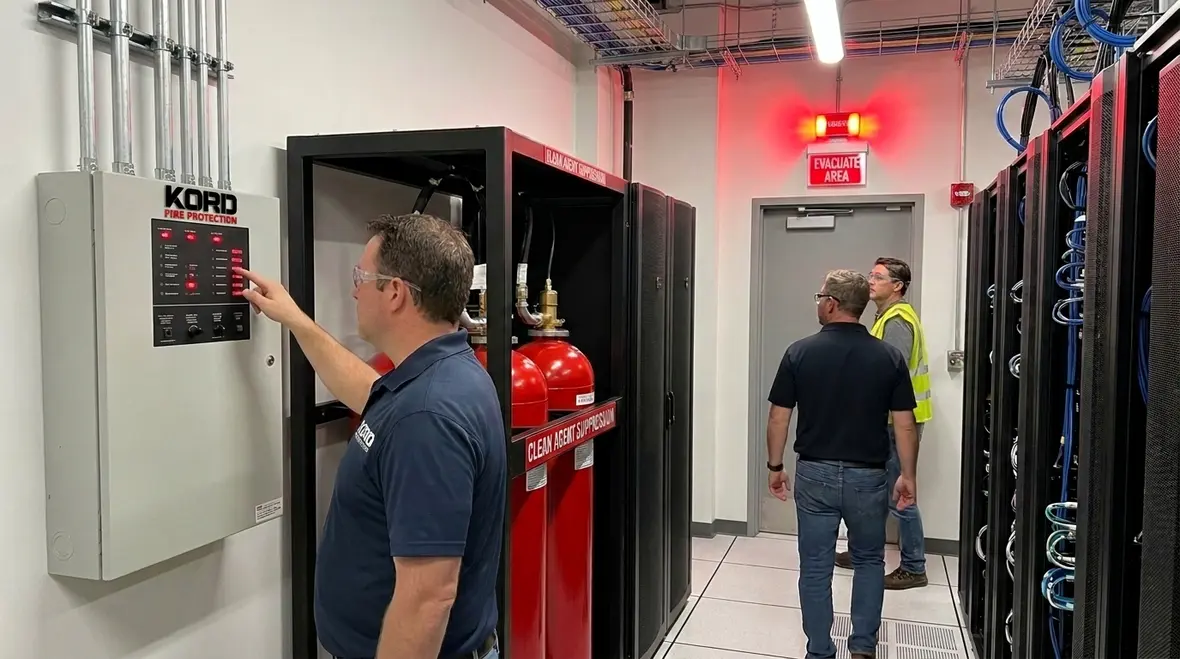
NFPA 12A Section 1.5: Personnel Safety Around Halon 1301 Systems
Quick Answer: NFPA 12A Section 1.5 sets the personnel safety expectations for Halon 1301 total flooding systems, focusing on safe evacuation, controlled discharge, and protecting occupants from hazardous concentrations. Compliance requires disciplined operating procedures, verified system performance, and ongoing inspections to prevent unsafe releases.
For facilities reviewing broader clean agent strategy, Kord Fire Protection’s clean agent fire suppression systems page provides a practical starting point before diving into the people-focused requirements of NFPA 12A Section 1.5.
Why Section 1.5 Matters in Real Facilities
In commercial, industrial, and retail environments, Halon 1301 personnel safety is not a theory. It is an operational outcome that depends on how the system interfaces with people, doors, alarms, ventilation, and emergency response.
NFPA 12A Section 1.5 addresses the practical reality that Halon 1301 is a clean agent, but it still poses risks to occupants if released while people are present or if the system is not properly maintained. That is why the Halon 1301 personnel safety requirements NFPA 12A are built around controlled release logic, reliable detection and alarm initiation, and verified readiness of life safety components.
For facility owners and safety teams, the compliance challenge often shows up during audits and inspections, not during initial installation. Common pressure points include tampered or misused manual controls, door hold open devices that do not close as intended, outdated inspection documentation, and ventilation systems that do not respond as required.
For a broader baseline on system design and enforcement context, see NFPA 12A overview.
What Section 1.5 Requires Before Discharge: The Safety Sequence
NFPA 12A Section 1.5 establishes the operational expectations that must protect personnel prior to and during agent release. In practice, safety depends on a sequence that ensures the protected space is cleared and occupants are warned and directed before Halon 1301 is discharged.
1) Alarm and notification that drives occupant action
Personnel safety begins with the alarm strategy. The system must alert occupants promptly enough to allow evacuation and prevent exposure. This includes notification timing, alarm audibility, and message consistency with the site’s emergency procedures.
Commercial facilities frequently fail the intent of Section 1.5 when alarms are not integrated with site paging standards, when sound levels change due to renovations, or when drills are not aligned with the actual discharge sequence.
2) A controlled delay or release logic tied to evacuation
Total flooding systems require logic that prevents immediate agent release without sufficient warning. The safety sequence should provide time for evacuation and for the space to reach an appropriate condition for discharge.
If facility staff override the sequence without retraining, or if the system is placed into a mode that bypasses intended delays, personnel protection is compromised. Section 1.5 focuses on preventing those unsafe operational states.
3) Door, ventilation, and enclosure integrity during discharge
Even when warning is correct, personnel safety can still be undermined by improper enclosure conditions. Section 1.5 expects that the protected space is controlled so the agent remains within the intended boundaries and exposures outside those boundaries do not increase.
Common issues include propped doors, malfunctioning automatic door closures, ventilation dampers that fail to close fully, and control sequences that are not validated after HVAC upgrades. Any of these can increase uncertainty in where agent concentration accumulates.
Operational Procedures That Support Compliance
NFPA 12A personnel protection requirements are only as effective as the operating procedures that govern daily use and emergency response. Section 1.5 pushes facilities to treat system operation as an organized life safety function, not a standalone fire suppression feature.
Training and role clarity for facility staff
Commercial sites often rely on multiple roles: security, facilities management, dispatch centers, and on call responders. Compliance improves when responsibilities are documented and rehearsed, including who initiates evacuation, who acknowledges alarms, and who verifies safe conditions.
Where training lapses, two risks commonly appear. First, staff may delay evacuation awaiting confirmation. Second, staff may attempt to troubleshoot within the protected area, exposing themselves during the safety sequence.
Permit to work and change control for protected spaces
Section 1.5 is frequently impacted by “small” work orders: temporary partitions, new duct runs, added signage, electrical rewiring, and HVAC modifications. Each can alter sound levels, detection coverage, and airflow behavior that affects agent distribution.
Facilities that maintain a change control process reduce unsafe conditions by requiring engineering review, suppression system verification, and updated documentation after modifications.
Emergency documentation and post event reset discipline
After an alarm or discharge event, facilities must follow a disciplined reset process that prevents accidental re-entry during unsafe conditions. Reset also includes verification steps that confirm the system returns to a known safe state with alarms operational and safety devices functioning.
Inspections and Testing: How Section 1.5 Is Verified
Personnel safety requirements rely on verified performance. NFPA 12A aligned inspection and maintenance practices ensure the system will execute the safety sequence correctly when an actual event occurs.
Common inspection focus areas for personnel safety
- Alarm initiation and notification performance: audibility and strobe synchronization, alarm circuitry integrity, and alarm response procedures.
- Release control timing and logic: confirmation of required delay and interlocks, including proper operation in “normal” and “alarm” modes.
- Door and damper operation: verification that closures and ventilation isolation occur as designed during alarm states.
- Detection subsystem functionality: sensor health, placement integrity, contamination checks, and verification that activation occurs within the system’s intended time window.
- Agent quantity and system readiness: confirmation that the stored Halon 1301 quantity remains within acceptable parameters.
Failure points that create unsafe conditions
The most consequential failures for Section 1.5 typically relate to uncertainty and bypass. Examples include:
- Notification path degradation such as failed speakers, disconnected alarm outputs, or changed occupancy patterns that reduce effective coverage.
- Interlock failure where damper closure feedback is not monitored correctly or where door closure devices slip out of calibration.
- Documentation drift where inspection records show work completed but the sequence verification was never performed after modifications.
- Manual control misuse that can override safety timing, particularly during troubleshooting.
Commercial Compliance Challenges and Maintenance Reality
Many facilities understand the system exists, but they do not always manage it as a life safety process. The result is a gap between what the design intends and what the site actually does over time.
Renovations and occupancy changes
Retail remodels, warehouse layout changes, and industrial equipment additions can affect airflow and enclosure integrity. Even if detection remains functional, evacuation conditions can change. Higher noise environments, new partitions, and blocked egress routes can reduce the effectiveness of the warning sequence required by the safety intent of Section 1.5.
Ventilation system upgrades
HVAC changes are a top cause of nuisance or failed operational behavior. Ventilation dampers and smoke control related components must be verified in the specific operating mode associated with system alarms. If HVAC controls get reprogrammed, the suppression system may no longer isolate the space as intended.
End of life documentation and recurring audit issues
Commercial audits often focus on repeatability. If inspections are inconsistent, if testers use different assumptions each visit, or if safety sequence verification is not documented, the facility can struggle to demonstrate compliance to inspectors and insurers.
How Kord Fire Protection Supports Halon 1301 Personnel Safety Requirements
Kord Fire Protection positions personnel safety around Halon 1301 as an ongoing compliance program, not a one time installation task. That approach directly supports the intent behind the Halon 1301 personnel safety requirements NFPA 12A by ensuring the alarm, release logic, and enclosure control mechanisms perform as designed throughout the system’s life.
In practice, Kord Fire Protection helps commercial facilities by:
- Validating the safety sequence logic and confirming notification and release timing behavior.
- Inspecting and documenting operational readiness of agent release, detection, and interface components that affect evacuation safety.
- Reviewing maintenance gaps and change control impacts after renovations and equipment additions.
- Supporting commercial compliance with clear reporting that aligns technical verification to audit expectations.
This operational discipline reduces unsafe conditions such as misaligned alarm behavior, failed enclosure isolation, and incomplete proof of readiness.
Frequently Asked Questions
Take Action Now
Review how your Halon 1301 total flooding system protects personnel during alarms, including evacuation timing, enclosure control devices, and post modification verification. If you cannot show consistent, sequence level testing and documented operational readiness, treat that as a compliance risk. Contact Kord Fire Protection to schedule a targeted review and maintenance plan that supports NFPA 12A personnel safety intent and helps keep your system audit ready.

Join Our Newsletter!
Get the latest fire safety tips delivered straight to your inbox From our Newsletter.



