
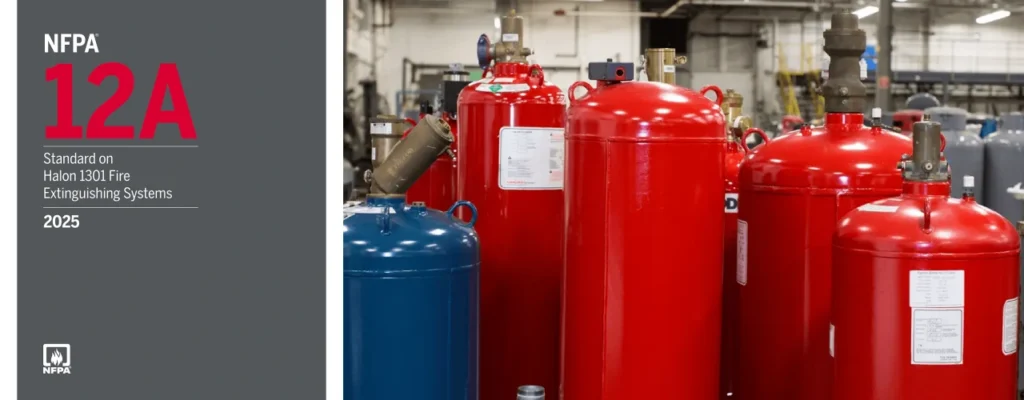
NFPA 12A Standard Overview: Halon 1301 Systems Explained
Quick Answer
This NFPA 12A explanation covers the standard that governs Halon 1301 fire extinguishing systems. NFPA 12A sets the minimum requirements for designing, installing, inspecting, testing, and maintaining systems that use the Halon 1301 gas to protect high-value areas such as electrical rooms, server spaces, and switchgear. In short, it defines where the agent may be used, how people are protected during a discharge, how the system must be engineered, and how a system must be cared for over its life.
What Is Halon 1301?
Halon 1301 is a clean-gas fire extinguishing agent. When it discharges, it puts out fire by interrupting the chemical reaction of combustion rather than by soaking the area in water or coating it with foam. It leaves no residue, conducts no electricity, and clears from a space relatively quickly, which is why it was once the go-to agent for protecting expensive, sensitive equipment: switchgear, server rooms, control centers, museums, archives, and aviation assets.
NFPA 12A exists because a powerful, invisible, toxic-at-high-concentration gas deserves a strict rulebook. The standard makes sure every Halon 1301 system is designed to actually work, is safe around the people who work in the protected space, and stays dependable for decades of service.
Where Halon 1301 Can — and Cannot — Be Used
One of the first things a reader of this NFPA 12A guide should understand is that Halon 1301 is not a universal solution. The standard draws clear lines around where the agent is appropriate.
In plain terms, Halon 1301 works in enclosed or semi-enclosed spaces where the gas can be held at a concentration high enough to extinguish the fire. It is commonly applied to electrical and electronic equipment rooms, industrial processes, and other high-value hazards. The standard limits use where the gas cannot be retained or the hazard is not suited to a clean-gas approach.
Just as important, the standard controls how much agent is applied. The concentration needed to extinguish a fire can be well above the level that is safe for a person to breathe, so every use is paired with safeguards for occupants.
Protecting the People, Not Just the Equipment
A common misconception is that a Halon 1301 system is purely about saving equipment. The standard gives equal weight to the people who might be in or near the protected space when a fire starts.
Because Halon 1301 reduces the oxygen available to breathe at high concentrations, the standard requires a layered approach before the gas is ever released: detection, a clear audible and visible warning, a discharge delay long enough for people to evacuate, and signage that explains what the warning means. Anyone in the space gets fair notice and time to get out.
Recycling: Why You Can’t Just Buy More Halon 1301
This is what makes NFPA 12A different from most other extinguishing-system standards. Halon 1301 depletes the ozone layer, and international agreement halted its production. That means there is no fresh supply on the market — only what is already installed, plus agent that is recovered, recycled, and reclaimed back to usable quality.
The standard therefore bakes environmental responsibility into the engineering: when a system is serviced, repaired, or replaced, recovered agent must be properly handled and recycled rather than vented. If a facility still runs on Halon 1301, the ongoing relationship with the agent is a managed, closed loop, and the standard sets the rules for that loop.
What a Halon 1301 System Is Made Of
At its core, a Halon 1301 system has three jobs: store the agent, deliver it, and know when to release it.
The storage portion holds the agent under pressure in approved containers. The delivery portion moves the agent through piping to nozzles placed where the protected area needs coverage. The release portion combines detection equipment, manual initiation devices, alarms, and control equipment so the system discharges only when a real fire is confirmed — and warns people first.
The standard requires that these components be listed and approved for the service, rated for the pressures involved, and installed so the system performs as one coordinated unit.
How a Halon 1301 System Is Designed
Design is where the NFPA 12A detail gets technical, but the plain-English version follows a clear logic:
- The enclosure must hold. The protected space has to retain the gas long enough to do its job. If the room leaks, the required concentration drops and the system can fail.
- The concentration must match the fire. Different hazards need different agent concentrations to be extinguished, and the standard provides the basis for determining the right one.
- The quantity must be calculated. Once the required concentration is set, the amount of agent needed is worked out from the space and its leakage.
- Altitude matters. Thin air at elevation changes how the gas behaves, so designs at higher elevations need adjustment.
- The nozzles must cover. Discharge points are chosen and placed so the agent is distributed evenly across the protected volume.
- The paperwork must be complete. Specifications, plans, and approvals keep the design accountable and give inspectors something concrete to review.
Keeping a Halon 1301 System Ready
A Halon 1301 system is a long-lived asset, and the standard devotes a full portion of its requirements to making sure it stays reliable:
- Routine visual and functional inspection of the system
- Scheduled pressure testing of the agent containers
- Testing of hose and flexible connections
- Periodic inspection of the protected enclosure for leakage
- Ongoing maintenance of valves, nozzles, and control equipment
- Training for the people responsible for operating the system
- Final approval of the installation before it is put into service
Records matter too. The standard expects documented proof that testing and maintenance actually happened, which is what turns a system that looks ready into a system a facility can rely on during an inspection or a real emergency.
Is NFPA 12A Still Relevant Today?
Yes — and for most facilities, that is exactly why it matters. Because new Halon 1301 can no longer be manufactured, the standard is today less about building new systems than keeping the many existing ones safe, compliant, and functional. Buildings with Halon 1301 installed decades ago still operate under the same rules for safety, enclosure integrity, testing, and agent recycling.
Modern alternatives — other clean agents and inert gas systems — are common in new projects, but they do not change the obligation for facilities that already have Halon 1301 in service. Understanding this NFPA 12A overview is the foundation for deciding whether a legacy system should be maintained, modified, or ultimately replaced.
Frequently Asked Questions
Conclusion
NFPA 12A is the complete rulebook for Halon 1301 fire extinguishing systems: where the agent may be used, how occupants are protected during a discharge, how the agent must be recycled, how the system is engineered from storage to nozzle placement, and how inspection, testing, and training keep a decades-old system dependable.
If a facility you manage carries a Halon 1301 system, this NFPA 12A explanation is your starting point — the foundation every deeper topic, from enclosure integrity to container testing, builds on.



