
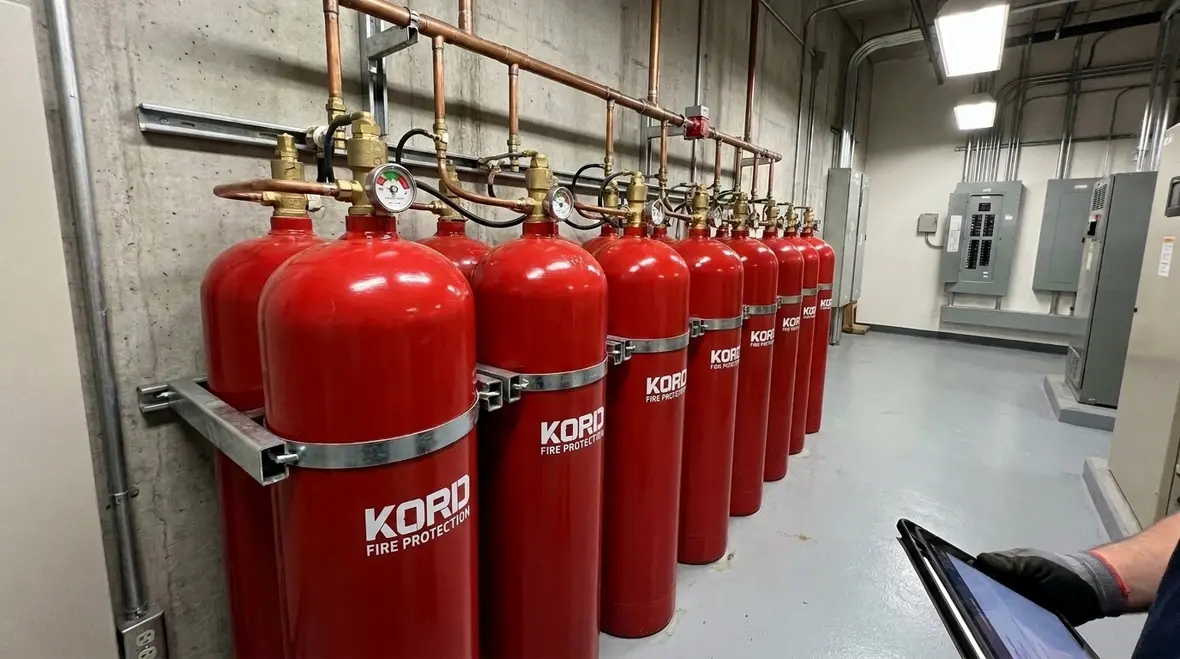
NFPA 12A Section 4.1: Halon 1301 Agent Supply and Storage Requirements
Quick Answer
NFPA 12A Section 4.1 focuses on how Halon 1301 is supplied, stored, and kept ready for discharge. It addresses container integrity, arrangement, controls, and readiness checks that prevent failures during an actual fire event.
For facilities managing special hazard systems, fire suppression system services fit naturally into the maintenance side of Section 4.1 because storage readiness is only useful if the full system stays discharge-ready.
Why Section 4.1 matters in real facilities
For commercial and industrial fire protection programs, Halon systems often fail for practical reasons before they fail for technical reasons: improper storage layout, degraded valves or seals, incorrect access paths, or containers that are not maintained to readiness standards. When a total flooding system is called, the “supply and storage” portion of NFPA 12A determines whether the agent can be delivered at the required conditions and on demand.
In planning and compliance work, the Halon 1301 agent supply and storage container requirements should not be treated as a paperwork exercise. They directly influence inspection frequency, maintenance procedures, operational verification, and the long term reliability of the system architecture.
Kord Fire Protection’s NFPA 12A overview provides helpful context for how the standard connects agent handling with system performance objectives.
What Section 4.1 requires for Halon 1301 supply and storage
NFPA 12A Section 4.1 establishes requirements for the agent containers and their ability to function when actuated. While the exact wording and numbering in any current edition should be verified directly in the text, the compliance intent consistently covers four operational areas: container suitability, physical arrangement and protection, access and working clearances, and readiness verification that supports reliable discharge.
1) Container integrity and suitability for service
Containers used to store Halon 1301 must remain suitable for the application. This includes meeting the acceptance expectations for pressure storage components and ensuring that seals, valves, pressure relief devices if applicable, and associated fittings remain in serviceable condition. Commercial facility audits often find issues such as corrosion at mounting points, damaged protective caps, improper reinstallation after service, or evidence of tampering that affects valve operation.
From a maintenance standpoint, Section 4.1 requirements typically translate into a disciplined approach to: valve access without obstruction, confirmation that protective hardware remains intact, and careful handling during inspection or any cylinder-related service event.
2) Proper arrangement, support, and protection
Storage and mounting influence reliability. The containers must be installed in a configuration that supports stable operation and helps prevent impact damage, excessive vibration exposure, and exposure to conditions that can degrade components. In retail and light commercial occupancies, storage is commonly placed in mechanical rooms, electrical closets, or protected corridors. Industrial facilities often place containers near process areas where heat, humidity, and mechanical stresses are higher.
Practical compliance challenge: containers are sometimes “made to fit” during construction or tenant changes. Any modification that results in misalignment, compromised brackets, or blocked access can create failure points at the worst time.
3) Controls and discharge readiness tied to the storage setup
Section 4.1 is not limited to the cylinder. It connects storage to system readiness, including the conditions that allow the agent supply to be actuated as designed. Containers and associated components must remain accessible for verification and maintain the mechanical and operational states needed for discharge.
Common failure points include incorrectly routed lines that create stress on fittings, missing or damaged components that prevent proper actuation, and inadequate labeling or identification during maintenance. These issues can slow response during inspection and reduce confidence in readiness during commissioning and annual checks.
4) Accessibility, working clearances, and safe maintenance pathways
NFPA style compliance expects containers to be discoverable, reachable, and inspectable without unsafe detours. Many commercial facilities fail this point during tenant turnover because storage areas are repurposed, clutter accumulates, or access routes are blocked by racks and temporary equipment.
To stay compliant, facilities typically implement controlled access for agent storage rooms and maintain consistent housekeeping standards. Kord Fire Protection supports ongoing compliance by verifying access pathways, component visibility, and the physical conditions that allow effective inspection and maintenance.
Common compliance gaps with Halon 1301 agent supply and storage container requirements
Audits and field service experience show recurring gaps. These usually appear when facilities treat Halon 1301 agent storage as a “set it and forget it” asset instead of an engineered pressure system that depends on ongoing condition verification.
Inadequate access and clearance: blocked pathways, locked storage without managed keys, or storage areas used for unrelated storage.
Physical damage to storage hardware: dents, abrasion, compromised mounting brackets, or missing protective caps.
Corrosion and moisture exposure: especially in humid industrial environments or poorly ventilated rooms.
Improper rework after service: fittings reinstalled without correct torque procedure, seal damage, or misalignment of cylinder mounts.
Poor identification: labels faded or absent, making it difficult to confirm which containers correspond to which protected hazard.
Maintenance drift: deferred inspections lead to small defects that later become discharge delays or operational inconsistencies.
Kord Fire Protection often finds that correcting these gaps takes more than replacing a component. Facilities typically need a structured, documented approach that ties physical condition, inspection records, and operational readiness together.
Inspection and maintenance practices that support Section 4.1
Compliance works best when inspection and maintenance procedures align with how the agent supply and storage system actually operates under fire conditions. The goal is to keep the supply ready for discharge and maintain confidence that the agent will release as designed.
What technicians verify during container-focused checks
Visual condition assessment: mounting integrity, signs of impact or corrosion, and confirmation that protective elements remain in place.
Valve and fitting readiness: verification that controls and connections show no evidence of leakage, damage, or improper installation.
Labeling and identification: container identification matches the system design and hazard it protects.
Access and working clearance: confirmation that containers remain inspectable and serviceable without obstruction.
Documentation alignment: service history and inspection findings are recorded and remain traceable to the system design.
Operational readiness and common “maintenance trap” scenarios
A frequent operational trap occurs after construction changes or routine facility maintenance. Electrical rooms get upgraded, piping routes change for new equipment, or ceiling obstructions appear after renovations. Even when the Halon system stays untouched, the storage area may change enough to affect safe access and inspection quality.
Kord Fire Protection helps commercial clients prevent readiness drift by integrating Halon system checks into facility maintenance schedules and by documenting any condition changes that could affect compliance.
How to plan for compliance in commercial, industrial, and retail environments
Different occupancies create different risk patterns. Section 4.1 compliance should therefore be managed through an occupancy-specific plan that addresses access, environment, and maintenance constraints.
Commercial offices and retail
Agent storage areas may be smaller and more exposed to tenant changes. The compliance focus typically includes maintaining controlled access, ensuring housekeeping consistency, and preventing blocked clearance through interior layout changes.
Industrial facilities
Agent containers can face higher humidity, dust loading, and mechanical stress. Compliance planning should emphasize corrosion prevention, protective hardware integrity, and verification that storage locations continue to support safe access during production operations.
Data centers and specialized rooms
In high value electronic spaces, maintenance work may compete for access time. Storage readiness remains dependent on predictable access schedules and disciplined documentation that ties container condition checks to the protected hazard configuration.
For all occupancies, Kord Fire Protection supports practical program management: scheduling, documenting results, and maintaining the engineered readiness state that NFPA 12A expects for agent supply and storage systems.
Frequently Asked Questions
Call to action: For a compliance-ready program, schedule a Halon 1301 agent supply and storage container readiness review aligned with NFPA 12A expectations. Kord Fire Protection can evaluate storage accessibility, container condition, and documentation traceability, then recommend corrective actions with clear service next steps. Contact Kord Fire Protection to plan your inspection and maintenance workflow now, before the next audit cycle.

Join Our Newsletter!
Get the latest fire safety tips delivered straight to your inbox From our Newsletter.



