Monitored Fire Alarm System for Hotel Safety
In the hospitality world, peace of mind is not a luxury. It is part of the reservation. From the front desk to the penthouse suite, every guest expects safety without ever having to think about it. That is where a monitored fire alarm system steps in quietly, like a night manager who never sleeps. Our monitored fire alarm system connects hotels to trained professionals who respond in real time, ensuring help is dispatched the moment a signal appears. Throughout this article, the focus will expand to full scale monitoring services for hotels, including how Kord Fire Protection technicians explain the process in plain language that even the most jet lagged traveler could understand.
Monitoring Services for Hotels: 24/7 Oversight and Risk Reduction
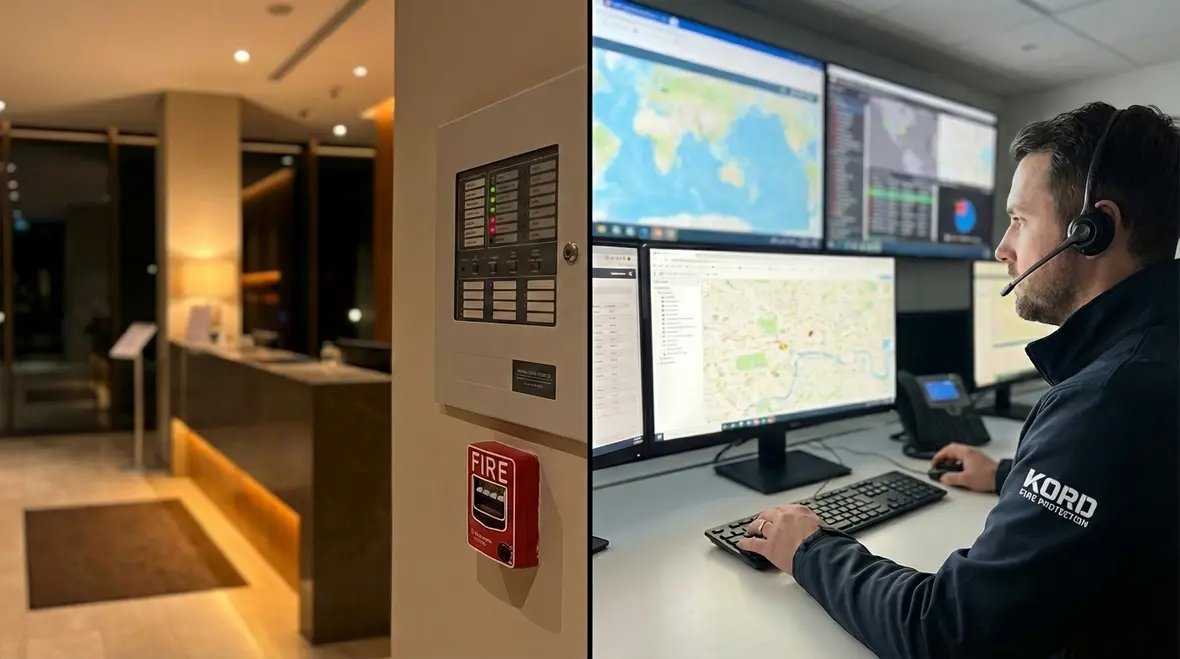
Hotels never close. Therefore, their safety systems cannot clock out either. Monitoring services provide constant oversight of fire alarms, sprinkler systems, and other life safety equipment. When an alarm triggers, a signal travels instantly to a supervising station staffed around the clock. Trained operators verify the alert and contact emergency responders without delay.
Moreover, local fire codes and the National Fire Protection Association NFPA require that fire alarm systems be supervised 24/7. This is not a friendly suggestion. It is a clear mandate designed to protect occupants and property. Hotels that comply not only avoid penalties, but they also protect their brand reputation. After all, bad reviews travel faster than a fire truck with sirens on.
Kord Fire Protection technicians often explain it this way. A hotel can install the best equipment in the world, but without supervision, it is like having a security guard who naps through the night shift. Monitoring transforms equipment into an active shield.
For properties that want to dive deeper into how commercial monitoring fits into a broader protection plan, Kord Fire’s fire alarm monitoring systems guide shows how building-wide monitoring supports faster response and long-term reliability.
The Link Between Hotel Operations and Monitoring
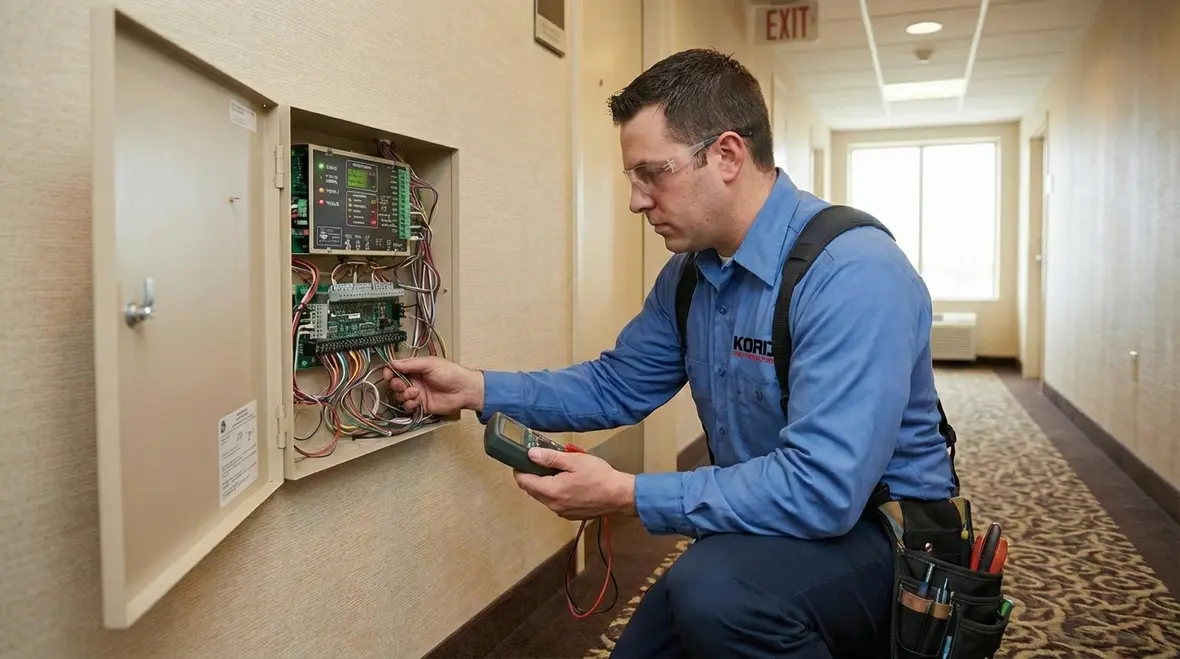
Behind every calm guest experience sits a network of alarms, supervisory signals, and documented procedures. Monitoring connects these elements into a single, always-awake safety net. For many hotels, that net stretches far beyond basic fire alarms to cover elevators, emergency power, and more.
How Does a Monitored Fire Alarm System Work in a Hotel Setting?
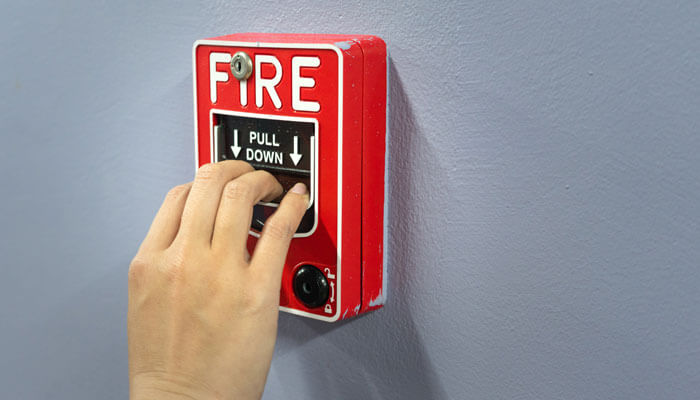
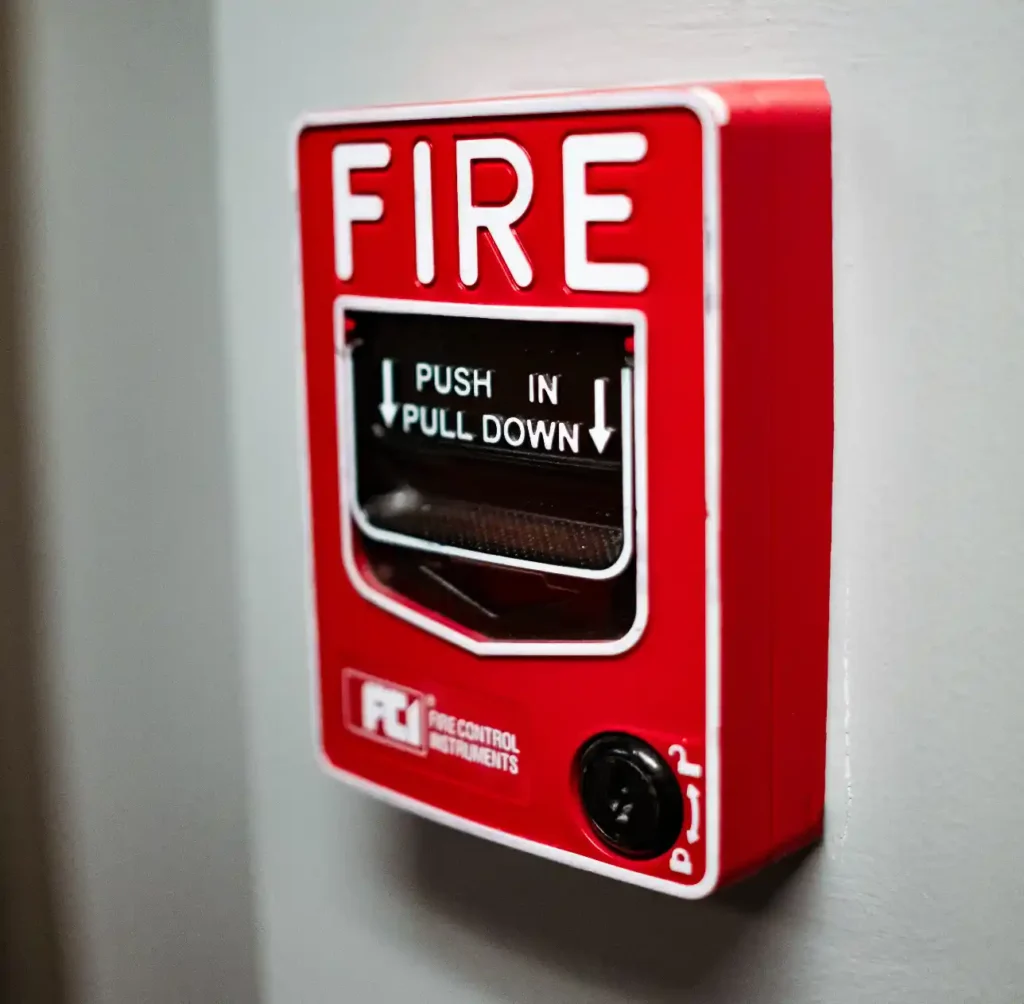
When someone pulls a manual station or when smoke activates a detector, the system does more than ring bells. It sends a digital signal through secure communication lines to a central monitoring station. From there, trained personnel evaluate the signal and follow a strict response protocol.
Because hotels house hundreds of guests at any given time, response speed matters. Within seconds, operators notify local emergency services. Simultaneously, designated hotel contacts receive alerts. As a result, management can begin evacuation procedures while first responders are already on the way.
Kord Fire Protection technicians take time to walk hotel managers through this process step by step. They avoid jargon. Instead, they describe signals, panels, and communication paths in practical terms. For example, they compare the control panel to the brain of the building. If the brain senses danger, it speaks. Monitoring ensures someone listens.
Additionally, technicians test communication paths regularly. They confirm signals reach the supervising station without interruption. Therefore, hotels avoid the silent failure that can occur when outdated phone lines or network changes disrupt connectivity.
If you want a broader refresher on how fire alarm components work together behind the scenes, Kord Fire’s article on what a fire alarm system is offers a helpful breakdown of panels, detectors, and notification devices.
From Alarm to Action in Seconds
The journey from a single detector to a full emergency response takes only a few heartbeats: detection, signal transmission, operator verification, dispatcher notification, and on-site hotel actions. Monitored systems compress this timeline so that no one is left wondering who should make the first call.
Meeting Local Fire Codes and NFPA Requirements with Confidence
Compliance may not sound glamorous, yet it forms the backbone of hotel safety. Local fire codes and NFPA standards clearly state that fire alarm systems must be supervised at all times. Inspectors expect documentation. Insurance carriers expect proof. Guests expect nothing less than safety.
However, compliance involves more than installing equipment. Hotels must maintain records of inspections, testing, and monitoring agreements. They must ensure signals are transmitted and received correctly. Otherwise, they risk fines, failed inspections, or even temporary closure.
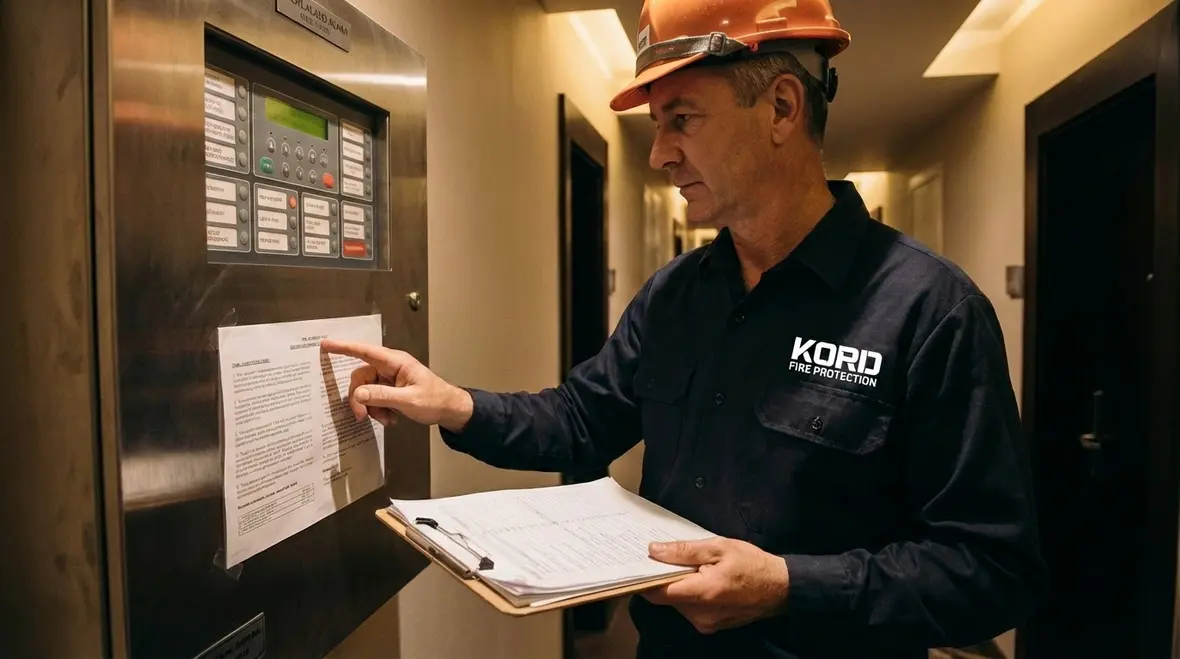
Kord Fire Protection technicians guide hotel operators through these requirements. They review current systems, identify gaps, and recommend updates. Furthermore, they coordinate with local authorities to confirm that monitoring arrangements meet jurisdictional expectations. In other words, they help hotels stay on the right side of the rule book without drowning in paperwork.
Because regulations evolve, ongoing partnership matters. Monitoring providers track changes in code requirements and adjust services accordingly. Consequently, hotel management can focus on guest experience instead of flipping through thick binders of standards late at night.
Documentation Hotels Should Keep Handy
At a minimum, hotels should keep a clear file of inspection reports, sensitivity test results, monitoring contracts, and any notes from authorities having jurisdiction. This paperwork becomes the roadmap during audits and a powerful ally if questions arise after an incident.
Reducing Risk Beyond Fire Events
Although fire remains a primary concern, modern monitoring services extend further. Many hotels integrate sprinkler supervisory signals, water flow alerts, and even carbon monoxide detection into the same monitored network. Therefore, potential hazards surface quickly, even if they do not involve visible flames.
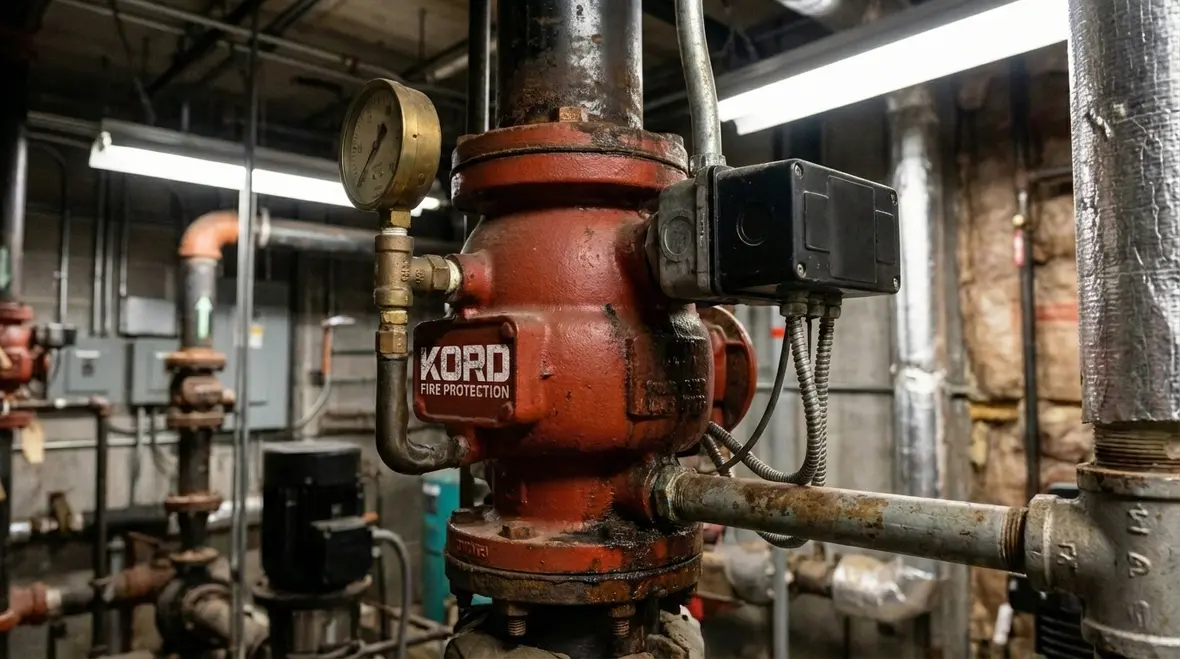
For instance, a closed sprinkler valve can render an entire floor vulnerable. Without supervision, staff might not notice the issue until it is too late. With professional oversight, a signal triggers immediately, prompting investigation and correction.
Moreover, some properties connect elevator recall, emergency power status, and other critical systems. As a result, hotel operators gain a centralized view of life safety conditions. It is a bit like having a mission control room, minus the dramatic countdown and space suits.
By addressing risks early, hotels reduce property damage, limit business interruption, and protect guests. Additionally, documented monitoring can support insurance claims and potentially improve coverage terms. In the long run, proactive oversight costs far less than reactive repairs.
Tying Monitoring into a Bigger Protection Strategy
Hotels that already rely on routine testing, such as smoke sensitivity testing, gain extra value when those results feed into monitored systems. Well-tuned detectors paired with attentive supervision create fewer nuisance alarms and clearer signals when something truly goes wrong.
What Should a Hotel Look for in Monitoring Services?
Hotel decision makers often ask what separates average monitoring from exceptional service. The answer lies in reliability, transparency, and expertise.
First, the supervising station should operate 24/7 with trained personnel, not automated recordings. Human verification reduces false dispatches and ensures accurate communication with emergency responders.
Second, redundant communication paths matter. A dependable monitored fire alarm system uses multiple channels such as cellular and internet connections. Therefore, if one path fails, another carries the signal. Redundancy acts like a backup generator for communication.
Third, ongoing support proves essential. Kord Fire Protection technicians emphasize education during every interaction. They explain testing schedules, signal types, and response procedures. Consequently, hotel staff feel confident rather than confused when alarms occur.
Finally, detailed reporting strengthens accountability. Monitoring providers should supply clear records of signals, responses, and system status. These reports support inspections and internal reviews.
Questions to Ask Potential Monitoring Providers
When evaluating monitoring partners, hotel teams can ask about response times, staffing levels, training programs, and how the provider coordinates with local fire departments. It is also wise to confirm how reports are delivered and how quickly technicians can respond if the system goes offline.
Hotel Operations and Monitoring Services Side by Side
Monitoring is not a separate universe from guest services. It quietly supports day-to-day operations so teams can focus on hospitality instead of scrambling through emergency plans. The table below highlights how closely hotel needs align with monitoring support.
| Hotel Operations Need | Monitoring Service Support |
| Continuous guest safety | Round the clock signal supervision and rapid dispatch |
| Regulatory compliance | Documentation aligned with local codes and NFPA standards |
| Minimal disruption | Fast verification to reduce unnecessary evacuations |
| Asset protection | Early detection of fire, sprinkler, and system faults |
| Staff confidence | Clear training and explanations from Kord technicians |
As shown above, monitoring does not operate in isolation. Instead, it supports daily hotel functions. When safety systems run smoothly, staff can focus on hospitality. Guests enjoy their stay without ever noticing the invisible shield around them.
The Human Element Behind the Technology
Technology plays a central role, yet people make the difference. Behind every signal stands a trained operator ready to act. Behind every installation stands a technician who understands both code requirements and real world hotel challenges.
Kord Fire Protection technicians often share stories from the field. They describe late night service calls, routine inspections that uncovered hidden faults, and moments when swift monitoring response prevented major damage. While they keep a professional tone, they sometimes add a touch of humor. After all, if one cannot smile while discussing smoke detectors, when can one?
Furthermore, technicians encourage hotels to treat monitoring as a partnership. Regular reviews, updated contact lists, and periodic drills strengthen response effectiveness. Therefore, when an alarm sounds, everyone knows their role.
In many ways, monitoring resembles a well rehearsed orchestra. The panel sends the signal. The supervising station responds. Emergency services arrive. Hotel staff guide guests. Each part plays in time. When coordination works, the result is not applause. It is safety.
Training Hotel Teams for Real-World Scenarios
From new-hire orientation to annual drills, consistent training is what turns a monitoring contract into a living safety program. When staff understand what each tone means, how to read the panel, and who calls whom, the human side of the system becomes just as dependable as the hardware.
FAQ: Monitoring Services for Hotels
Hotel managers, engineers, and even front desk teams often raise similar questions when they first explore monitoring options. The answers below tackle the most common concerns.
Conclusion: Protecting Every Guest, Every Hour
Hotels promise comfort, but they must deliver safety first. With professional monitoring in place, they gain constant oversight, code compliance, and rapid emergency response. Kord Fire Protection technicians stand ready to explain every detail and tailor solutions to each property. For hotels that value reputation, reliability, and restful nights, now is the time to strengthen protection and ensure every guest stays safe from check in to check out.
To see how hotel monitoring can connect with broader fire alarm services, explore Kord’s full range of fire alarm service solutions, from installation to inspections and testing.
If your hotel is ready to upgrade to a modern monitored fire alarm system—or you suspect your current setup is not giving you true 24/7 coverage—Kord Fire offers dedicated fire alarm monitoring systems designed for commercial occupancies.
Take the next step toward safer, calmer nights for guests and staff alike by requesting a fire alarm monitoring service review today. A short conversation can reveal whether your alarms are simply making noise or truly connected to the responsive, professional oversight your hotel deserves.
Know Your Weapon Before You Fight the Flame
Kord Fire Protection is your go-to when it comes to all things fire protection. For over 20 years, we’ve been serving Southern California with the quality service and equipment to keep your home or business safe at all times. Our competitive prices reflect our unwavering commitment to protecting what matters most in the event of a fire emergency. Give us a call, send an email, or use that form!

Join Our Newsletter!
Get the latest fire safety tips delivered straight to your inbox From our Newsletter.