

How Commercial Building Fire Safety Systems Work
How Fire Safety Systems Work Together in Commercial Buildings
When people hear the phrase commercial building fire safety systems explained, they often picture a lone sprinkler head or a blinking red alarm on the wall. However, that image barely scratches the surface. In reality, modern protection relies on a coordinated network of detection, suppression, containment, communication, and human response. Each component supports the others, much like musicians in an orchestra who follow the same conductor. When one instrument plays, the rest respond.
Kord Fire Protection technicians often explain it this way to building owners. A fire safety system is not a collection of parts. It is a living strategy. Moreover, when properly designed and maintained, it acts within seconds, often before occupants even understand what is happening. That quiet, swift coordination is what keeps businesses operating and people safe.
So let us walk through how these systems connect, why integration matters, and how each layer of protection supports the next.
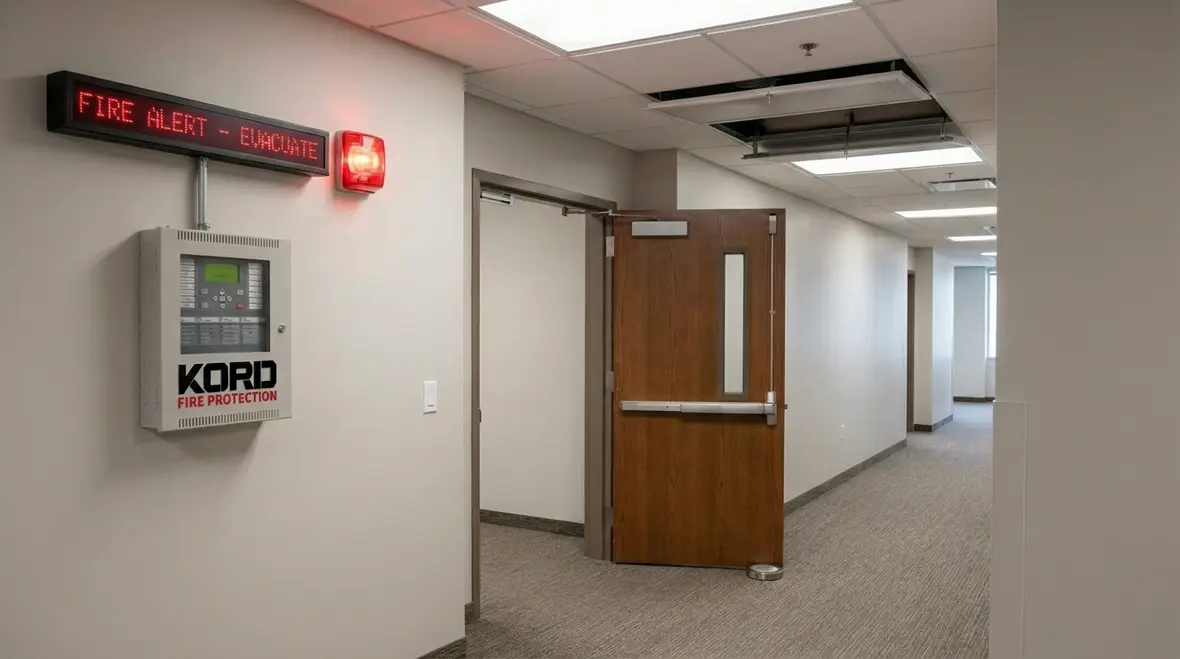
The Foundation of Commercial Building Fire Safety Systems Explained
Every effective fire protection plan begins with detection. Without early detection, even the most advanced suppression equipment cannot respond in time. Therefore, smoke detectors, heat detectors, flame detectors, and manual pull stations form the first layer of defense.
How different detectors work together
Smoke detectors sense tiny particles in the air. Heat detectors respond to rapid temperature increases. Flame detectors identify specific light wavelengths produced by fire. Together, they create redundancy. If one method misses the signal, another likely catches it.
However, detection alone does not save a building. It must trigger action. Once a sensor activates, it sends a signal to the fire alarm control panel. That panel serves as the system’s brain. From there, it activates alarms, alerts monitoring services, and communicates with suppression equipment.
Why programming and integration matter
Kord Fire Protection technicians often remind property managers that a detector without proper programming is like a doorbell that rings in an empty house. The signal must reach the right people and systems instantly. Consequently, integration between devices becomes critical.
In many ways, commercial building fire safety systems explained begins with this simple principle. Detect early. React faster. Communicate clearly.
How Detection Triggers Action Across the Building
Once detection occurs, the system shifts from watchful to active. The fire alarm control panel initiates a chain reaction. First, audible and visual alarms alert occupants. Next, signals travel to monitoring centers or directly to emergency responders. At the same time, the system may unlock doors, shut down air handling units, or activate smoke control systems.
Managing smoke, doors, and building systems
This coordination matters because fire rarely spreads in a straight line. Instead, it travels through air ducts, open stairwells, and concealed spaces. Therefore, shutting down HVAC systems prevents smoke from moving freely. In addition, releasing magnetic door holders helps contain fire within specific compartments.
Kord Fire Protection technicians explain that automation removes hesitation. People might pause. Systems do not. Within seconds, the building begins responding in a structured, preprogrammed way.
It almost feels like the building takes a deep breath and says, “I have got this.” And honestly, that is the goal.
Sprinkler and Suppression Systems in Action
While alarms alert and guide occupants, suppression systems address the fire directly. Most commercial buildings rely on automatic sprinkler systems. Contrary to popular movie scenes, sprinklers do not all activate at once. Only the sprinkler head exposed to sufficient heat opens. So no, one burnt bagel in the breakroom will not flood the entire office. Hollywood has some explaining to do.
How sprinklers actually activate
Each sprinkler head contains a heat sensitive element. When the surrounding air reaches a specific temperature, that element releases. Water flows directly onto the fire’s source. Because activation occurs at the point of heat, suppression remains targeted and efficient.
Specialized suppression for unique hazards
However, some facilities require specialized suppression systems. Data centers, commercial kitchens, and manufacturing plants often use clean agent systems, foam systems, or dry chemical systems. These agents suppress fire without damaging sensitive equipment.
As Kord Fire Protection technicians often explain, suppression is not one size fits all. Instead, engineers match the hazard to the correct method. Electrical rooms demand a different response than storage warehouses. Consequently, design plays a critical role in system performance.
Within the broader conversation of commercial building fire safety systems explained, suppression stands as the muscle of the operation. Detection sees the threat. Suppression handles it.
Containment and Compartmentalization: Slowing the Spread
Fire protection is not only about putting out flames. It is also about buying time. Therefore, passive fire protection features serve as silent guardians inside walls, ceilings, and floors.
Passive barriers and firestopping
Fire rated walls, floors, and doors create compartments. When properly sealed, these barriers prevent flames and smoke from moving freely. Firestopping materials seal gaps around pipes, cables, and ducts. Without these seals, small openings become highways for smoke.
In addition, fire dampers within ductwork close automatically when heat rises. This prevents smoke from spreading through ventilation systems. Although occupants rarely see these features, they play a powerful role.
Kord Fire Protection technicians emphasize that passive systems require just as much attention as active systems. After renovations, new cable runs or pipe installations can compromise fire barriers. Therefore, inspections ensure that containment remains intact.
In many cases, containment determines whether a fire stays in one room or consumes an entire floor. That difference can mean hours of downtime versus months of reconstruction.
Emergency Communication and Human Response
Technology responds quickly, yet people still make critical decisions. Clear communication bridges that gap. Modern systems include voice evacuation messages that provide calm instructions rather than simple alarm tones.
Instead of a generic siren, occupants may hear, “Attention. A fire emergency has been reported. Please proceed to the nearest exit.” That clarity reduces panic. It also improves evacuation speed.
Moreover, integrated systems can send alerts to smartphones, security desks, and facility managers. As a result, key personnel receive detailed information about the location and type of alarm. They do not have to guess.
Kord Fire Protection technicians often compare this coordination to air traffic control. Every signal must reach the right destination without confusion. When communication flows smoothly, emergency responders arrive informed and prepared.
At this point in the journey of commercial building fire safety systems explained, one truth becomes clear. Technology works best when it supports human action, not replaces it.
Inspection, Testing, and Maintenance Keep Systems Ready
A fire safety system that sits untested for years may look impressive. However, appearances mean little in an emergency. Regular inspection, testing, and maintenance ensure reliability.
Sprinkler systems require periodic flow tests and valve inspections. Fire alarms need functional testing to verify signal transmission. Batteries and backup power supplies must operate under load conditions. In addition, clean agent systems require pressure checks and enclosure integrity testing.
Kord Fire Protection technicians frequently explain that compliance is not just paperwork. It is proof that every component functions as designed. Furthermore, local codes and national standards outline specific intervals for inspections. Skipping them invites risk.
In the broader landscape of commercial building fire safety systems explained, maintenance serves as the quiet hero. It does not grab headlines. Yet without it, even the best design can fail.
How Integrated Systems Protect Business Continuity
Fire protection is about life safety first. However, it also safeguards business continuity. When systems respond quickly and effectively, damage remains limited. Consequently, companies avoid extended closures, lost revenue, and damaged reputations.
Consider how integration supports this goal:
System Component
- Smoke and heat detection
- Fire alarm panels
- Sprinkler and suppression systems
- Fire rated barriers
- Emergency communication
Business Impact
- Early warning reduces fire growth
- Fast alerts limit response time
- Targeted suppression minimizes damage
- Containment protects unaffected areas
- Clear instructions speed evacuation
When viewed together, the structure of commercial building fire safety systems explained reveals a layered defense. Each layer supports the next. If one encounters strain, another compensates. That redundancy protects not only people but also operations.
As Kord Fire Protection technicians often say, “The best fire is the one that never grows.” It is hard to argue with that logic.
What Makes a Truly Coordinated Fire Protection Strategy?
A coordinated strategy begins with risk assessment. Engineers evaluate occupancy type, fuel loads, building layout, and operational processes. Then they design systems that address those specific risks.
Design, integration, and training
Integration follows design. Alarm panels must communicate with suppression systems. Suppression systems must align with structural fire ratings. Communication systems must guide occupants clearly. In addition, all components must meet applicable codes.
Training also plays a role. Staff should understand evacuation routes, alarm signals, and reporting procedures. Although systems operate automatically, informed occupants respond more effectively.
In discussions of commercial building fire safety systems explained, coordination stands out as the defining factor. A disconnected set of devices cannot provide the same protection as a unified network. Therefore, collaboration between engineers, technicians, property managers, and local authorities becomes essential.
When that collaboration succeeds, the building itself becomes resilient. It anticipates risk. It reacts with precision. And it supports the people inside.
Frequently Asked Questions
Conclusion
Fire protection in commercial properties demands more than equipment. It demands strategy, integration, and ongoing care. When each component works in harmony, risk shrinks and confidence grows. Kord Fire Protection technicians stand ready to guide building owners through every layer of protection.
For deeper insight into how real-world sprinkler design adapts to complex spaces, explore Kord’s article on sprinkler solutions for irregular and angled Santa Monica rooms, which shows how thoughtful engineering keeps protection both effective and architecturally clean.
For those seeking clarity, reliability, and a coordinated approach, now is the time to strengthen your system and secure your future. Kord’s team provides inspection, testing, design, and 24/7 service across California, so your alarms, sprinklers, suppression, and communication systems stay code compliant and ready when it counts.
If you are planning upgrades, need a system review, or want ongoing support for a multi-building portfolio, start with a dedicated fire protection service partner. Visit the Dinuba Fire Protection Services page or contact Kord Fire Protection to request a site assessment, schedule inspections, or build a long-term fire and life safety plan around your specific facility.
Know Your Weapon Before You Fight the Flame
Kord Fire Protection is your go-to when it comes to all things fire protection. For over 20 years, we’ve been serving Southern California with the quality service and equipment to keep your home or business safe at all times. Our competitive prices reflect our unwavering commitment to protecting what matters most in the event of a fire emergency. Give us a call, send an email, or use that form!

Join Our Newsletter!
Get the latest fire safety tips delivered straight to your inbox From our Newsletter.


