Fire Suppression Safety Protocols for Coverage Optimization
In complex industrial spaces, the difference between “mostly protected” and truly ready can come down to how well the system coverage matches the layout. Kord fire protection technicians start every project by following fire suppression safety protocols that keep teams aligned, reduce risk, and guide decisions from the first walkdown to final acceptance. First, they verify drawings against real conditions, then they confirm water supply or agent capacity, and they document hazards and access routes. Next, they coordinate shutoffs, maintenance access, and inspection routines so the system can perform when it matters. After that, they stress test assumptions because assumptions are like a screen door on a submarine, technically present but not very helpful. With that foundation, coverage optimization becomes a controlled, measurable process instead of guesswork.
That practical mindset shows up across Kord Fire Protection’s broader work in fire suppression services, where layouts, hazards, and maintenance demands all have to work together instead of competing for attention. It also aligns with the educational focus of the Kord Fire Protection Blog, which helps property teams understand how real-world protection decisions play out long before an inspector or emergency ever enters the picture.
What optimal coverage looks like in industrial layouts
Industrial layouts rarely behave like neat textbook diagrams. Instead, they twist and split through mezzanines, process rooms, stair towers, duct runs, and equipment alcoves where airflow and heat patterns act differently. As a result, “optimal coverage” means the system protects the intended hazards at the right density, with the right coverage pattern, and within the time it needs to control fire growth. Kord fire protection technicians explain that they focus on how fire behaves in the real world: how it starts, how it spreads, and how it gets oxygen.
To reach that goal, they map the layout into protection zones and then connect each zone to a specific hazard profile. Then they adjust component placement, spacing, and response characteristics so the system supports the plant’s actual workflow. In other words, they align the fire suppression safety protocols with plant operations, not against them.
Why zone-based planning beats blanket assumptions
A large industrial building can look uniform on paper while behaving very differently from one corner to the next. A loading area may have tall palletized storage, a nearby process room may introduce higher heat sources, and an upper platform may trap heat in ways the floor below never will. When technicians divide those spaces into practical protection zones, they give each area a response that fits its fuel load, geometry, and exposure profile. That is the difference between a system that exists and a system that actually understands the room it protects.
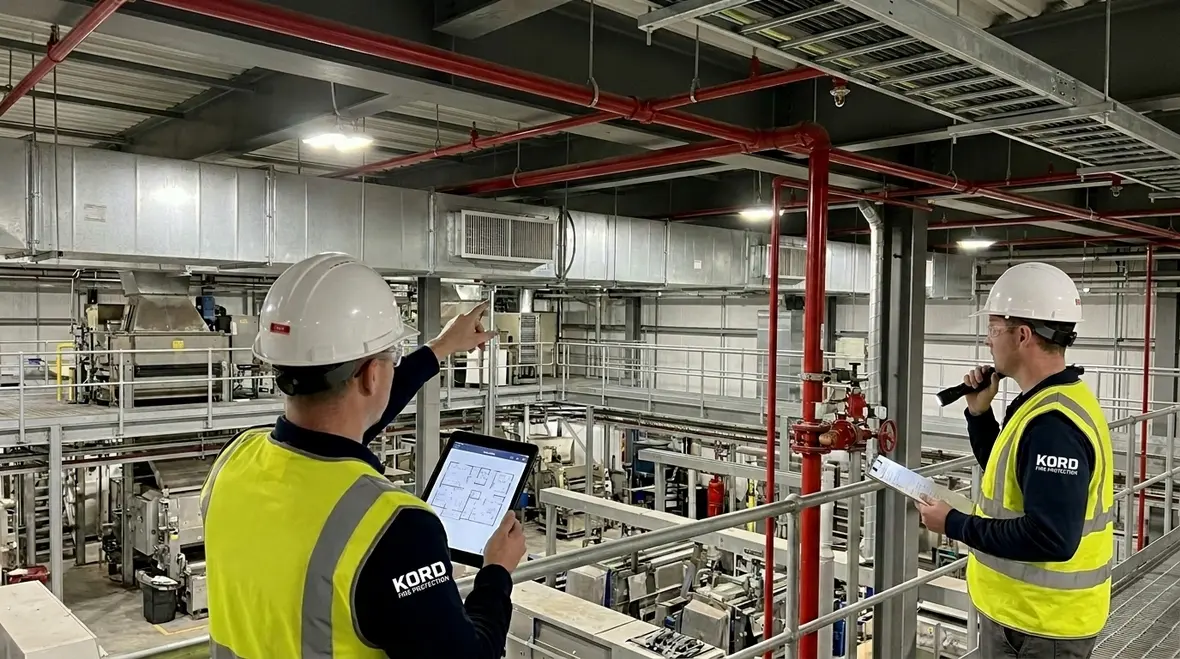
How Kord fire protection technicians run the layout walkdown
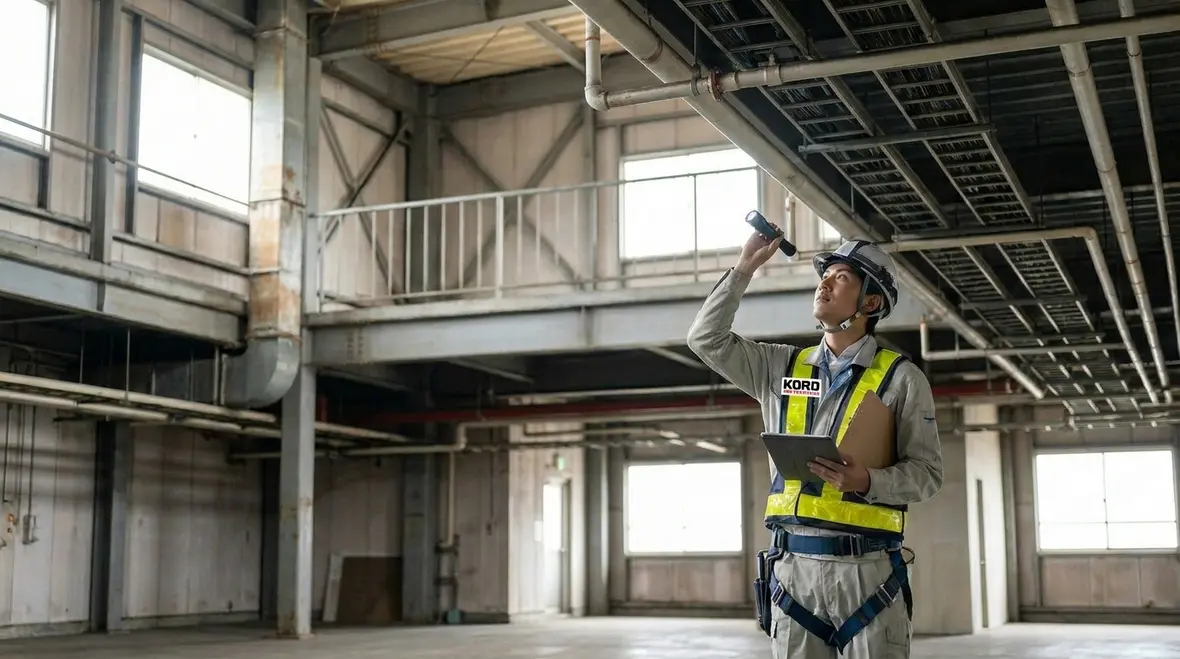
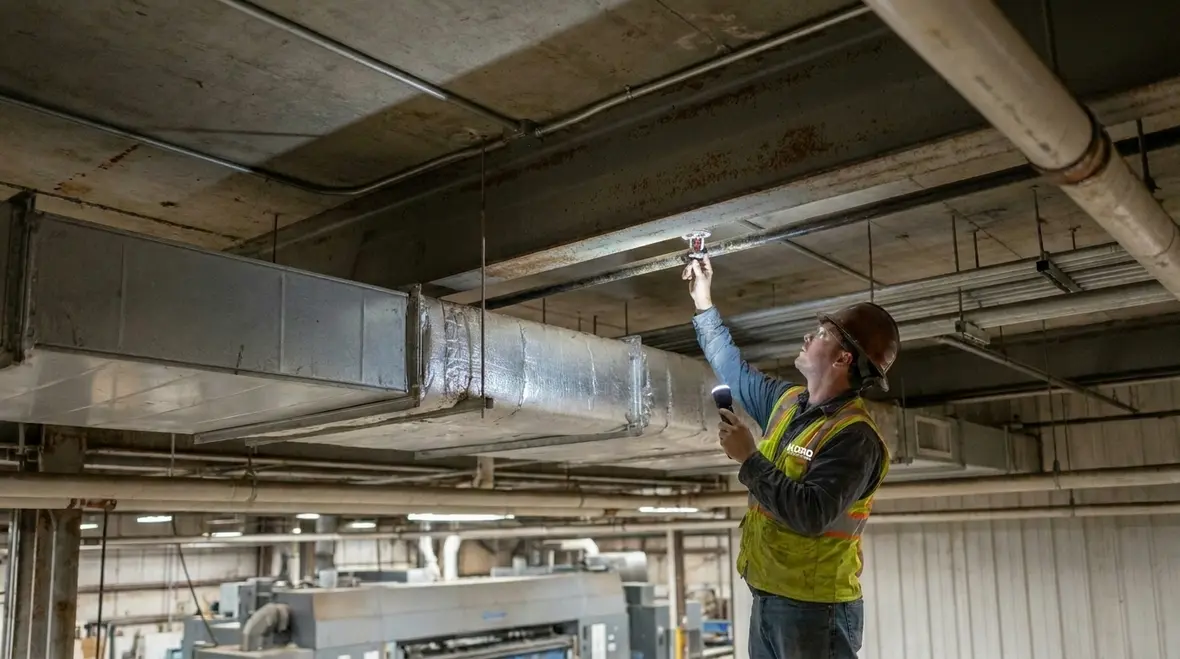
Even the best drawings miss details. Therefore, Kord fire protection technicians conduct a methodical walkdown before they finalize coverage. They check ceiling heights, obstructions, rafter spacing, beam depth, and any changes that happened after the last renovation. They also review the placement of lights, HVAC diffusers, sprinklers, and cable trays because those “small” items can redirect heat and smoke, which changes activation and effectiveness.
Once the walkdown finishes, they build a clear record that ties field findings to the design basis. Then they compare the recorded obstructions and ceiling conditions against the coverage assumptions. If something does not match, they adjust spacing or install deflectors, adjust placement, or revise the hazard classification approach. This is where the work stops being theory and starts being engineering that can stand up in front of both operations and inspectors.
Field verification turns nice drawings into dependable protection
Walkdowns also reveal operational realities that no plan sheet loves to advertise. Maybe a production line now extends deeper into a corner, maybe a cable tray was added after a tenant improvement, or maybe the ceiling profile changes just enough to affect distribution. Those details matter because coverage is not graded on good intentions. It is graded on whether discharge reaches the hazard as expected. By documenting what is really there, technicians give owners a design path that is defensible, maintainable, and a lot less surprising later.
Obstacle management: when ceilings, beams, and ducts fight back
In complex areas, obstructions do not just “get in the way.” They create pockets of trapped heat, block water distribution, and shift spray patterns. Consequently, the best coverage strategy includes an obstruction plan. Kord fire protection technicians commonly address ceiling geometry and airflow pathways by treating the room like a living system.
For example, they look for soffits and partial ceilings that can reduce effective spray reach. They also evaluate large ducts and cable trays near the protected surface. If a duct sits low enough, it can act like a visor that keeps discharge from reaching the target area. So, instead of relying on a one size fits all pattern, they evaluate how water or agent will travel after it leaves the nozzle. Then they select adjustments that improve distribution without overcomplicating the design.
Yes, the math can feel like a pop quiz from a teacher who never smiles, but when the system performs as designed, that stress turns into confidence.
Common obstruction trouble spots teams should not ignore
- Deep beams and irregular ceiling pockets that interrupt heat collection and distribution patterns
- Large ductwork or cable trays positioned close to protected surfaces
- Equipment clusters that shield corners, elevated shelves, or service clearances
- Partial walls, soffits, and mezzanine edges that split a space into hidden micro-zones
- Air movement sources that push smoke and heat away from expected activation paths
Designing for hazard shifts across rooms and levels
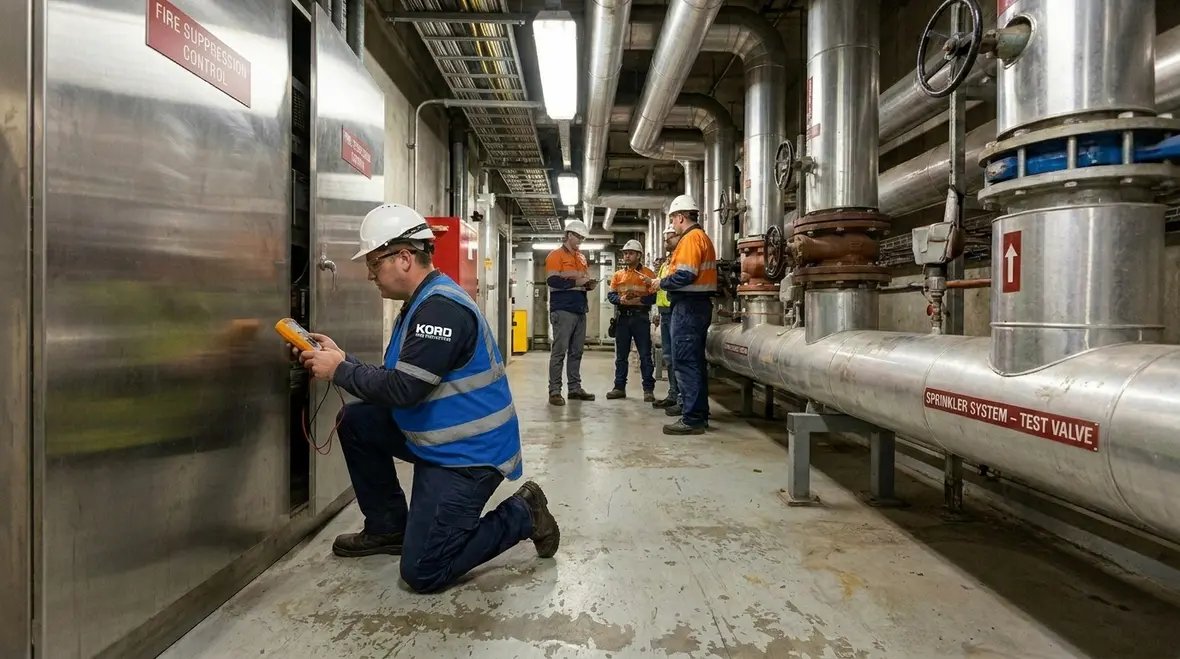
Industrial sites often mix hazards like they are mixing paint colors. One room stores packaging that burns readily; another holds combustible liquids in smaller volumes; yet another includes control areas with different fuel loads. As a result, hazard classification can change across rooms, corridors, and even levels. Kord fire protection technicians optimize coverage by treating those transitions as part of the fire suppression safety protocols, not as an afterthought.
They define boundaries that reflect actual storage practices and process conditions. Then they confirm that system zones match those boundaries. Where hazards intensify, they adjust density, coverage area, or installation approach based on the design basis. Where hazards drop, they prevent overbuilding by using the right classification instead of blanket protection. This approach helps the plant maintain reliable performance while controlling cost and simplifying future maintenance.
And since plants love adding new equipment without telling anyone, technicians also plan how future changes should be handled. They encourage a clear change control path so coverage stays accurate when the layout evolves.
Water supply and agent performance for complicated coverage
Coverage only works if the system can deliver the required flow and pressure at the right time. Therefore, optimization includes supply verification, hydraulic analysis, and performance review under realistic conditions. Kord fire protection technicians often explain that “coverage” and “supply” are inseparable. If the layout demands higher demand but the system cannot meet it, then the design fails in practice, even if the drawings look perfect.
In complex facilities, supply challenges can come from long pipe runs, elevation changes between levels, and clustered demand scenarios during concurrent events. Technicians account for these factors so the system can maintain the needed discharge at the farthest points. They also check that valves, pumps, and controllers support reliable response. Additionally, they verify that drain and test arrangements do not interfere with routine operations or inspection access.
On the commercial side, some teams treat testing like an annual chore. In industrial settings, Kord fire protection technicians treat testing like a company health check. It catches hidden issues early, before they become emergency headlines.
Why supply verification deserves equal billing with layout review
A strong layout with weak delivery is like bringing a ladder to a submarine leak. Technically, you brought equipment, but it is not solving the right problem. That is why technicians review the relationship between discharge demand and available supply before anyone gets too attached to a clean drawing set. In facilities with multiple elevations or long runs, small pressure losses add up fast. Verifying performance early helps avoid expensive corrections after installation is underway.
Installation, testing, and maintenance access in real plant conditions
Even a great design can underperform if installation quality and maintenance access do not match the plan. Kord fire protection technicians plan installation details around the plant’s constraints. They coordinate shutdown windows, route piping where it will not interfere with movement or future work, and ensure that components remain reachable for inspection and cleaning.
They also verify alignment with the field layout after installation. Then they test the system using a stepwise approach that supports documentation and fast issue resolution. Because complex industrial layouts can hide defects in the least convenient locations, they focus on verification for critical areas such as high obstruction zones, corners behind equipment, and elevated spaces.
Maintenance matters too. Technicians design access routes so inspections do not require creative ladder setups or borrowed scaffolding that seems to appear only on emergency days. As a result, the system stays dependable, and the facility stays compliant with its safety program and inspection cycles.
For facilities that need a broader partner beyond one isolated upgrade, Kord Fire Protection also outlines its wider capabilities through full fire protection services. That can be especially useful when suppression coverage improvements intersect with sprinkler inspections, alarms, fire pumps, or long-term maintenance planning in one operating site.
Featured FAQ on fire suppression coverage optimization
Final call: turn layout complexity into coverage confidence
Complex industrial layouts do not have to create uncertainty. Kord fire protection technicians optimize coverage by following fire suppression safety protocols, verifying field conditions, managing obstructions, matching hazard shifts, and confirming supply performance. If your site has changed, added equipment, or simply grew more complicated over time, it is smart to review coverage now while updates are still manageable.
Reach out to Kord Fire Protection to schedule a walkdown and coverage optimization plan, and keep your system ready for the one moment you cannot plan for. If you are evaluating upgrades or service support, explore Industry Fire Protection Services for a practical next step and a clearer path toward dependable sitewide protection.

Join Our Newsletter!
Get the latest fire safety tips delivered straight to your inbox From our Newsletter.