Fire Pump Electrical Troubleshooting for Controller Faults
Fire pump controllers sit in the background like the quiet hero in a superhero movie, until something goes wrong. When that happens, downtime, code risk, and expensive blame games often follow. In this guide, readers get practical Fire pump electrical troubleshooting steps for common controller problems, explained in plain language. Kord Fire Protection technicians walk through what they see in the field and how to resolve issues without guessing. After all, electrical faults love mystery, and they also love deadlines. So, this article focuses on the patterns that show up again and again, and it maps the fixes to real symptoms.
A solid troubleshooting process does more than restore operation. It also helps protect compliance, shorten outage time, and keep a small controller issue from turning into a larger fire protection headache. That is why experienced technicians do not start with random part swapping. They start with symptoms, trace the control path, verify what the controller is seeing, and compare it to what should be happening in the field. The difference between those two things is usually where the real answer lives.
How Kord technicians diagnose controller symptoms fast
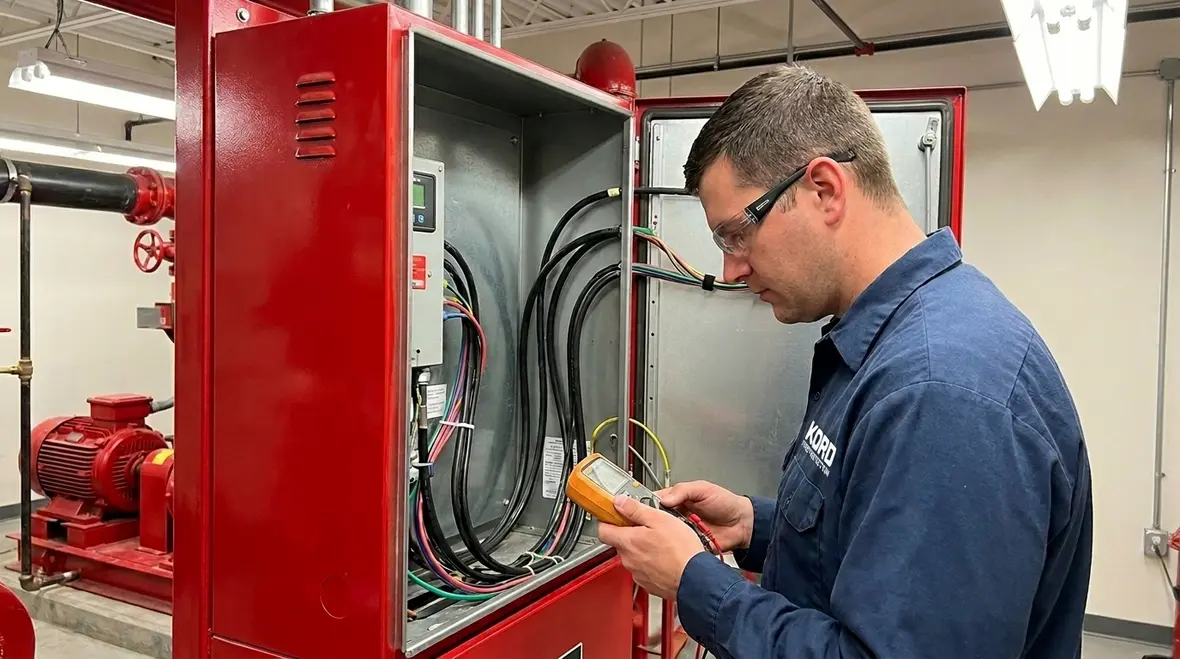
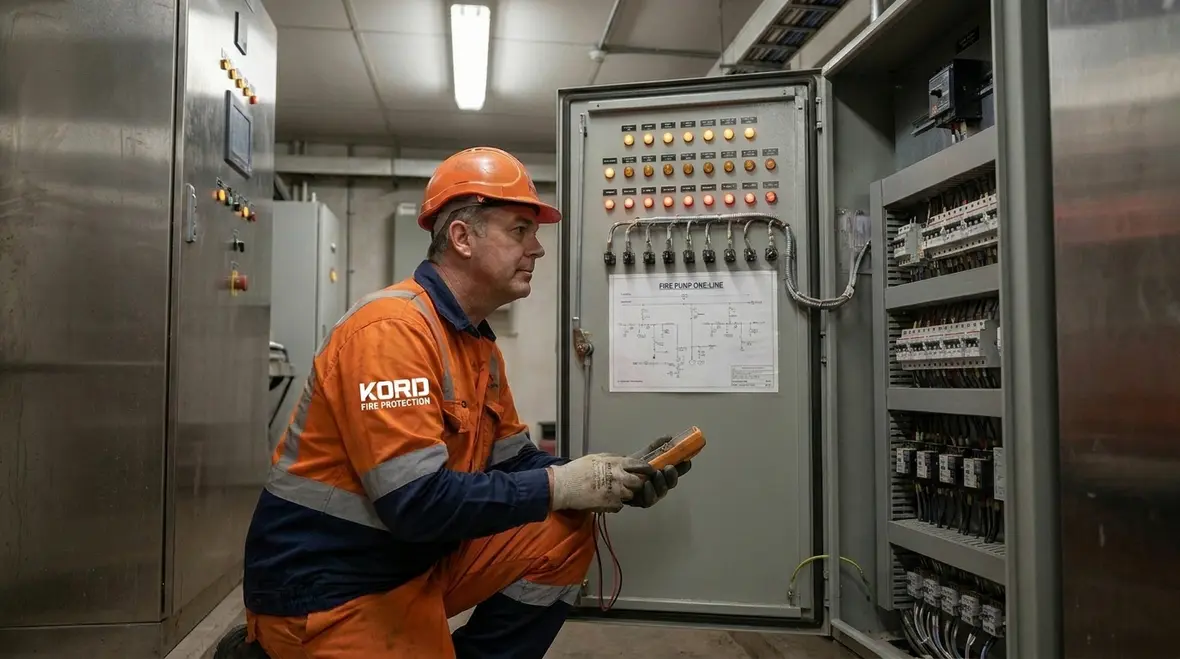
Fire pump controller failures rarely announce themselves politely. Instead, Kord Fire Protection technicians look at the evidence in a calm order: alarms, indicator lights, fault logs, and the power path. First, they verify input power and controller health. Then they check the output to the motor starter and the feedback signals that confirm the pump started and ran. Finally, they confirm that protective devices and control wiring match the plan on the one-line diagram.
Because controllers depend on correct signals, even small electrical issues can create big operational results. For example, a loose ground can cause nuisance trips, while a failed relay contact can block a start command. And yes, it can look “fine” until it suddenly does not. This troubleshooting approach keeps the work safe and methodical, which reduces repeat calls and guessing. It also helps the technician decide early whether the fault is in the power side, the control side, or the feedback loop that tells the controller what just happened.
The first-pass checklist that saves time
- Review active alarms, prior events, and fault history
- Verify incoming voltage and control power availability
- Check whether a start signal is being generated
- Confirm the starter, relay, or contactor is receiving the command
- Validate run feedback and supervisory signal status
- Compare field wiring to the controller schematic and one-line
Loose terminals, bad grounds, and overheating that trips protection
One of the most common electrical issues involves connections. Over time, terminals loosen from vibration, heat cycling, and repeated start events. As a result, resistance rises. That resistance creates heat. Eventually, the controller detects a fault or the starter fails to pull in.
Kord Fire Protection technicians typically check the incoming power terminals for discoloration, burn marks, or crumbling insulation, then move to ground and bonding points to confirm tightness and clean contact surfaces. After that, they inspect motor starter and relay wiring for signs of arcing or heat, along with control circuit splices that may crack with age. What makes these issues tricky is that they can be intermittent. A conductor may pass a visual inspection while still dropping voltage under load, which is why real verification matters more than optimism.
They then correct the problem by tightening to the proper torque, cleaning and re-seating lugs, and replacing damaged wire ends. Most importantly, they verify the fix with voltage checks under load, not just a “looks tight” visual inspection. That step often separates a temporary bandage from an actual repair. If overheating has already affected adjacent components, they also inspect for secondary damage so the same fault does not come back wearing a different disguise.
Warning signs technicians take seriously
- Discoloration around lugs or breaker terminations
- Insulation that looks brittle, glossy, or heat-damaged
- Ground points with corrosion, paint contamination, or looseness
- Controller faults that happen only during start attempts
- A faint burned odor that no one wants to admit was there yesterday
Control power faults: when the controller behaves like it is asleep
Many controller problems begin with control power. If the transformer or control supply fails, the controller may show partial lights, lock out, or fail to accept commands. In many cases, the motor never gets the start signal, and the pump stays idle.
Kord Fire Protection technicians resolve this by checking transformer secondary voltage across the control supply, fuses or breaker elements feeding the logic and status circuits, battery backup or charger circuits if the system uses them for control continuity, and status relays that may drop when control voltage dips. They also confirm that the wiring matches the controller schematic. A frequent field issue involves misrouted control leads from past repairs. So even if the numbers look close on a meter, the control path can still be wrong. In that moment, the controller acts “confused,” like a blockbuster villain holding the wrong key.
Technicians also pay attention to voltage stability, not just presence. A supply that appears acceptable with no demand can sag badly during a start attempt. That sag may be enough to drop relays, reset logic, or create inconsistent alarms that seem unrelated until the control power trend is checked. When a controller appears half-awake, half-functional, or randomly moody, the control transformer and protection devices deserve immediate attention.
Failed relays and contactors that stop starts or create nuisance alarms
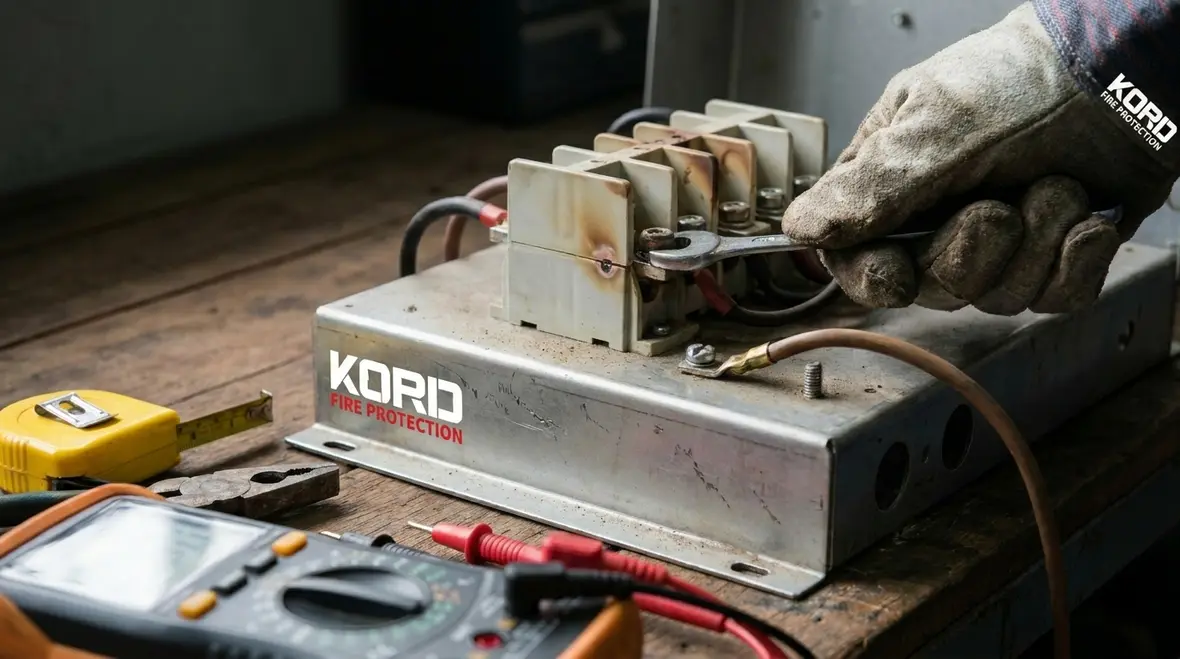
Relays and contactors can wear out. Contacts pit. Coils weaken. Over time, a controller may still run diagnostics, but it cannot actually energize the motor starter or transfer contacts. This leads to start failures, chattering, or repeated alarms.
To troubleshoot, Kord Fire Protection technicians often use a sequence check. They confirm that the controller issues the start command. Then they verify continuity in the control wiring. After that, they check coil voltage at the relay and inspect contact condition. If contacts show burning or uneven mating, they replace the component and correct the cause, like loose terminations or coil undervoltage. Meanwhile, nuisance alarms can come from feedback contacts stuck closed or open. Therefore, the system thinks the pump ran when it did not, or it thinks it failed when it started fine. That mismatch matters, especially when code officials ask for records.
This is also where patience matters. A relay issue may look like a sensor issue, and a contactor problem may look like a control board issue. Good technicians prove the sequence instead of guessing the villain in the first ten minutes. If the start signal is present but the device does not respond, the field evidence usually narrows quickly. If the device responds but the controller still reports failure, the answer is often in the auxiliary contacts and feedback path.
Sensor and feedback circuit problems that block automatic operation
Controllers rely on feedback to confirm conditions like pressure switch status, flow signals, and run confirmation. When sensors drift, wiring breaks, or terminals loosen, the controller may reject the start or fail to clear a fault.
Kord Fire Protection technicians focus on the logic side, not just the power side. They check pressure switch wiring and whether the signal matches expected states, run status feedback from the motor starter and auxiliary contacts, supervisory points that may appear active due to a short or open circuit, and wire routing and shielding to reduce noise effects. Then they validate readings against the controller display or log entries. If the system uses communication modules, they also confirm proper addressing and signal integrity. In other words, they make sure the controller and field devices agree, because disagreement leads to lockouts. And nobody wants an “argument” between a sensor and a controller during a fire event. That is not a friendly debate.
A broken or drifting feedback circuit can be especially frustrating because the pump may mechanically be ready to run while the controller refuses to trust what it sees. That gap between reality and reported status is where detailed electrical troubleshooting earns its keep. Technicians compare expected contact positions, actual measured states, and the sequence of operation shown in the schematic to pinpoint where the story stopped making sense.
Transformer, breaker, and insulation issues that show up under load
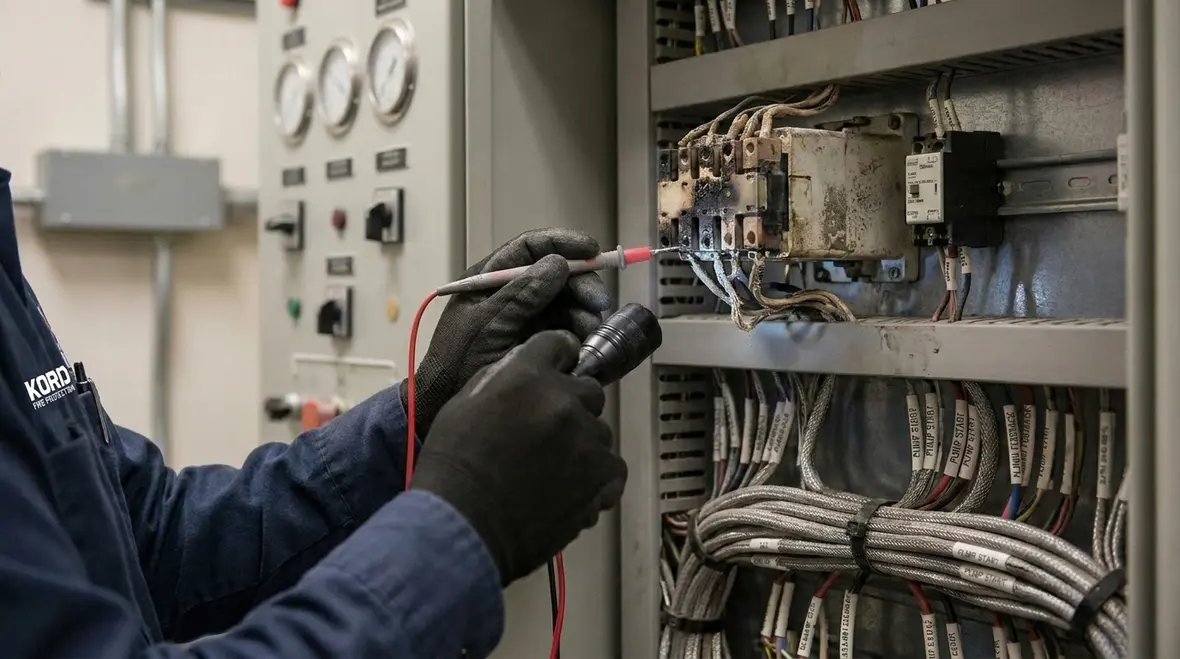
Some faults do not appear during simple testing. They reveal themselves under real load or during start attempts. For example, insulation problems and weak components may only break down when current rises.
Kord Fire Protection technicians treat this like a detective story with a multimeter. They verify breaker condition for proper trip behavior and stable operation, transformer health through voltage checks and inspection of connections, motor branch wiring for insulation damage and correct sizing, and ground fault indicators if the system uses them. When they detect insulation concerns, they stop and recommend the correct next test methods, guided by the controller type and system requirements. They do not “power through” a problem that can get worse. After all, electrical failures like to escalate fast, much like a plot twist in a late season episode.
Load-sensitive faults are why some controllers pass a casual look and still fail during a test cycle. Static checks have value, but they cannot always reveal a weak transformer, unstable breaker behavior, or wiring insulation that gives up exactly when current demand increases. Field experience matters here, because the best clue is often the timing of the failure. If the controller only misbehaves during transfer, start, or sustained run conditions, the fault likely lives where electrical stress increases.
Comparison: common symptoms and the likely controller causes
Technicians often reduce guesswork by matching symptoms to causes. Below is a quick reference, used by Kord Fire Protection technicians in the first pass of troubleshooting.
| Symptom | Likely Cause |
|---|---|
| Controller shows fault during start attempt | Loose terminals, undervoltage at control supply, failed relay output |
| Start command present but motor does not run | Contactor coil failure, feedback contact not closing, wiring mismatch |
| Nuisance alarms with no actual pump start | Stuck feedback contacts, sensor wiring short, grounding issues |
| Random resets or dropping logic | Transformer instability, control fuse issues, damaged control circuits |
Where interlocking issues can complicate the diagnosis
Not every failure belongs neatly in one box. Sometimes a loose terminal causes undervoltage, undervoltage weakens relay pull-in, and weak relay operation creates false feedback. Suddenly one fault has three costumes and a dramatic soundtrack. That is why technicians move through the controller sequence in order. When the sequence is proven one step at a time, the root cause usually loses its ability to hide.
Strengthen troubleshooting with related system insight
Controller faults rarely exist in isolation. Electrical design, service history, and the surrounding life safety systems all affect how reliably a fire pump starts and reports status. For a broader look at how design choices shape dependable performance, see Essential Fire Pump Electrical Requirements and Design. When a facility is also coordinating alarm reporting and notification pathways, it helps to review how those systems are maintained through Fire Alarm Services so critical signals are not left to improvise under pressure.

FAQ: Fire pump controller electrical troubleshooting
Final call for safe, reliable controller performance
Fire pump controllers should run without drama. Yet electrical faults, loose wiring, and worn relays can turn quiet systems into repeated alarms and unwanted downtime. To keep fire protection ready, schedule a qualified inspection and Fire pump electrical troubleshooting review with Kord Fire Protection technicians. They will identify the root cause, document findings, and restore reliable start and feedback performance.
If the controller has faults now, do not wait for the next test cycle. Contact Kord Fire Protection for support through their full fire protection services and make sure the system gets back on track before the next alarm, inspection, or start attempt decides to get theatrical.

Join Our Newsletter!
Get the latest fire safety tips delivered straight to your inbox From our Newsletter.