Emergency Lighting Service: What a Proper Test Includes
Emergency Lighting Service: What a Proper Test Includes and What It Doesn’t
When the lights go out, people do not rise to the occasion. They fall to the level of their preparation. That is why a reliable emergency lighting service matters more than most people realize. It is not just about glowing exit signs. It is about safe exits, calm movement, and clear paths when the unexpected happens. Kord Fire Protection technicians often explain it this way. Emergency lighting is the quiet hero of a building. It waits patiently in the background and then performs when everything else fails.
This article walks through what a proper test includes, what it does not include, and why cutting corners is a gamble no property owner should take. Think of it as a backstage tour of safety systems. No capes required.
1. Why Emergency Lighting Deserves Serious Attention
First, it helps to understand the role of emergency lighting. These systems activate when normal power fails. They illuminate exit routes, stairwells, corridors, and critical areas. As a result, occupants can leave quickly and safely without panic.
In Canada and the United States, building and fire codes require regular inspection and testing. However, compliance is not just about passing an inspection. It is about ensuring that, during a blackout, the lighting works for the required duration, usually 30 minutes or more.
Kord Fire Protection technicians often remind clients that most people never think about emergency lights until they flicker on. Yet during an emergency, those small fixtures become the difference between order and chaos. It is not dramatic. It is practical. And practical safety saves lives.
Emergency lighting and exit signs also work alongside other life safety systems like fire alarms, sprinklers, and fire doors. When combined, they create a layered safety strategy that helps people find their way out even in smoke, confusion, or crowding. If you manage apartments or multi-tenant buildings, pairing a solid emergency lighting program with regular fire protection inspections keeps you aligned with evolving local requirements and best practices.
2. What a Proper Emergency Lighting Service Actually Includes
A professional emergency lighting service goes far beyond a quick glance at glowing bulbs. While some assume testing means pushing a button and walking away, a thorough process follows specific steps.
Below is a clear breakdown of what a proper service visit should cover.
Visual Inspection
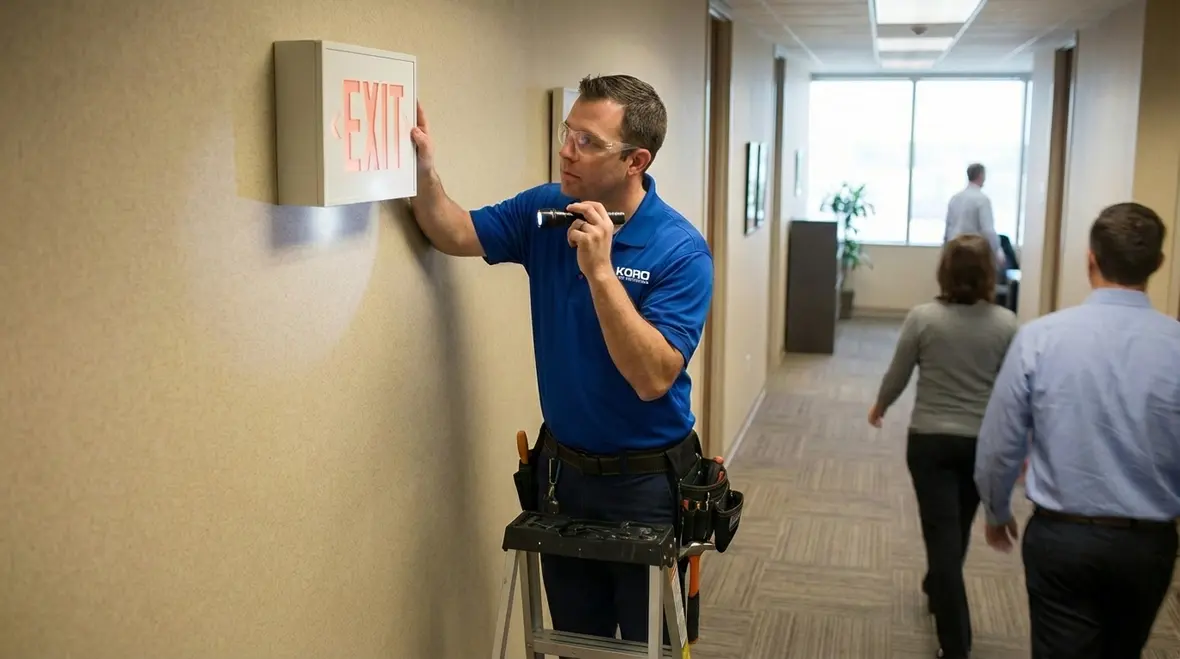
Technicians begin with a detailed visual inspection. They check for:
- Physical damage to fixtures
- Loose wiring or exposed conductors
- Corrosion in battery compartments
- Obstructed light paths
- Missing covers or lenses
In addition, they confirm that units are mounted securely and positioned correctly along exit routes. A light hidden behind a new storage rack is about as helpful as a flashlight with dead batteries.
Functional Testing
Next comes functional testing. Technicians simulate a power failure by interrupting normal power. This step ensures that:
- The unit switches to battery power immediately
- Lamps illuminate without flicker
- Light output is sufficient for safe egress
Because this process tests real response time, it reveals issues that visual checks alone cannot catch.
Battery Testing
The battery is the heart of any emergency lighting system. Therefore, technicians test battery voltage and overall condition. If the battery shows signs of weakness, swelling, or reduced capacity, they recommend replacement.
Many codes require an annual full duration test. During this test, the system runs on battery power for the required time, often 30 minutes. If the lights fade before that mark, the unit fails. No excuses. No gold stars for effort.
Documentation and Reporting
Finally, a proper service includes documentation. Technicians log test dates, results, deficiencies, and corrective actions. This record supports compliance and gives building owners proof of maintenance.
Kord Fire Protection technicians emphasize this step often. Without documentation, even a well tested system may create problems during inspections. Paperwork may not be glamorous, but it keeps the gears of compliance turning smoothly.
3. What a Proper Test Does Not Include
Now, here is where some confusion creeps in. A professional inspection is thorough, yet it does not cover everything in the building.
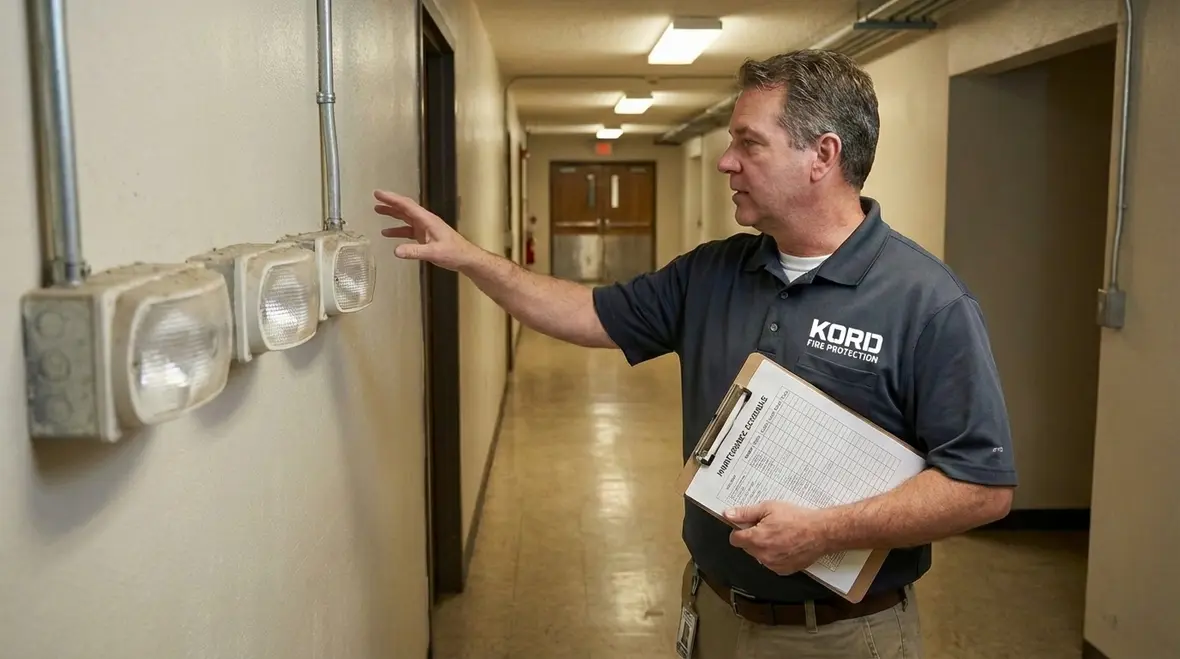
First, an emergency lighting test does not replace a full electrical inspection. Technicians focus on the emergency fixtures and related components, not every circuit in the property.
Second, it does not upgrade outdated systems automatically. If a building operates with older units that still meet minimum code, the service verifies performance. It does not redesign the system unless requested.
Third, it does not guarantee future performance beyond the test date. Equipment can fail unexpectedly. However, regular testing reduces that risk significantly.
In other words, a proper test confirms current functionality. It is not a crystal ball. Even Morgan Freeman cannot narrate the future of a battery with absolute certainty.
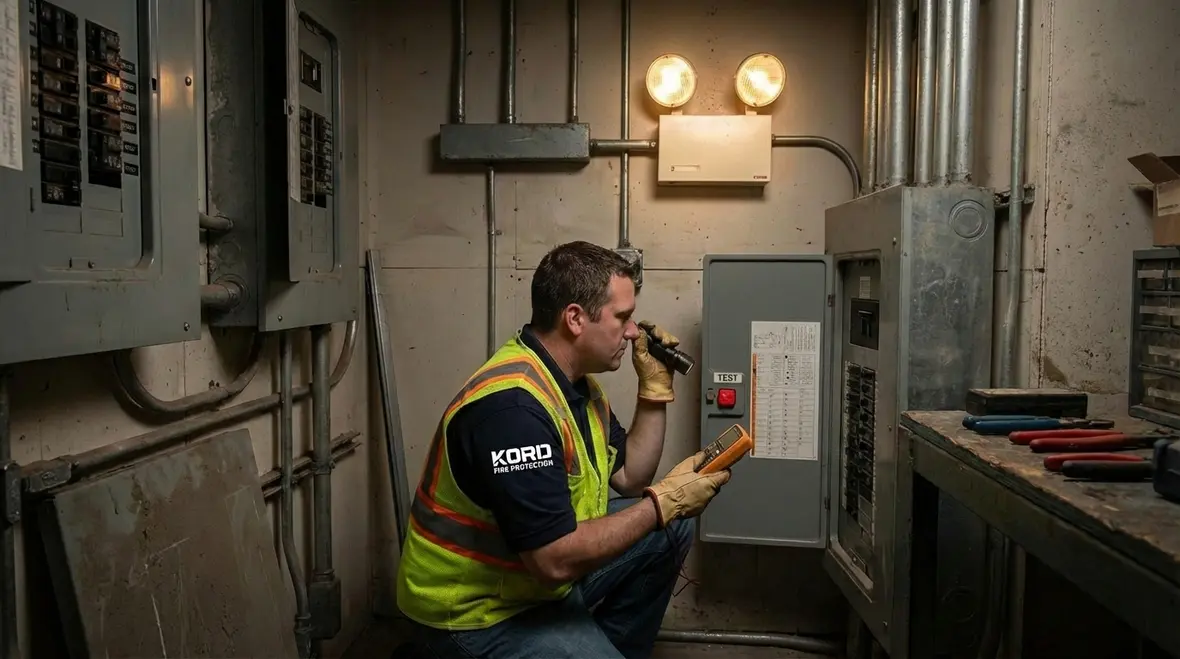
4. How Often Should Emergency Lights Be Tested
This is one of the most common questions property managers ask.
Most fire codes require:
- Monthly 30 second functional tests
- Annual full duration tests, typically 30 minutes
However, local regulations may vary. Therefore, facility managers should confirm requirements with qualified professionals.
Kord Fire Protection technicians often explain that monthly testing catches small problems early. For example, a unit that fails to switch to battery power can be repaired long before an inspection or emergency occurs. Meanwhile, the annual test verifies sustained performance under real conditions.
Consistent scheduling also builds a maintenance rhythm. Instead of scrambling before inspections, property owners stay ahead of issues. That approach saves time, reduces stress, and often lowers long term costs.
5. Common Failures Found During an Emergency Lighting Service
Even in well managed buildings, technicians regularly find issues. Fortunately, most are preventable.
Battery Failure
Batteries degrade over time. Heat, age, and infrequent testing accelerate that decline. As a result, lights may activate but fail before the required duration ends.
Lamp or LED Malfunction
Although modern LED units last longer than older lamps, they still fail. Dimming, flickering, or partial illumination indicates a problem.
Charging System Issues
If the charging circuit fails, the battery never fully replenishes. Therefore, even a new battery can underperform.
Improper Installation
Sometimes, renovations create new obstacles. A relocated wall, added shelving, or new equipment can block light distribution. During testing, technicians confirm that escape paths remain clearly illuminated.
Kord Fire Protection technicians often share a simple truth. Most failures do not happen because someone ignored safety. They happen because systems were installed and then forgotten. Emergency lighting is not a set it and forget it device. It is more like a smoke alarm. It needs attention to stay reliable.
6. What Property Owners Should Expect During a Service Visit
Understanding the process helps reduce disruption. A professional emergency lighting service typically follows a clear sequence.
Before the Visit
Technicians confirm the scope of work and access requirements. They may request electrical room access or keys to locked areas.
During the Visit
They move systematically through the building, testing each unit. Temporary lighting interruptions may occur. However, experienced technicians coordinate to minimize inconvenience.
After the Visit
Clients receive a detailed report outlining:
- Units tested
- Pass or fail results
- Recommended repairs
- Compliance status
Because clarity matters, Kord Fire Protection technicians take time to explain findings in plain language. They do not hide behind jargon. Instead, they outline risks, options, and next steps so decision makers can act confidently.
7. Professional Service Versus DIY Testing
Some facility teams perform monthly button tests internally. While that approach can support routine checks, it should not replace professional evaluation.
Below is a simplified comparison.
In House Check
- Presses test button briefly
- Limited battery assessment
- Basic visual scan
- Minimal documentation
Professional Service
- Simulates real power loss
- Measures battery condition and load
- Detailed fixture and wiring inspection
- Code compliant reporting
While in house checks help maintain awareness, professional testing ensures compliance and deeper diagnostics. It is the difference between checking your car tires visually and having a mechanic inspect the braking system. Both matter. One goes further.
8. Frequently Asked Questions
9. Conclusion: A Calm Light in the Dark
When the power fails, preparation speaks louder than panic. A thorough emergency lighting service ensures that exit paths remain visible and occupants stay safe. Kord Fire Protection technicians approach each building with care, precision, and clear communication. They test what matters, document what they find, and help you correct problems before they turn into liabilities.
For property owners who value compliance and peace of mind, now is the time to schedule a professional evaluation. Pairing reliable emergency lighting with full fire protection services keeps your site ready for inspectors and real-world emergencies alike. Kord Fire Protection can coordinate inspections, maintenance, and upgrades across alarms, sprinklers, extinguishers, and emergency lighting so your building is always one step ahead.
Because when darkness falls, the right light should already be waiting.
Schedule emergency lighting and fire protection service with Kord Fire Protection today.
Know Your Weapon Before You Fight the Flame
Kord Fire Protection is your go-to when it comes to all things fire protection. For over 20 years, we’ve been serving Southern California with the quality service and equipment to keep your home or business safe at all times. Our competitive prices reflect our unwavering commitment to protecting what matters most in the event of a fire emergency. Give us a call, send an email, or use that form!

Join Our Newsletter!
Get the latest fire safety tips delivered straight to your inbox From our Newsletter.