Emergency Lighting Fire Safety and Fire Protocol Alignment
Quick Answer
Synchronizing emergency lighting with commercial fire safety protocols means aligning testing, placement, power sources, and records with the building’s fire strategy. When done well, Emergency Lighting Fire Safety becomes a living part of evacuation planning, not a last minute checklist. Kord Fire Protection can support that integration so your sites stay compliant and ready.
In commercial and industrial facilities, people sometimes treat life safety systems like a set it and forget it subscription. Unfortunately, real life does not work that way. Emergency Lighting Fire Safety needs to match the building’s fire procedures, emergency management plans, and inspection routines. Otherwise, the lights may work, but the process fails. And when the process fails, human behavior follows like dominoes, only louder and with more panic.
That is why smart facilities connect emergency lighting strategy with broader protection planning early. Near the top of that effort, it helps to coordinate with emergency exit light services for testing, repairs, and ongoing support, while keeping broader system oversight tied into full fire protection services when multiple life safety systems must stay aligned.
So this article explains how commercial operators synchronize emergency lighting with fire safety protocols, what to coordinate with and why, and how Kord Fire Protection can become a vital partner for the service or job.
How Fire Plans Connect to Exit Lighting Performance
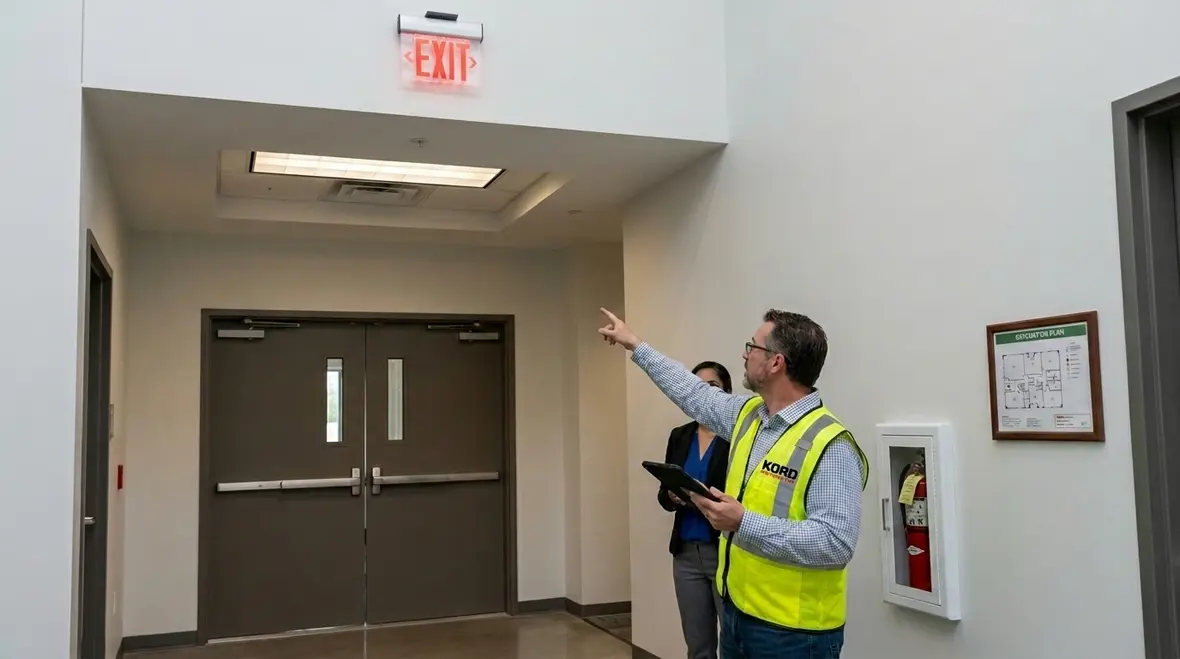
Emergency Lighting Fire Safety starts with the evacuation concept. Fire safety protocols often include alarm modes, evacuation routes, staff roles, and assembly areas. However, exit lighting only matters when it guides people along the right path at the right time. If the route on paper and the route people actually use are not the same, the lights can end up supporting a theory instead of a safe exit.
Therefore, the team must treat lighting and fire operations as one connected system. When a fire occurs, the building may shift to alarm conditions, doors may release or hold, lifts may stop, and signage must remain readable. Emergency lighting works alongside that sequence. For example, if the evacuation plan assumes people use a specific corridor, the lighting must support that corridor’s visibility during power loss and reduced clarity, not just look fine during a casual walkthrough on a normal day.
What needs to match before commissioning and after changes
- Evacuation routes match the actual layout, not the layout from the last renovation
- Stairwells, final exit doors, and corridor intersections receive adequate coverage
- High risk areas have lighting that supports movement when visibility drops
- Sequence of operations aligns with how the building alarms trigger evacuation
- Exit signs and luminaires work together so direction stays obvious, not open to interpretation
And yes, this includes the boring stuff. The boring stuff is what keeps people calm when alarms kick in like an overcaffeinated fire drill. Clear routes, readable exits, and lighting that supports decision points are not glamorous, but they are exactly what people need when the room suddenly gets very interested in leaving.
Where to Coordinate Emergency Lighting with Fire System Workflows
Once the site’s fire strategy is clear, the next step is to coordinate the workflow between fire safety and lighting maintenance. Many businesses treat emergency lighting testing as its own lane. That approach creates gaps: the fire alarm contractor logs alarm events while the lighting contractor logs lamp performance, and nobody connects the dots. The result is a tidy pile of records that do not always prove the building will behave the way the plan says it should.
To fix that, the facility manager can require a shared coordination rhythm. The same work package should cover commissioning data for emergency luminaires tied to floor plans, testing schedules aligned with alarm checks, and defect reporting that triggers the same urgency process used for other life safety issues. Consistent naming matters too, because a luminaire cannot be tracked very well if one report calls it EL-12 and the next report calls it hallway unit near vending machine probably.
Workflow points worth tying together
- Commissioning data for emergency luminaires mapped to the floor plan
- Test schedules aligned with fire alarm testing and related functional checks
- Battery, charge, and duration findings recorded with consistent naming
- Defect reporting that feeds the same response process as broader life safety faults
- Post work verification after repairs so coverage is still correct, not merely restored somehow
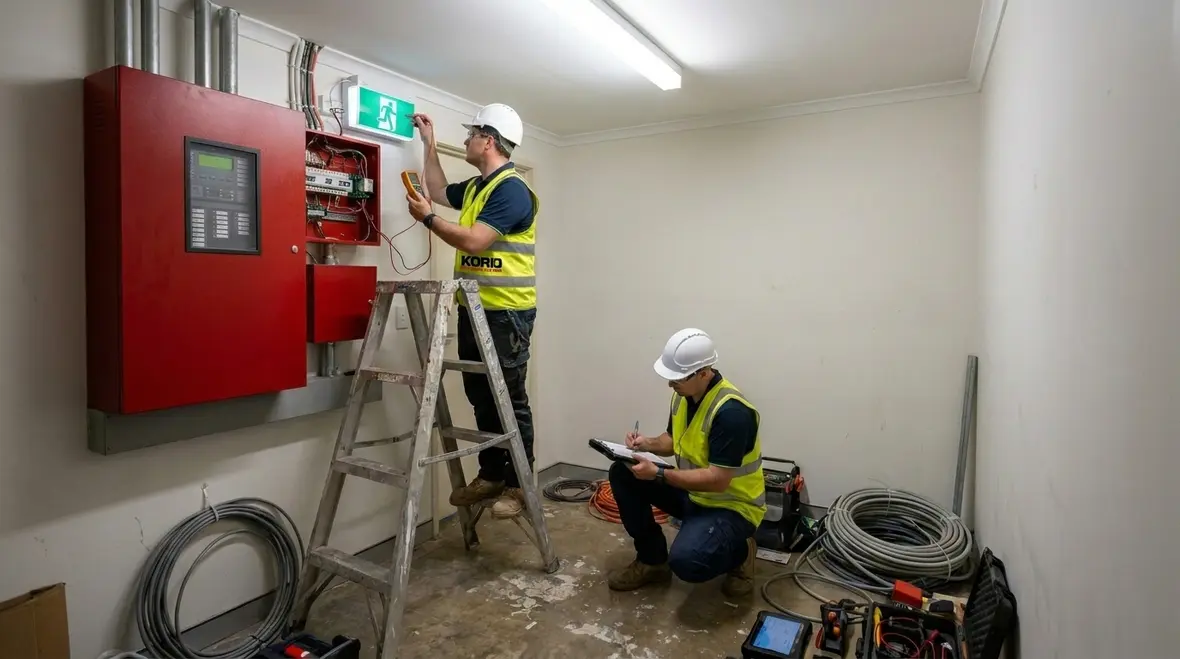
The team should also confirm how emergency lighting behaves under realistic scenarios. If the fire plan uses staged evacuation, then the lighting performance needs to support that staged movement. If the site uses smoke control, the lighting should be planned around how people will move when airflow, shadows, and visibility begin changing. A system that passes a simple test but does not support actual movement patterns is doing half the job and claiming full credit.
Planning for Compliance Across Industrial, Retail, and Commercial Sites
Commercial buildings vary widely, from warehouses with high bays and long travel paths to retail back of house areas where layouts change faster than anyone updates the file name. Because of that, synchronization must account for different hazards, traffic patterns, and occupancy behavior. Emergency Lighting Fire Safety should reflect practical site conditions, not just a standard template pasted from another property that happens to also have walls and doors.
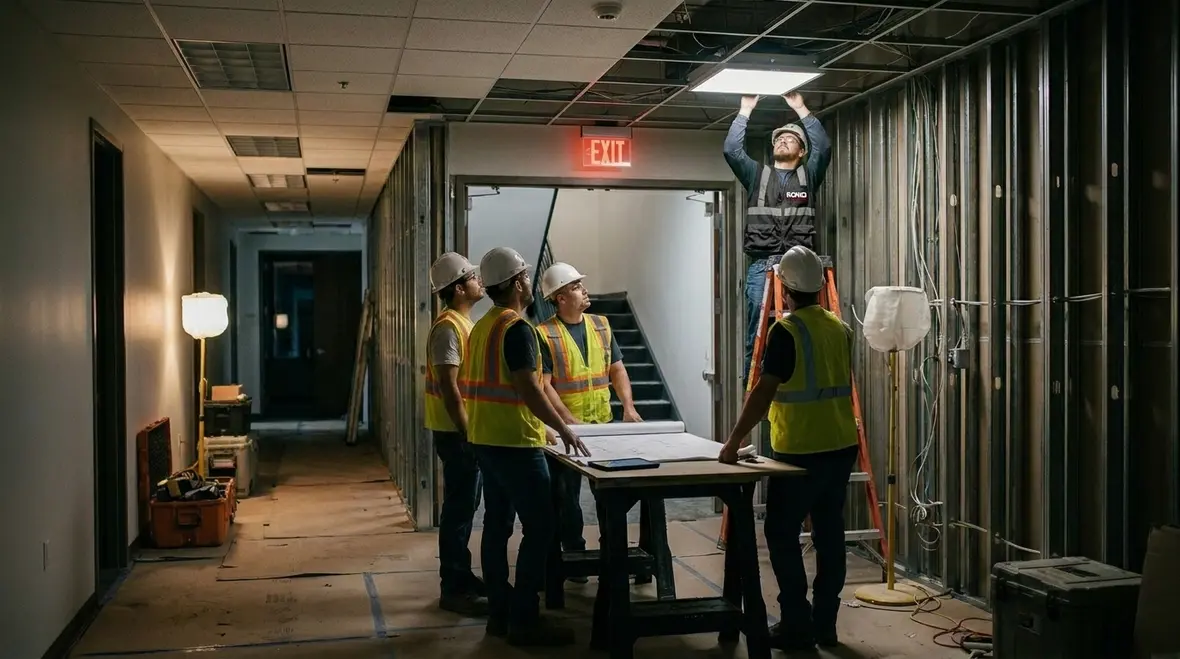
An industrial facility may involve dust, vibration, contractor access, and storage patterns that alter sightlines. Retail environments can shift even faster, with counters moving, temporary displays appearing, and partitions changing how people approach exits. Office and mixed use buildings add another layer with visitors who do not know the layout nearly as well as staff do. In every case, the emergency lighting plan and the fire protocol should be reviewed together whenever the space changes in a meaningful way.
Common changes that should trigger a joint review
- Renovations and fit outs that alter corridors or door locations
- New plant, shelving, or racking that affects access paths
- Temporary works during upgrades that modify normal traffic flow
- After hours storage changes that block sightlines
- Door hardware or messaging changes that alter evacuation behavior
Documentation has to stay consistent as well. When auditors or internal reviewers check the record trail, they should be able to see a clear line from plan to installation to testing outcomes to corrective action. In other words, the paperwork should make sense even to the brave soul who was not around for the last shutdown, fit out, or emergency lighting mystery tour.
Integrating Testing, Maintenance, and Evacuation Exercises
Testing is not just push the button, write the log, move on. When emergency lighting testing aligns with evacuation practice, the business gains evidence that systems perform under real movement and real human stress. Even if the site runs full drills only occasionally, it can still run smaller internal checks more often. Meanwhile, maintenance work should verify that luminaires remain installed, clean, visible, and aimed correctly rather than slowly disappearing into the background clutter of daily operations.
| Activity | How it supports Emergency Lighting Fire Safety |
|---|---|
| Visual inspection | Confirms luminaires, signs, and exit points stay unobstructed after changes |
| Functional testing | Verifies battery and illumination performance during power loss modes |
| Evacuation exercise | Checks whether people follow the intended routes, with lighting aiding navigation |
Then the facility captures outcomes and improves. If an exercise shows people hesitate at a junction, the solution might involve route reinforcement, improved signage, or repositioning or upgrading luminaires. That is how Emergency Lighting Fire Safety becomes a controlled improvement loop rather than a periodic obligation. The goal is not merely proving that fixtures turn on. The goal is proving that people can keep moving when everything around them gets noisy, urgent, and suddenly very unhelpful.
Why Kord Fire Protection Can Be a Vital Partner
When businesses try to coordinate everything in house, the job often becomes a patchwork of contractors, spreadsheets, and hope. Hope is great for romance novels. For fire safety, it is not a strategy. A stronger approach is to use a partner that can help connect emergency lighting expectations with the rest of the site’s fire protection workflow, so maintenance, testing, records, and response priorities stop living in separate universes.
Kord Fire Protection can serve as that vital partner by aligning emergency lighting documentation, testing, and fault handling with broader fire safety requirements. Instead of treating emergency luminaires as a standalone service, the process stays tied to the site’s actual fire strategy. As a result, the facility reduces gaps between what the plan says, what the systems do, and what the records prove when someone finally asks to see all of it at once.
What practical support can look like
- Structured inspection and testing that supports audit readiness
- Clear reporting that links issues to urgency and operational risk
- Coordination support during fit outs, refurbishments, and temporary works
- Consistent processes across multiple facilities so standards do not drift
- Better alignment between field findings and the building’s documented fire strategy
And when a company operates across multiple buildings, consistency matters. One warehouse should not have a different safety culture than a retail distribution hub just because the maintenance manager changed or the filing system became a creative writing project. A steady partner helps keep the approach uniform, so the operations team can focus on running the site instead of firefighting paperwork.
Handling Faults, Upgrades, and Site Changes Without Losing Coverage
Fault management is where synchronization often breaks down. A defective luminaire gets replaced, yes. But sometimes the fire plan was updated, routes changed, or signage moved, and the emergency lighting coverage was never rechecked. That leaves the site with a repaired fitting and an unresolved visibility problem, which is a bit like fixing the steering wheel while ignoring the missing road signs.
To prevent that, the facility should treat any fault or upgrade as a trigger for a mini review. This is especially important when the site experiences blocked exits due to storage or works, new partitions or temporary fencing, door changes affecting final exits, or updates to alarm zones and evacuation messaging. Small physical changes can create surprisingly large wayfinding problems when people are under stress and relying on fast visual cues.
The site should also confirm that replacements match the original design intent for brightness, spacing, and coverage. Even small differences can create weak points at intersections, in stair approaches, or near final exit doors. Emergency lighting should guide people calmly, not just turn on during a power loss like a stubborn nightlight that chooses the worst possible moment to become relevant.
FAQ: Emergency Lighting Fire Safety and Fire Protocol Alignment
Conclusion and Call to Action
Synchronizing emergency lighting with commercial fire safety protocols keeps evacuation routes clear, testing meaningful, and compliance easier to defend. When the lighting plan, the fire strategy, and the maintenance record all point in the same direction, facilities reduce confusion before confusion ever gets a chance to become a problem.
When Kord Fire Protection partners on the job, sites gain coordinated reporting, smoother maintenance workflows, and fewer gaps between plans and performance. If your facility needs a more connected approach, now is a good time to review your emergency lighting strategy and bring it into line with the rest of your fire protection process.

Join Our Newsletter!
Get the latest fire safety tips delivered straight to your inbox From our Newsletter.