
Commercial Kitchen Fire Extinguisher Requirements
Fire Extinguisher for Commercial Kitchens: Minimum Types and Placement Map
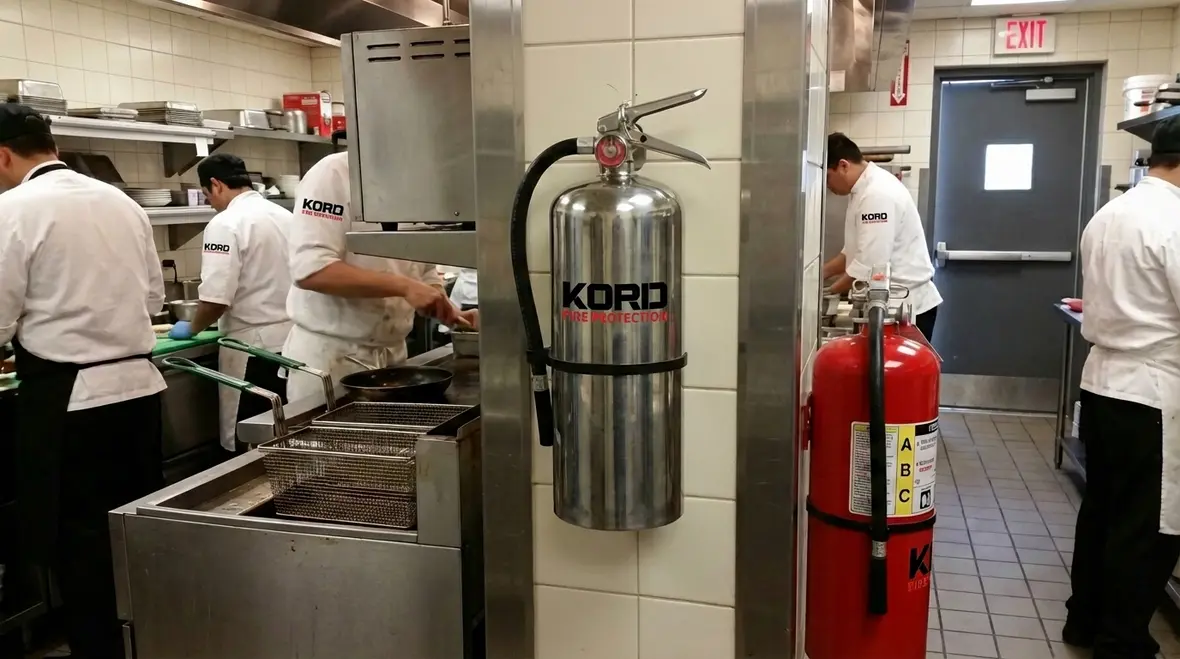
Every commercial kitchen operates under clear fire extinguisher requirements for commercial kitchens, and those standards are not suggestions. They are life safety rules shaped by real fires, real losses, and hard lessons learned. Health departments, fire marshals, and insurance carriers all expect specific extinguisher types, proper mounting heights, and strategic placement near cooking equipment. Throughout this guide, Kord Fire Protection technicians explain what those rules mean in practical terms, how to apply them, and why the right extinguisher in the wrong place is about as useful as a screen door on a submarine.
Moreover, understanding fire extinguisher requirements for commercial kitchens protects staff, customers, and the business itself. So let us step into the heat, calmly and confidently, and map out exactly what belongs on the wall of every serious kitchen.

The Real Risk Inside a Commercial Kitchen
Commercial kitchens produce controlled chaos. Open flames, high temperature oils, electrical appliances, and constant movement create a setting where small mistakes grow quickly. However, most kitchen fires follow predictable patterns. They start in deep fryers, on stovetops, inside hood systems, or behind overloaded electrical panels.
Because of this, national standards require more than just a basic red canister by the door. Instead, they demand specific extinguishing agents designed to match the type of fuel involved. Grease fires, for example, behave differently than paper or packaging fires. Throw water on burning oil and you will create a fireball worthy of an action movie. Unfortunately, real life does not yell cut before someone gets hurt.
Kord Fire Protection technicians often remind restaurant owners that compliance is not about checking a box. It is about matching the extinguisher to the hazard. Therefore, selecting the correct types becomes the first and most important step.
If you are reviewing broader code expectations for your building, resources like Kord Fire’s Los Angeles commercial fire code guide can help connect extinguisher decisions with alarms, sprinklers, and kitchen hood systems so everything works together instead of in silos.
Minimum Types Required Under Fire Extinguisher Requirements for Commercial Kitchens
Class K Extinguishers
Class K extinguishers are the heroes of the deep fryer. Specifically designed for cooking oils and fats, they use a wet chemical agent that cools the fire and creates a soapy foam layer over the burning grease. This process, known as saponification, prevents re ignition.
According to Kord Fire Protection technicians, every commercial kitchen that uses deep fat fryers must have at least one Class K extinguisher within 30 feet of the cooking equipment. Additionally, it must be clearly visible and unobstructed. Local guides, such as Kord Fire’s extinguisher requirement overviews for Los Angeles and Anaheim, regularly emphasize the same point: commercial kitchens with grease producing appliances do not get a pass on Class K.
ABC Multipurpose Extinguishers
While Class K handles grease, most kitchens also require an ABC extinguisher. This unit covers ordinary combustibles such as paper and wood, flammable liquids, and electrical fires.
Because storage areas, dry goods shelves, and electrical panels present separate risks, the ABC extinguisher fills in the gaps. However, it does not replace Class K. Using an ABC unit on a deep fryer may knock down flames temporarily, but it will not provide the same cooling and sealing effect.
Special Considerations for Large Facilities
Larger kitchens, food production facilities, or operations with unique equipment may require additional ratings. In some cases, fire inspectors request higher capacity units based on square footage or cooking load. Therefore, owners should never assume that a single extinguisher near the exit satisfies every requirement.
Kord Fire Protection technicians assess the layout, equipment type, and cooking volume before making final recommendations. Because every kitchen has its own rhythm, every fire plan must match that rhythm.

Strategic Placement Map for Commercial Kitchen Extinguishers
Placement is not random. In fact, proper location can mean the difference between quick control and a five alarm disaster. Fire extinguisher requirements for commercial kitchens outline clear spacing and mounting rules that inspectors enforce consistently.
Below is a simplified dual column guide that reflects common standards.
| Area of Kitchen | Recommended Extinguisher Placement |
| Deep fryers and high grease appliances | Class K within 30 feet, mounted 3.5 to 5 feet above floor, visible and unobstructed |
| General cooking line | Class K positioned near exit path but not so close that fire blocks access |
| Dry storage rooms | ABC extinguisher near doorway, within 75 feet travel distance |
| Electrical panels | ABC extinguisher nearby but not directly above equipment |
| Dishwashing and utility areas | ABC unit accessible within required travel distance |
Notice a pattern. Extinguishers must remain accessible without forcing staff to move toward the fire. In other words, the path to safety should never pass through flames. Kord Fire Protection technicians often say, if you have to reach through a fire to grab the extinguisher, the map needs redrawing.
If you want to dive deeper into mounting details beyond the kitchen, Kord Fire’s height and location guide for where to mount fire extinguishers walks through standards for offices, warehouses, and mixed use buildings so your whole property stays consistent.

Mounting, Signage, and Accessibility Standards
Beyond type and location, installation details matter just as much. Fire extinguisher requirements for commercial kitchens specify mounting height, bracket strength, and visibility standards.
Generally, extinguishers weighing less than 40 pounds must be mounted so the top sits no higher than five feet above the floor. Heavier units must be lower, with the top no more than three and a half feet high. Additionally, the bottom should sit at least four inches above the floor.
Clear signage must mark each unit. If equipment blocks the view, overhead signs become necessary. Furthermore, nothing should obstruct access. That means no stacked boxes, no rolling carts, and definitely no decorative plant trying to play hide and seek.
Kord Fire Protection technicians frequently find extinguishers tucked behind supplies during inspections. While that might save a few inches of wall space, it costs precious seconds during an emergency. Seconds, in a kitchen fire, move faster than gossip in a small town.
Integration With Hood Suppression Systems
Modern commercial kitchens typically include automatic hood suppression systems over cooking equipment. These systems detect heat and release wet chemical agents automatically. However, they do not eliminate the need for portable extinguishers.
In fact, codes require both systems to work together. If the hood system activates, staff may still need a Class K extinguisher to control residual flames. Moreover, fires can start outside the hood protected zone. Therefore, portable units provide flexible response options.
Kord Fire Protection technicians test hood systems regularly and verify that portable extinguishers remain charged and properly tagged. Because mechanical systems can fail, redundancy provides peace of mind. And in fire safety, peace of mind is priceless.
If your facility still runs an older suppression setup or you are not sure whether it meets UL 300 standards, Kord Fire’s dedicated kitchen hood fire suppression and UL300 restaurant system pages walk through why modern wet chemical systems matter for grease heavy cooking lines.

Inspection, Maintenance, and Documentation
Even the perfect extinguisher becomes useless without maintenance. Fire extinguisher requirements for commercial kitchens demand monthly visual inspections and annual professional servicing.
During monthly checks, staff should confirm:
- The extinguisher sits in its designated location
- The pressure gauge reads within the green zone
- The safety pin remains intact
- No visible damage or corrosion appears
Annually, certified technicians perform deeper inspections. They verify internal components, replace tamper seals, and update service tags. Additionally, some extinguishers require hydrostatic testing every several years depending on type.
Kord Fire Protection technicians document each service clearly. Proper records not only satisfy inspectors but also support insurance claims if a fire occurs. In other words, paperwork may feel dull, yet it protects the business long after the smoke clears.
Training Staff to Use Extinguishers Properly
An extinguisher on the wall means little if no one knows how to use it. Therefore, training becomes the final layer of protection.
Most programs teach the PASS method:
- Pull the pin
- Aim at the base of the fire
- Squeeze the handle
- Sweep side to side
However, Kord Fire Protection technicians emphasize decision making before action. Employees must evaluate fire size, escape routes, and personal safety. If the fire grows beyond a small, contained area, evacuation should come first.
Additionally, staff should understand which extinguisher matches which fire. Grabbing an ABC unit for a grease fire might feel heroic, but it can worsen the situation. Training replaces panic with calm action. And calm action, much like a steady voice in a storm, changes outcomes.
What Happens If a Kitchen Ignores Fire Extinguisher Requirements?
Ignoring standards invites more than a stern lecture from the fire marshal. First, inspectors can issue citations or shut down operations. Second, insurance carriers may deny claims after a fire if required equipment was missing or poorly maintained.
Most importantly, lives remain at risk. A small stovetop flare up can escalate in under a minute. Without proper extinguishers placed correctly, staff lose their first line of defense.
Kord Fire Protection technicians have seen near misses turn into costly rebuilds simply because an extinguisher sat ten feet too far away. Therefore, compliance is not just legal. It is practical and protective.
Common Mistakes Restaurant Owners Make
Even well intentioned owners make preventable errors. Recognizing them early saves trouble later.
- Relying solely on hood suppression systems
- Installing only ABC extinguishers without Class K units
- Blocking extinguishers with equipment or storage
- Skipping annual professional inspections
- Failing to train new hires
Furthermore, some assume that once installed, extinguishers require no further thought. In reality, kitchens evolve. New appliances arrive. Layouts shift. Consequently, extinguisher placement may need adjustment.
Kord Fire Protection technicians review layouts during renovations to ensure continued compliance. Because when the grill moves, the extinguisher should not stay frozen in time like a forgotten extra in a movie scene.
Conclusion and Next Steps
Fire extinguisher requirements for commercial kitchens protect more than property. They protect livelihoods, reputations, and human life. The right combination of Class K and ABC units, placed with intention and maintained with care, forms a reliable safety net. Kord Fire Protection technicians stand ready to assess layouts, install compliant systems, and train staff with clarity and confidence.
Schedule a professional evaluation today and let safety become the quiet strength behind every successful service. If your kitchen also needs upgrades to hood or foam based systems, Kord Fire’s broader fire suppression services help tie extinguishers, UL 300 kitchen suppression, and other specialty systems into one coordinated protection plan.
Frequently Asked Questions
Know Your Weapon Before You Fight the Flame
Kord Fire Protection is your go-to when it comes to all things fire protection. For over 20 years, we’ve been serving Southern California with the quality service and equipment to keep your home or business safe at all times. Our competitive prices reflect our unwavering commitment to protecting what matters most in the event of a fire emergency. Give us a call, send an email, or use that form!

Join Our Newsletter!
Get the latest fire safety tips delivered straight to your inbox From our Newsletter.


