Commercial Fire Pump Maintenance Tips to Extend Lifespan
Quick Answer: Extending the lifespan of commercial fire pump systems starts with disciplined maintenance, careful testing, and fast correction of small issues before they turn into big failures. Using proven commercial fire pump maintenance tips like routine inspections, flow testing, and alarm checks helps keep pumps reliable. Kord Fire Protection can manage this safely and consistently across sites. For facilities also tightening overall life safety communication, fire alarm monitoring systems fit naturally into a broader reliability strategy, while Kord Fire Protection’s commercial fire pump maintenance schedule optimization approach shows how structured service keeps pump performance steady instead of hopeful.
Commercial fire pump systems do not fail out of nowhere. More often, they wear down quietly, the way a coffee machine gets louder over time and management pretends it is “just how it runs.” In the first place, the lifespan of a fire pump depends on practical commercial fire pump maintenance tips carried out on schedule. That means routine checks of pressure, suction conditions, controllers, and alarms. It also means ensuring the pump starts when it should, delivers the correct flow, and shuts down cleanly. From there, Kord Fire Protection becomes the partner that turns a maintenance calendar into a reliability program, helping industrial, retail, and facilities teams stay prepared, documented, and far less vulnerable to nasty surprises.
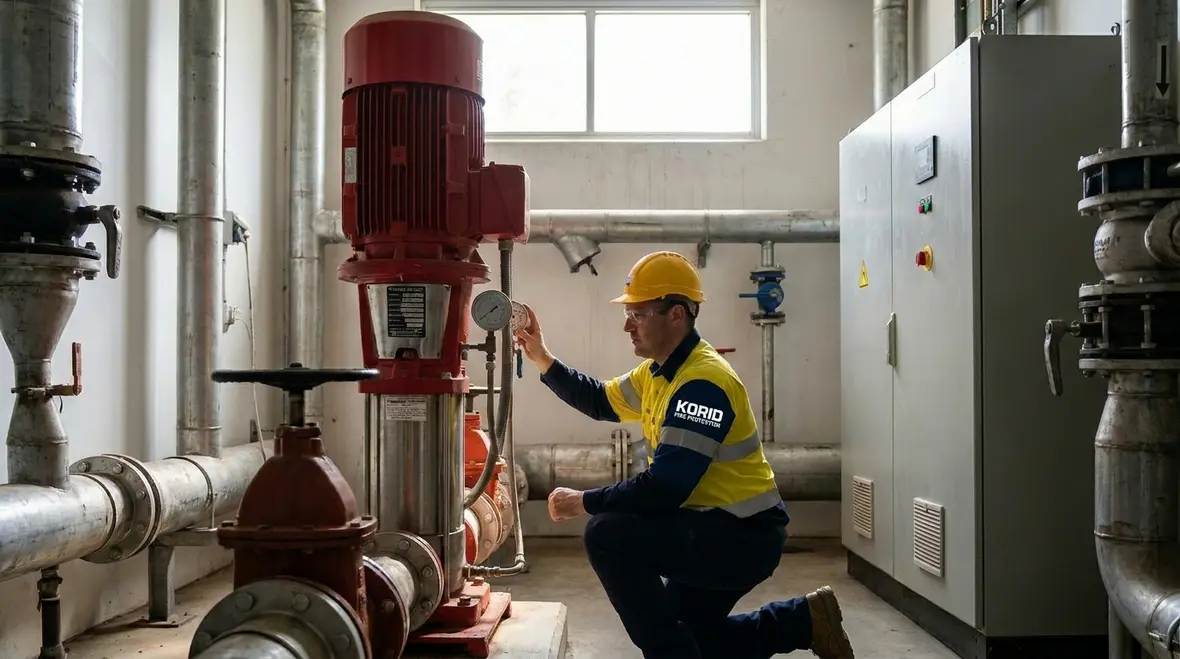
Why fire pump lifespan drops when maintenance gets casual
Fire pump systems live in a high demand environment. Even when fires do not show up, the equipment still absorbs heat, vibration, and humidity. Over time, small gaps in commercial fire pump maintenance tips allow wear to compound. For example, a slightly misaligned coupling can create extra vibration. Then bearings run hotter. Then seals start to drift. Finally, the pump may still run, but it delivers less performance than required, which is where things get serious.
Also, “casual” maintenance often hides behind busy schedules. A team might check gauges visually, but not verify setpoints through proper testing. Or they may inspect strainers, but miss partial blockage that only reveals itself under flow. As a result, the system looks fine during a walk-through and fails during a real demand. That is not confidence. That is luck. And luck, as the saying goes, is not an engineered control strategy.
The trouble with relaxed routines is that they create a false sense of security. Because a fire pump may sit quietly for long stretches, people assume “quiet” means “healthy.” Unfortunately, machinery does not grade itself on vibes. It responds to lubrication quality, alignment, valve position, electrical integrity, and water supply conditions. If those pieces drift, lifespan drops long before anyone writes “problem” on a clipboard.
What casual maintenance usually misses
- Pressure readings that look normal at rest but drift under demand
- Minor leakage around seals or fittings that grows over time
- Heat and vibration changes that only show up during structured testing
- Controller issues that do not appear during a quick visual inspection
- Environmental problems in the pump room, including moisture and blocked access
Commercial fire pump maintenance tips that prevent early wear
When a facility team applies commercial fire pump maintenance tips consistently, the system stays in the design range. First, they confirm suction conditions. That includes checking strainers, suction piping condition, valve positions, and any air or debris that can starve the pump. Next, they verify electrical and control performance. A pump can be mechanically healthy, yet still underperform due to controller settings, low voltage issues, or faulty sensors.
Then they focus on mechanical wear points. Seal leaks, abnormal noise, and temperature trends often provide early warning. Technicians should measure and log key values during testing rather than relying on memory. When trends show drift, the team can correct the cause, not just replace parts. After that, they verify alarms and interlocks, because real systems do not fail quietly, they announce problems loudly.
Finally, they keep the environment stable. If the pump room has moisture, poor ventilation, or storage clutter blocking access, the equipment suffers. So, teams should maintain clear working space and keep corrosive exposure under control. It sounds simple. But simple is not easy, especially when forklifts are involved.
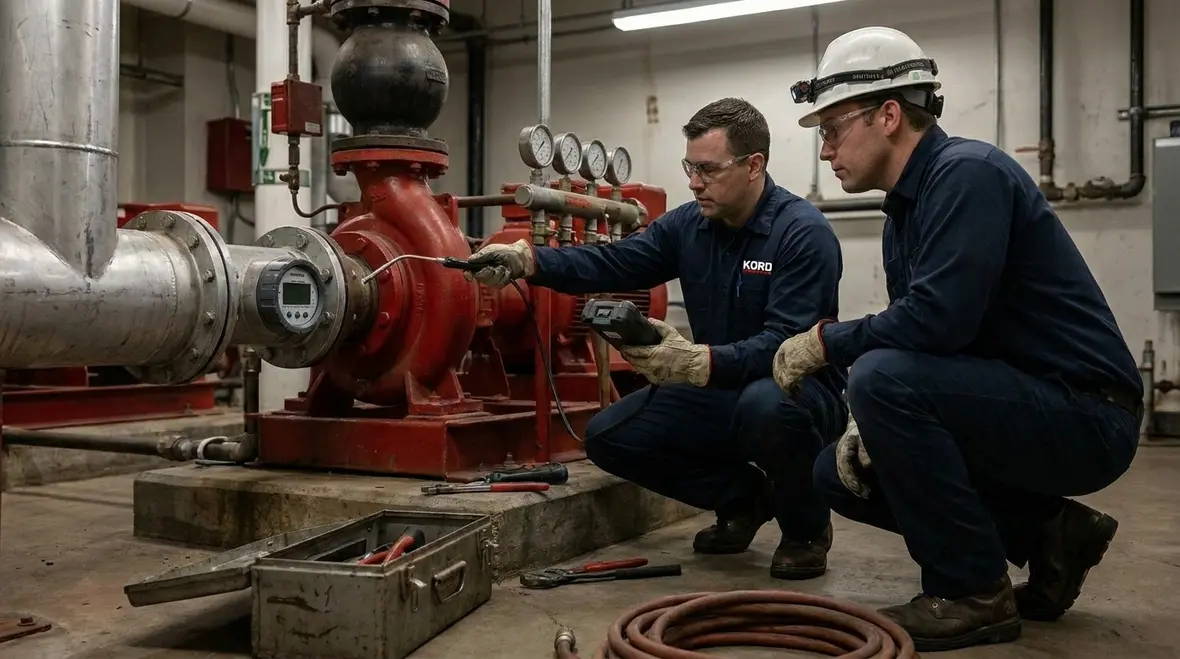
A practical maintenance rhythm that actually works
A useful routine is never just “inspect sometimes and hope for the best.” Teams need repeatable checks that make trend spotting easy. That means recording discharge pressure, suction pressure, controller events, run time, vibration behavior, and room condition in the same format every time. Once the data is consistent, the story becomes obvious. A stable pump stays stable. A drifting pump starts leaving clues. Good maintenance is really just the art of noticing those clues before the equipment decides to make the issue everyone’s emergency.
Testing plans that catch problems before they become emergencies
Testing does more than prove compliance. It reveals how the system behaves under actual demand conditions. A good plan includes periodic performance testing, verification of pump start and stop sequences, and checks of water supply assumptions. When technicians test the system as intended, they confirm flow, pressure, and stability. If the pump cannot maintain the required curve, the team addresses the issue while the fix is still manageable.
In addition, testing helps teams validate that the system remains matched to site conditions. Facilities change. Tenants expand. Piping gets added. Valves get moved during renovations. Water supply pressure can shift due to upstream work. Therefore, testing should not be a one time event. It should run on a schedule, with documentation that shows what changed and what was corrected.
And yes, it can feel like “another task.” But think about it like a seasonal tune up for a car. You do not wait until the engine dies in the middle of traffic just to learn your timing belt is tired. Fire pumps do not care about excuses. Fire pumps care about results.
What a strong testing plan usually includes
- Verification of automatic and manual start sequences
- Pressure and flow review against expected performance
- Alarm and supervisory signal checks
- Controller status review and event history confirmation
- Documentation of any site changes that may affect demand
How proper component care extends service life and uptime
Extending lifespan depends on disciplined attention to components that typically wear first. Bearings need correct lubrication and attention to vibration trends. Seals need monitoring for leakage and heat buildup. Couplings need alignment checks. Controllers need verification of protective functions, including safeties that shut the system down when readings drift out of limits.
It also helps to manage wear from water quality. Scale, sediment, and corrosion can reduce hydraulic performance. Over time, that means the pump works harder to produce the same output. Consequently, energy consumption rises and temperatures climb. Technicians should consider strainers and filtration where appropriate, and confirm that water chemistry supports long term operation.
Furthermore, technicians should inspect valves and check their movement. A valve that sticks might not fail completely, but it can delay opening or create flow restriction. During a high demand scenario, delay matters. So, components should receive attention that matches how the system actually performs during tests.
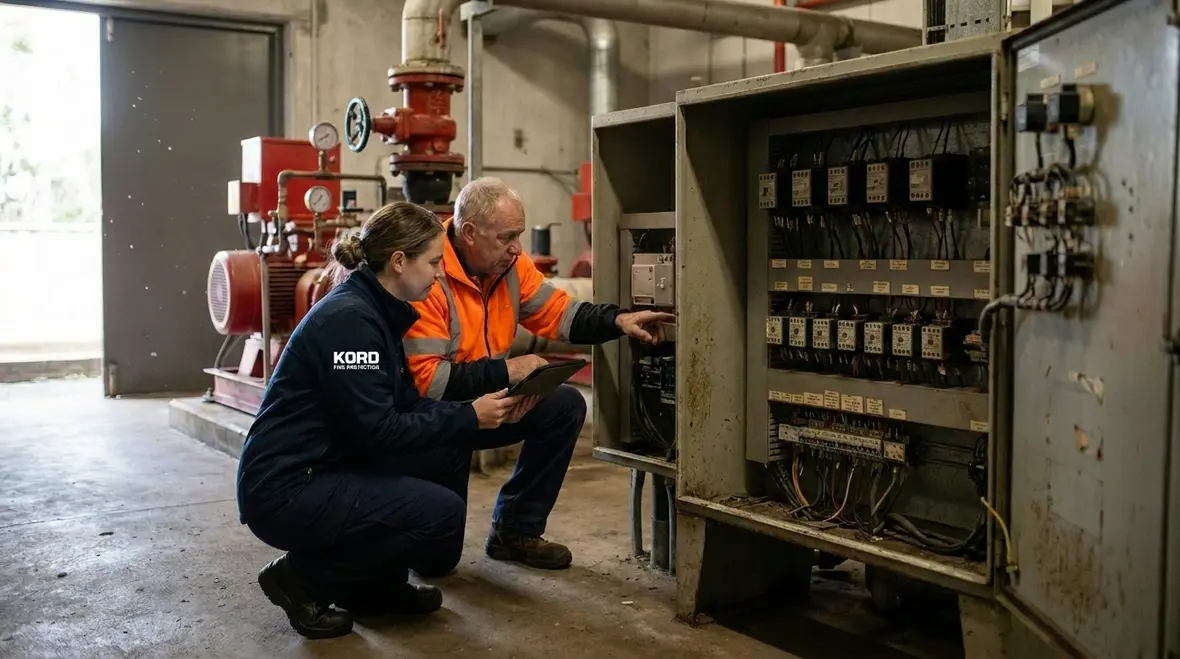
This is where disciplined service earns its keep. Replacing a worn component is sometimes necessary, but repeatedly replacing the same category of part without correcting the root cause is just expensive déjà vu. Careful attention to lubrication practices, alignment, flow conditions, and control logic cuts down repeat failures and gives uptime a fighting chance.
Kord Fire Protection as a reliability partner
Kord Fire Protection helps facilities shift from reactive patchwork to a structured reliability approach. For industrial, retail, and multi site commercial operations, this matters because the same problem can show up differently depending on local conditions and staffing. A partner team provides consistency: planned inspections, performance verification, and clear documentation that supports audits and internal governance.
Just as important, a strong service relationship improves response speed when issues appear. If a test shows a drift in performance, Kord Fire Protection can coordinate the right next steps based on evidence, not guesswork. Then facilities teams can keep their downtime minimal and their readiness high.
And when staff changes occur, documentation becomes the anchor. Pump systems stay the same, but people and responsibilities do change. Therefore, Kord Fire Protection supports continuity by tracking trends and maintaining records that show what happened, what was measured, and what was fixed. That reduces the “who knew?” moments that companies hate almost as much as a surprise audit.
Common pitfalls that shorten pump life in commercial facilities
Several patterns show up again and again. First, facilities sometimes delay corrections after minor findings. A small leak becomes a bigger leak. A temperature trend becomes a failure. Second, teams may skip suction area checks, then wonder why performance slips during tests. Third, they may overlook valve supervision, especially after renovations or maintenance on adjacent systems.
Another pitfall involves inconsistent record keeping. If technicians do not log measurements, trends disappear. Then troubleshooting turns into “let’s try replacing this” rather than “let’s fix the real cause.” Similarly, poor labeling and unclear access paths can slow response and increase the risk of incomplete work.
Finally, facilities sometimes treat pump rooms like storage space. When airflow drops or corrosion risk rises, the environment quietly damages equipment. When organizations take control of housekeeping and access, they protect both the system and the technicians who maintain it.
FAQ
Call Kord Fire Protection for a lifespan-focused plan
Commercial fire pump lifespan improves when maintenance turns into a measured reliability program. Kord Fire Protection helps commercial facilities plan inspections, verify performance, track trends, and correct root causes fast. If a pump system is already under strain, act now before wear becomes downtime.
Reach out to Kord Fire Protection to build a service plan that protects people, operations, and long term equipment value. The best time to fix reliability drift is before it introduces itself during an emergency. That is true for pumps, teams, and just about every other machine people swear they will “get to next week.”

Join Our Newsletter!
Get the latest fire safety tips delivered straight to your inbox From our Newsletter.