Bradbury Room Integrity Testing for Fire Safety
Room Integrity Testing in Bradbury: What It Involves
In Bradbury, safety is not left to chance. When facilities invest in fire suppression systems, they also rely on Bradbury room integrity testing to make sure those systems will perform when it matters most. Within the first moments of a fire event, a clean agent system must hold its concentration long enough to suppress flames. If the room leaks, the system fails. It is that simple. Fortunately, Kord Fire Protection technicians take the time to explain every step, translating technical detail into plain language that even the most spreadsheet loving facility manager can appreciate.
Although the process sounds complex, it follows a clear path. Moreover, it gives building owners confidence that their investment will protect lives, equipment, and operations. And yes, while it may not be as thrilling as a summer blockbuster, it plays a heroic role behind the scenes.

Why Room Integrity Matters for Fire Suppression Systems
Clean agent fire suppression systems rely on concentration. When activated, they release a gas designed to reduce oxygen or interrupt combustion. However, the gas must remain inside the protected enclosure for a specific hold time, usually ten minutes. If the room leaks through cracks, cable penetrations, or ceiling voids, the agent escapes. As a result, the fire may reignite.
Therefore, room integrity testing confirms that the enclosure can maintain that concentration. In Bradbury facilities such as data centers, server rooms, archives, and control rooms, even a brief failure could mean lost data, damaged hardware, or halted production. Consequently, this testing becomes a critical part of compliance with fire codes and insurance requirements. For a broader look at how this fits into overall clean agent protection, you can explore Kord Fire Protection’s guide on room integrity testing for clean agent systems and how it supports mission critical environments.
Kord Fire Protection technicians often explain it this way. Installing a clean agent system without testing the room is like buying a top of the line safe and leaving the door cracked open. It looks secure, but it does not do the job.
Room Integrity and Clean Agent Performance
Because clean agents behave similarly to air when it comes to leakage, even small gaps can drain concentration faster than expected. That means a room that looks solid on the outside may, in reality, perform more like a loosely sealed box. Without a quantified test, no one can say with confidence how long the agent will stay at the required level.
How Does Bradbury Room Integrity Testing Work?
This is the one question nearly every facility manager asks. Fortunately, the answer is straightforward.
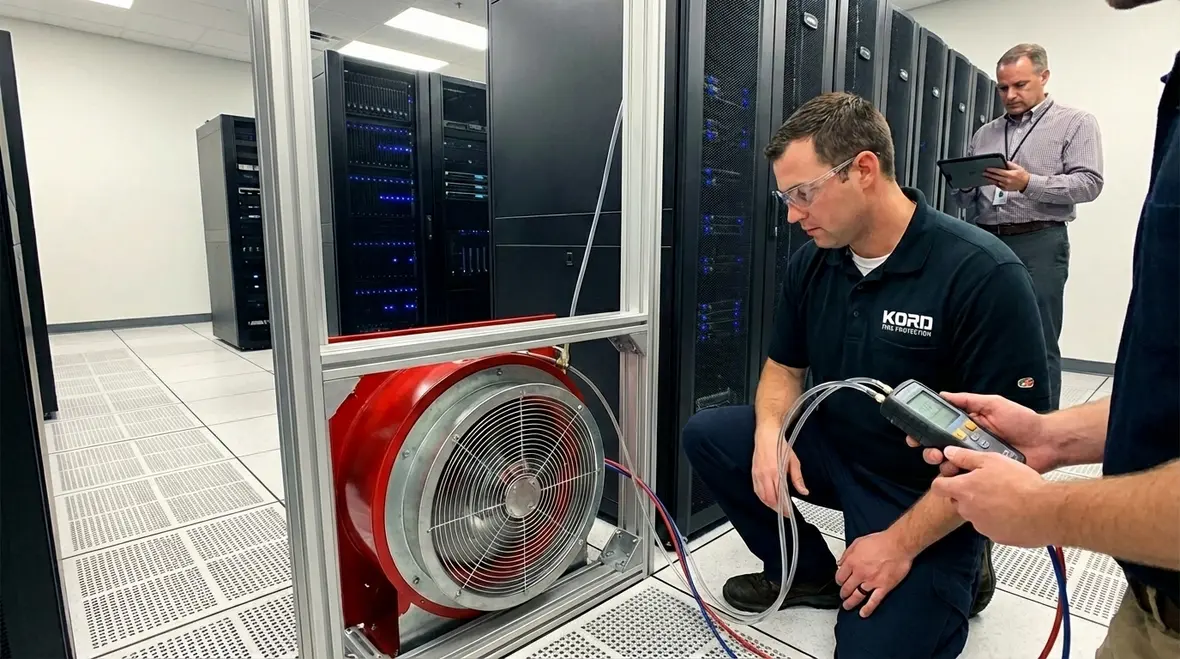
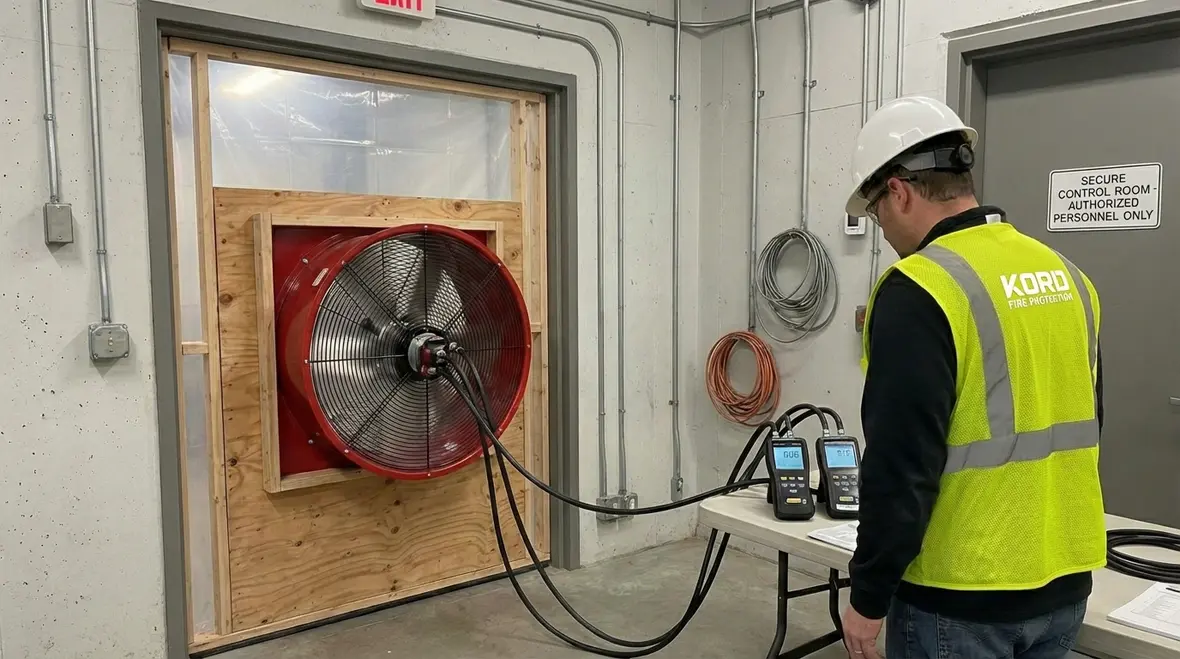
During Bradbury room integrity testing, technicians use a calibrated fan system mounted in a temporary doorway frame. The fan either pressurizes or depressurizes the room. Meanwhile, sensors measure the airflow required to maintain a specific pressure difference between the inside and outside of the enclosure.
Because air moves through every crack and opening, the test reveals how much leakage exists. Software then calculates the estimated hold time for the clean agent based on that leakage rate. If the projected retention time meets or exceeds code requirements, the room passes. If not, the report identifies areas that need sealing.
Kord Fire Protection technicians guide building staff through the results step by step. They explain what the numbers mean, where leaks commonly occur, and how corrective actions will improve performance. In addition, they answer questions without drowning anyone in jargon. It is technical, yes. But it is not mysterious.
From Fan Test to Action Plan
The true value of the test lies in the diagnosis it provides. A clear report shows whether the room currently meets the ten minute target and which leakage points matter most. That insight turns a vague concern about “air leaks” into a focused list of corrections that directly increase safety and reliability.
What Happens During a Typical Test Day
A successful test does not begin when the fan turns on. Instead, it starts with preparation.
Step 1: Pre-test Inspection and Setup
First, technicians inspect the enclosure. They check for obvious gaps around doors, cable trays, ductwork, and raised floors. Next, they confirm that the suppression system is in test mode to prevent accidental discharge. After that, they install the fan assembly securely in a doorway.
Step 2: Measuring Leakage and Hold Time
Once the equipment is set, the actual measurement phase begins. The fan gradually adjusts pressure while instruments record airflow and pressure levels. Meanwhile, smoke pencils or theatrical fog may help identify visible leaks. Yes, it can look a bit like a low budget rock concert. However, the purpose is precise.
Step 3: Reporting, Documentation, and Next Steps
Finally, technicians analyze the data using approved software. They generate a detailed report outlining pass or fail status, predicted hold time, and recommended improvements. Because documentation is critical for code compliance, this report becomes part of the facility safety records. Many Bradbury facilities also keep this report on file to support insurance audits and future system upgrades.
Common Leakage Points Found in Bradbury Facilities
Even well constructed rooms can leak. Over time, building movement, cable upgrades, and maintenance work create small gaps. Therefore, testing often reveals issues in places no one expected.
Below is a simplified two column overview that Kord Fire Protection technicians often review with clients.
Area
Cable penetrations
Drop ceilings
Door frames
HVAC ducts
Raised floors
Typical Issue
Unsealed openings around new data lines
Gaps above tiles allowing air escape
Worn weather stripping or misalignment
Dampers not closing tightly
Openings around conduits and supports
Because these issues often appear minor, they are easy to overlook. However, when combined, they can significantly reduce hold time. As a result, sealing even small gaps can dramatically improve room performance.
Compliance, Standards, and Local Expectations
Fire codes and standards such as NFPA 2001 require enclosure integrity verification for clean agent systems. Therefore, facilities in Bradbury must demonstrate that their protected rooms meet retention requirements. In many cases, authorities having jurisdiction request documented proof.
Moreover, insurance providers may require evidence of successful enclosure testing before offering coverage or favorable rates. Consequently, skipping this step can lead to higher costs or compliance issues.
Kord Fire Protection technicians stay current with applicable standards and local regulations. Because codes evolve, they ensure that each test aligns with the latest requirements. In addition, they help facility managers schedule retesting when modifications occur. For example, adding new cable runs or altering HVAC systems may affect room tightness. Therefore, periodic verification protects both compliance and operational continuity. For more context on how clean agent standards shape design, you can review Kord’s overview of the clean agent standard for fire suppression systems.
Room Integrity as a Code and Risk Management Tool
When room integrity testing and documentation are kept up to date, facility teams have a defensible record for fire marshals, insurers, and internal auditors. Instead of relying on verbal assurances, they can point to measured leakage, modeled hold times, and completed corrective actions.
Benefits Beyond Code Compliance
Although compliance drives many testing programs, the benefits extend further.
Avoiding Unnecessary System Upgrades
First, accurate testing can prevent unnecessary system upgrades. If a room fails, data from the test pinpoints exact leakage areas. As a result, targeted sealing often resolves the issue without expensive equipment changes.
Supporting Business Continuity
Second, testing supports business continuity. In environments such as data centers, downtime costs far more than the test itself. Therefore, confirming that suppression systems will function as designed protects revenue and reputation.
Building Confidence with Stakeholders
Third, the process builds confidence. Facility teams gain a clear understanding of how their enclosure performs. Meanwhile, executives gain documentation that demonstrates due diligence. And while no one throws a parade for a successfully sealed cable penetration, the quiet reliability it provides speaks volumes.
The Human Element Behind the Equipment
Technology plays a central role in room integrity testing. However, people make the difference.
Kord Fire Protection technicians approach each project with patience and clarity. They walk facility managers through the setup, explain the data in plain terms, and recommend practical solutions. Moreover, they understand that each building has its own quirks. A historic structure in Bradbury may behave differently from a modern server suite. Therefore, they adapt their approach while maintaining strict technical accuracy.
Clients often appreciate that the technicians treat questions with respect. No one is made to feel uninformed. Instead, the process becomes collaborative. Because safety depends on teamwork, that partnership mindset strengthens the overall protection strategy.
Frequently Asked Questions
Conclusion and Next Steps
Fire protection is not just about installing equipment. It is about ensuring that every component performs under pressure. Bradbury room integrity testing confirms that clean agent systems can do their job when seconds count. Therefore, facilities that value safety, compliance, and operational stability should not leave enclosure performance to guesswork. Contact Kord Fire Protection today to schedule an evaluation and gain the assurance that comes from a room built to hold the line.
If your facility in or near Bradbury also needs broader fire protection support, Kord offers full service solutions across Los Angeles County, including inspections, suppression, and testing services. You can explore nearby offerings such as Hawthorne fire protection services or request clean agent design and maintenance support through their clean agent fire suppression system services page. For Bradbury specific system planning, be sure to review local options including Bradbury fire protection services and integrate room integrity testing into your overall life safety strategy.
Know Your Weapon Before You Fight the Flame
Kord Fire Protection is your go-to when it comes to all things fire protection. For over 20 years, we’ve been serving Southern California with the quality service and equipment to keep your home or business safe at all times. Our competitive prices reflect our unwavering commitment to protecting what matters most in the event of a fire emergency. Give us a call, send an email, or use that form!

Join Our Newsletter!
Get the latest fire safety tips delivered straight to your inbox From our Newsletter.