
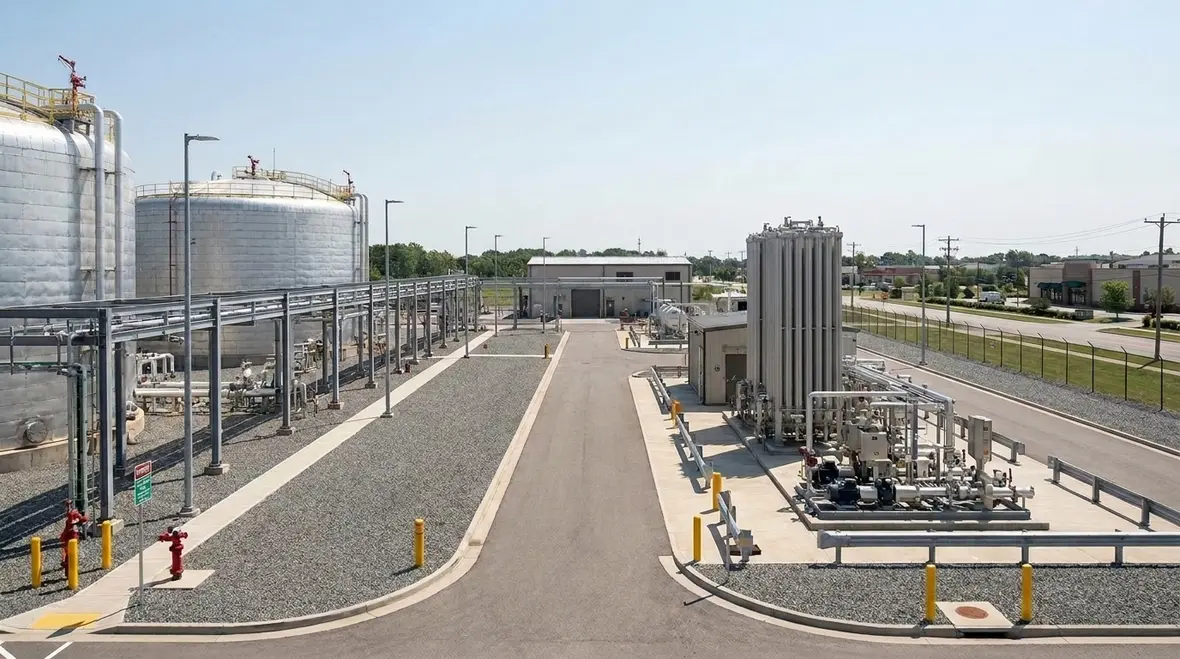
NFPA 52 Section 19.7: Separation Distances for LNG Facilities
Quick Answer
NFPA 52 Section 19.7 sets how to separate LNG equipment and related hazards from boundaries, occupied buildings, public ways, and other facilities. The rules drive risk control for fire, explosion, and heat exposure. Compliance depends on accurate siting, documentation, and maintained protective features.
For teams building a stronger documentation trail around inspection readiness, ITM fire protection inspection testing maintenance is a practical companion to LNG separation compliance because spacing only works when the protective features and records behind it stay current.
Why NFPA 52 LNG facility separation distance requirements matter in real deployments
Commercial LNG facilities rely on engineered spacing to reduce the consequences of credible releases, pool fire impingement, jet fire exposure, and heat radiation. NFPA 52 LNG facility separation distance requirements are not a paper exercise. They directly influence how facilities are laid out, how construction is phased, and how operators manage ongoing condition through inspections, maintenance, and change control.
In practice, facilities often encounter separation challenges when assets are upgraded, when adjacent properties develop, or when operational envelopes change, for example, updated vapor dispersion assumptions or new transfer operations. These issues create common gaps between the as built layout and the as operated risk profile, which is where enforcement and costly redesign can begin.
What Section 19.7 actually governs: separation for hazards and exposure pathways
NFPA 52 Section 19.7 addresses separation distances within LNG installations to mitigate the effects of LNG hazards. The core intent is to keep potential targets out of harmful regions created by likely fire and thermal exposure scenarios associated with LNG. This includes separation that protects:
- Nearby buildings and occupied areas
- Public or adjacent property exposures
- Other process equipment and fire compartments within the facility
- Vertical and horizontal siting relationships that govern radiant heat and incident energy
Separation is typically tied to hazard classification and scenario consequence outcomes, including the presence of barriers, attenuation effects, and the ability of the site to prevent or limit escalation. As a result, the “distance” requirement must be evaluated with the facility’s design basis, not treated as a fixed number that survives every change.
Compliance workflow: how sites demonstrate they meet separation distances
NFPA 52 compliance for separation distances usually requires a repeatable workflow that ties together design documentation, field verification, and operational controls. Typical steps include:
1) Establish the design basis and hazard mapping
Facilities should maintain a clear record of the LNG inventory basis, equipment list, operating modes, and the scenarios used to define heat and hazard reach. This is where teams often fall short. When scenario assumptions are outdated, the distances validated in original drawings may no longer represent the current risk.
2) Verify as built geometry against drawings
Field verification should include more than a quick tape measure. Separation distances depend on reference points and credible release and exposure locations. Common failure points include incorrect coordinate datum on site plans, relocated equipment during construction, and missing revision history in the asset register.
3) Confirm protective features that influence consequence control
Separation distances interact with site features such as berms, fireproofing strategies, shielding elements, and the effectiveness of detection and emergency response provisions. Even when the site meets a distance target, degradation in protective features can change outcomes. Maintenance and testing records should therefore be part of the separation compliance file, not kept separately.
4) Implement change control and inspection triggers
Separation distance compliance must survive changes. Facilities should use triggers such as:
- New construction on adjacent land
- Relocation or replacement of LNG pumps, vaporizers, transfer hoses, or tanks
- Changes to operating pressure, flow rate, or transfer frequency
- Modifications to barriers, shielding, or access/egress layouts
These are the moments when risk assessments and documentation updates should occur before the field configuration diverges from the regulatory basis.
Operational and inspection realities that affect separation distance outcomes
Separation distances are only as effective as the systems and conditions that support them. Commercial and industrial LNG sites often experience compliance drift through operational wear, administrative gaps, and delayed corrective actions.
Common failure points that undermine separation
- Equipment drift and relocation: Replacement modules sometimes change footprint or elevation without updating hazard mapping and spacing documentation.
- Barrier impairment: Berm integrity, shielding panels, or protective coatings can deteriorate, changing how radiant heat transmits.
- Detection and emergency response latency: If detection, alarm processing, or response staging is slower than the assumptions used in the design basis, consequences can increase.
- Housekeeping and ignition control: Accumulated combustible materials near critical spacing zones can add fuels that extend fire duration.
- Documentation gaps: Drawings, inspection plans, and as built surveys may not align with the equipment list and current operating configuration.
Why maintenance records belong in the separation compliance file
Separation is a passive protection strategy, but it is not standalone. Inspections for integrity of surfaces, barriers, and protective features should be scheduled and tracked with evidence. Testing for related safety systems also matters because it affects the real-world time profile of releases and fire development. For many facilities, the fastest path to defensible compliance includes a unified audit trail tying separation documentation to inspection and test outcomes.
How Kord Fire Protection supports separation distance compliance long term
Kord Fire Protection helps commercial LNG facilities maintain the conditions that separation distance requirements rely on. The most effective programs do not just “inspect.” They verify that the site configuration, inspection testing, and corrective actions remain consistent with the regulatory basis over time.
For example, Kord can support ongoing compliance through structured inspection planning, documentation readiness, and maintenance coordination for fire and life safety systems that influence hazard mitigation outcomes. Teams can also use Kord’s approach to strengthen audit readiness and reduce the likelihood of separation documentation becoming detached from field reality.
If you want to align your compliance program with operational evidence standards, review fire protection services in Southern California for ways to maintain commercial fire protection performance and documentation discipline.
Frequently Asked Questions
Take action now to protect compliance and reduce redesign risk
Confirm your LNG facility’s as built geometry, validate that your separation documentation still matches current operations, and ensure related protective features and test records remain current. Partner with Kord Fire Protection to build an evidence driven maintenance and inspection program that supports defensible NFPA 52 separation compliance and reduces late discovery during audits or incidents.

Join Our Newsletter!
Get the latest fire safety tips delivered straight to your inbox From our Newsletter.


