Sprinkler System Piping Corrosion: Early Detection and Control
Commercial facilities depend on sprinkler systems. When sprinkler system piping corrosion forms, it can slow water flow, weaken pipe walls, and increase the chance of failures during a fire. The good news is that corrosion can be identified early and managed with smart inspections, correct coatings, and careful water control.
Quick actions matter. A facility team that detects early scale, pinholes, or pressure drops, then corrects the cause, keeps systems reliable. And if the job is complex, Kord Fire Protection can step in as a vital partner for inspection support, repairs, and ongoing protection planning.
Now, let’s walk through how corrosion shows up, how professionals spot it, and what to do before it turns into an expensive “oops.” If your team is already reviewing broader fire protection services for commercial properties, corrosion control fits naturally into that bigger readiness plan. ([kordfire.com](https://kordfire.com/full-fire-protection-services/?utm_source=openai))
Why sprinkler system piping corrosion becomes a business risk
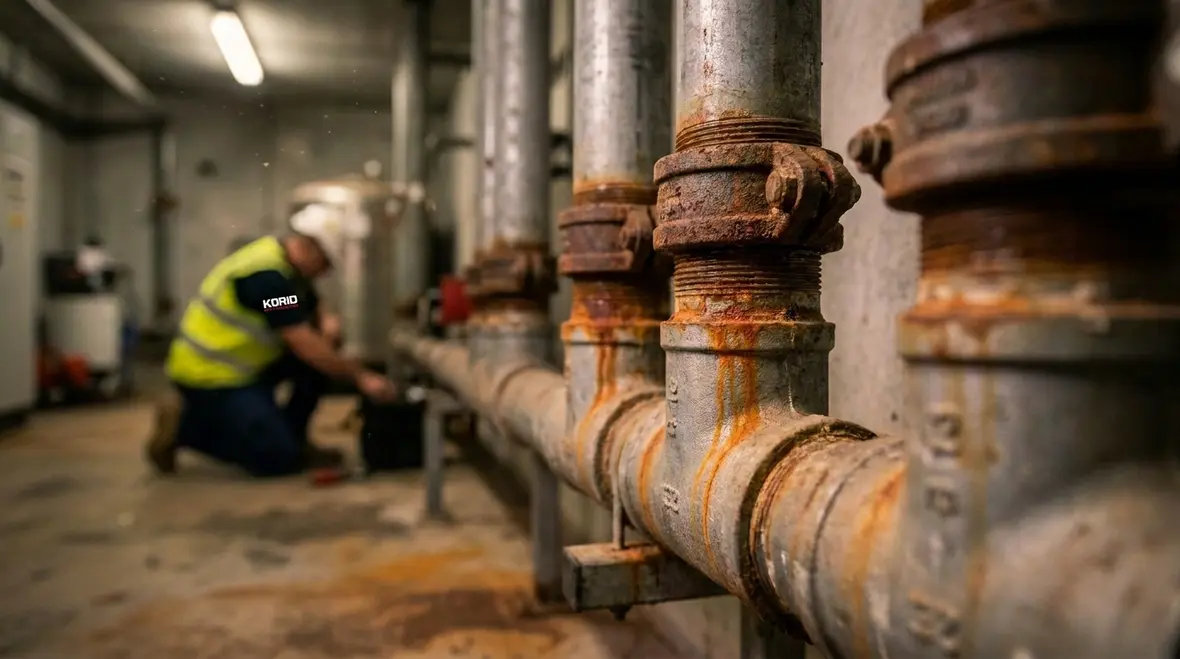
In commercial sites, corrosion rarely announces itself with a dramatic scene. Instead, it builds quietly inside pipes where water chemistry, moisture, and system design work against the metal. Over time, sprinkler system piping corrosion can reduce internal diameter, create rough surfaces that increase friction, and trigger leaks at joints and threaded connections. Kord Fire’s own guidance on internal corrosion points to pitting, scale buildup, thinning metal, and weeping joints as early warning signs that deserve attention before they become failures. ([kordfire.com](https://kordfire.com/fire-sprinkler-pipe-corrosion-signs-causes-and-prevention/?utm_source=openai))
Furthermore, once corrosion accelerates, maintenance costs rise fast. For facilities across retail, industrial, hospitality, education, and multi site campuses, downtime costs feel real because a sprinkler outage affects compliance, risk exposure, and operations. Therefore, the best approach treats corrosion control as a reliability program, not a one off repair. Kord Fire also frames corrosion prevention in large facilities as a planning issue tied to water quality, trapped air, mixed materials, and long pipe runs rather than random bad luck. ([kordfire.com](https://kordfire.com/fire-sprinkler-corrosion-prevention-in-large-facilities/?utm_source=openai))
In plain terms, corrosion turns a life safety system into a maintenance project. And nobody wants that kind of surprise, unless the venue is a comedy club and the punchline is “we missed the early signs.”
Why the risk grows quietly
The real problem is that performance can drift long before anyone sees a dramatic leak. Minor flow restriction, residue at test points, or recurring dampness around fittings may look small on their own. Together, they suggest the inside of the system is changing. That is why early detection saves both money and stress.
Where corrosion starts in commercial sprinkler lines
Different environments create different corrosion patterns. Therefore, the inspection plan must match the building reality. For example, humid environments, temperature swings, stagnant water, and trapped air can all push corrosion harder. In Kord Fire’s related corrosion articles, technicians repeatedly connect internal attack to oxygen, water quality, air intrusion, minerals, and areas where moisture lingers longer than it should. ([kordfire.com](https://kordfire.com/fire-sprinkler-pipe-corrosion-signs-causes-and-prevention/?utm_source=openai))
Common starting points include the following:
- Threaded joints and couplings, where crevices trap water and debris
- Low points, where water sits and forms deposits
- Crossovers and hangers, where condensation can persist
- Areas with trapped air, which can change how water contacts the pipe wall
- Sections near fasteners, where galvanic effects can begin
Additionally, corrosion may appear as surface pitting, flaking scale, discolouration, or hardened tuberculation. Yet the system might still pass basic visual checks. That is why professionals combine visual inspection with pressure and flow awareness, and they check for patterns that repeat across similar pipe runs.
Hot spots worth watching
If a building has older threaded sections, known water quality issues, or a history of black water during maintenance, those areas deserve extra attention. Kord Fire’s article on corrosion and black water makes it clear that discoloured water is not just ugly, it often signals underlying oxidation and sludge buildup inside the system. ([kordfire.com](https://kordfire.com/corrosion-and-black-water-in-fire-protection-piping/?utm_source=openai))
How to identify corrosion without guessing
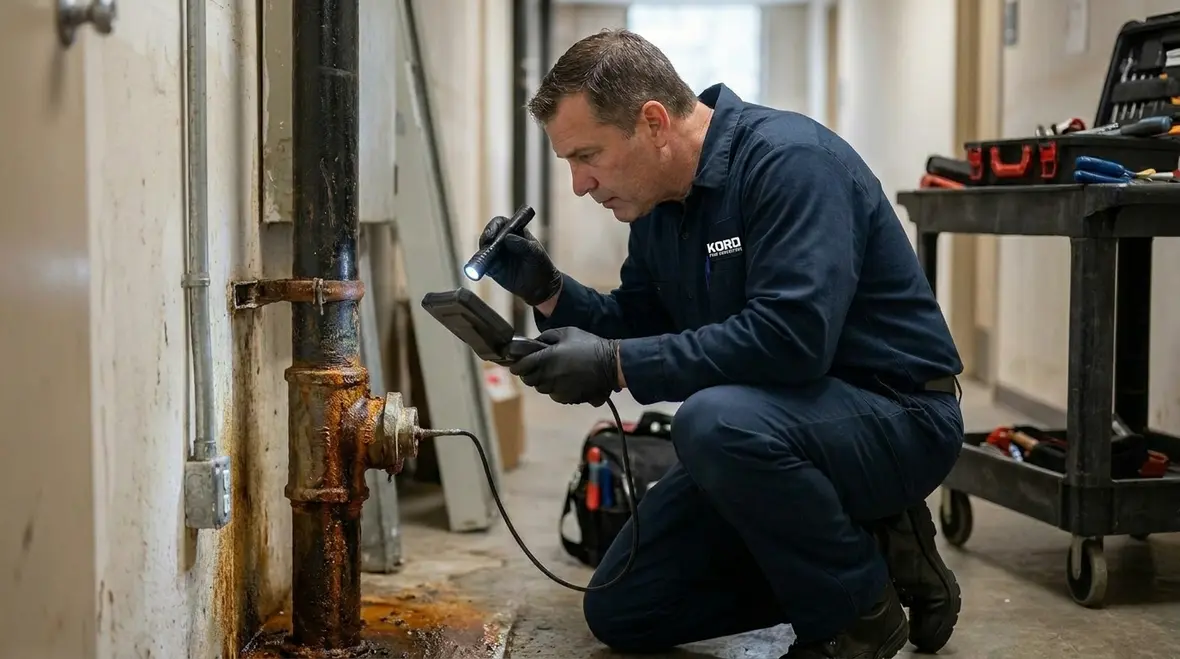
Facilities teams should avoid the “hope it’s fine” method. Instead, they should run a structured evaluation that links signs to causes. First, technicians review history: maintenance records, previous leak reports, water treatment notes, and inspection findings. Then they walk the system and look for physical indicators.
During inspection, they typically look for these signals:
- Visible rust trails around fittings, valves, and supports
- Discoloured water or residue at test locations
- Evidence of seepage, especially at threaded connections
- Reduced flow or minor pressure issues during functional tests
- Corrosion “halos” where the pipe wall has thinned around a contact point
Next, professionals may use internal inspection methods when access and risk justify it. If the site has a history of contamination or water quality issues, deeper checks can prevent hidden losses in pipe thickness. However, technicians must balance access limits with safety and service disruption.
At this stage, partnering matters. Kord Fire Protection can support a coordinated approach, aligning inspection, compliance needs, and practical repair planning so facilities do not juggle multiple vendors and dates like a circus act. Teams that want a broader company background can also review About Kord Fire Protection to understand the full service scope behind that support. ([kordfire.com](https://kordfire.com/about-fire-protection/?utm_source=openai))
Mitigation steps that stop corrosion from coming back
Repairing damaged sections helps, but it does not always solve the cause. Therefore, mitigation must address both the symptom and the driver of corrosion. The goal is simple: stop the environment from attacking the pipe wall, then restore reliable performance.
Mitigation commonly includes these measures:
- Targeted pipe replacement for sections with measurable deterioration or repeated leaks
- Use of compatible materials so new components do not create new corrosion paths
- Joint and connection upgrades to reduce crevice hold and water trapping
- Protective coating or system upgrades where conditions support it
- Water quality control through coordinated treatment and monitoring
In addition, technicians should clean lines when appropriate, but they should do it safely and with a plan to avoid blocking hazards. Then they verify system performance after work completes, so the facility knows the job restored the original intent of the sprinkler design. Kord Fire’s service page specifically notes support for corrosion control and pipe flushing as part of broader sprinkler readiness work. ([kordfire.com](https://kordfire.com/full-fire-protection-services/?utm_source=openai))
Because corrosion can shift locations over time, facilities benefit from a schedule that fits their risk profile. Humidity, industrial processes, maintenance routines, and long periods of stagnant water all influence how often inspections should occur.
It is like checking the pantry. You can rearrange the shelves all you want, but if the humidity keeps coming in, the problem returns. Corrosion control works the same way.
Common mistakes that make corrosion worse
Several errors show up on real sites, and they usually come from rushing, skipping documentation, or misunderstanding the system. First, some teams patch leaks without evaluating the nearby pipe condition. As a result, the repair holds for a short period, then nearby sections fail because the underlying corrosion still accelerates.
Next, facilities sometimes apply coatings or materials that do not match existing pipe types. That mismatch can create galvanic action. Furthermore, if the system sees repeated contamination or poor water quality, any repair becomes a short term fix.
Other mistakes include:
- Delaying inspections until a leak forces attention
- Relying on surface rust only, instead of checking patterns and performance
- Ignoring low point drainage and the way water collects
- Overlooking supports that trap moisture against the pipe
- Skipping post repair verification and documentation
When teams avoid these errors, they lower risk and protect budget. And when they work with experienced fire protection partners, they keep the sprinkler system reliable for the next inspection cycle, not just the next calendar month.
Working with Kord Fire Protection for corrosion control
For many commercial sites, the sprinkler system is not a single job. It is ongoing service, compliance support, testing, documentation, and repairs over time. That is why sprinkler system piping corrosion work benefits from a dedicated fire protection partner who understands life safety systems end to end.
Kord Fire Protection can support facilities by helping teams plan inspections, coordinate repairs, and maintain accurate records that support audits and ongoing compliance. Also, because corrosion mitigation often ties into broader system readiness, Kord can help align the work with how the building actually operates. Kord’s official company page describes fire sprinkler service among its core offerings, and its full services page highlights inspections, testing, repairs, retrofits, and related system support. ([kordfire.com](https://kordfire.com/about-fire-protection/?utm_source=openai))
In a practical sense, that means fewer surprises on site. Fewer “who owns this issue?” conversations. And a clearer pathway from detection to repair to verification. In other words, less chaos, more control.
Maintenance planning for commercial facilities
Corrosion control works best when it is planned. Therefore, facilities should build a schedule that includes visual checks, functional testing alignment, and targeted inspections based on risk factors like water quality, location, and system age.
Recommended planning elements include these actions:
- Create a corrosion risk map across critical zones and high exposure areas
- Set inspection intervals that match building environment and history
- Track findings with clear documentation for trend analysis
- Coordinate repair timing with minimal disruption to operations
- Verify system performance after mitigation work closes
Additionally, facilities should train maintenance staff to recognise early signs. Small observations matter: a recurring damp patch at a support, a repeated residue in test areas, or new discolouration at joints. When these notes feed into professional inspections, corrosion control becomes a team sport instead of a reactive firefight.
FAQ
Final call to action
Commercial sprinkler system reliability depends on early detection and smart mitigation of sprinkler system piping corrosion. If a facility team wants clear next steps, it should schedule a professional inspection and build a risk based maintenance plan.
Kord Fire Protection can help coordinate inspection, repairs, and verification so compliance stays strong and operations stay steady. Reach out to start the process and reduce the odds of “surprise” failures when it matters most. If helpful, your team can also learn more about the company through Kord Fire Protection’s background and service approach. ([kordfire.com](https://kordfire.com/about-fire-protection/?utm_source=openai))

Join Our Newsletter!
Get the latest fire safety tips delivered straight to your inbox From our Newsletter.