Smart Fire Alarm Panel Connectivity for Rapid Response
Quick Answer: Fast fire response starts with reliable Smart fire alarm panel connectivity. By using clean network design, tight device addressing, secure integrations, and planned failovers, sites can route alarms, alerts, and updates to the right teams in seconds. In Australia, kord fire protection helps standardize, test, and maintain these systems.
In industrial and commercial spaces across Australia, seconds matter. When fire indicators trigger, people need clear instructions, not a tech mystery. That is why Smart fire alarm panel connectivity deserves real attention, not a last minute “it works on test” shrug. When the wiring, network, and reporting paths align, alarms travel faster, fewer things get lost in translation, and response teams act with confidence. In the rest of this article, a facilities lead, contractor, or safety manager can see how to optimize connectivity for rapid response, while kord fire protection can serve as a vital partner to keep it reliable over time.
For teams building or refining these systems, it also helps to connect this topic with Kord Fire’s fire alarm services near the start of planning, because installation, inspections, monitoring, and maintenance all shape how well connectivity performs once the system is live. ([kordfire.com](https://kordfire.com/fire-alarm-service-systems/?utm_source=openai))
Why rapid response depends on connectivity that actually performs
Fire panels may detect events locally, but modern sites need more than detection. They need fast communication to duty staff, monitoring services, building management, and sometimes evacuation systems. If connectivity stutters, response slows, and the system becomes a “sometimes” alarm. And nobody wants a safety system that behaves like a streaming service with buffering.
When Smart fire alarm panel connectivity works well, it supports three things at once. First, it keeps event data intact, including device identity and location. Second, it ensures priority routing, so critical alerts do not wait behind routine updates. Third, it helps remote visibility, so supervisors can verify what triggered and guide next steps. As a result, teams reduce guesswork and avoid time waste, which improves compliance and safety outcomes.
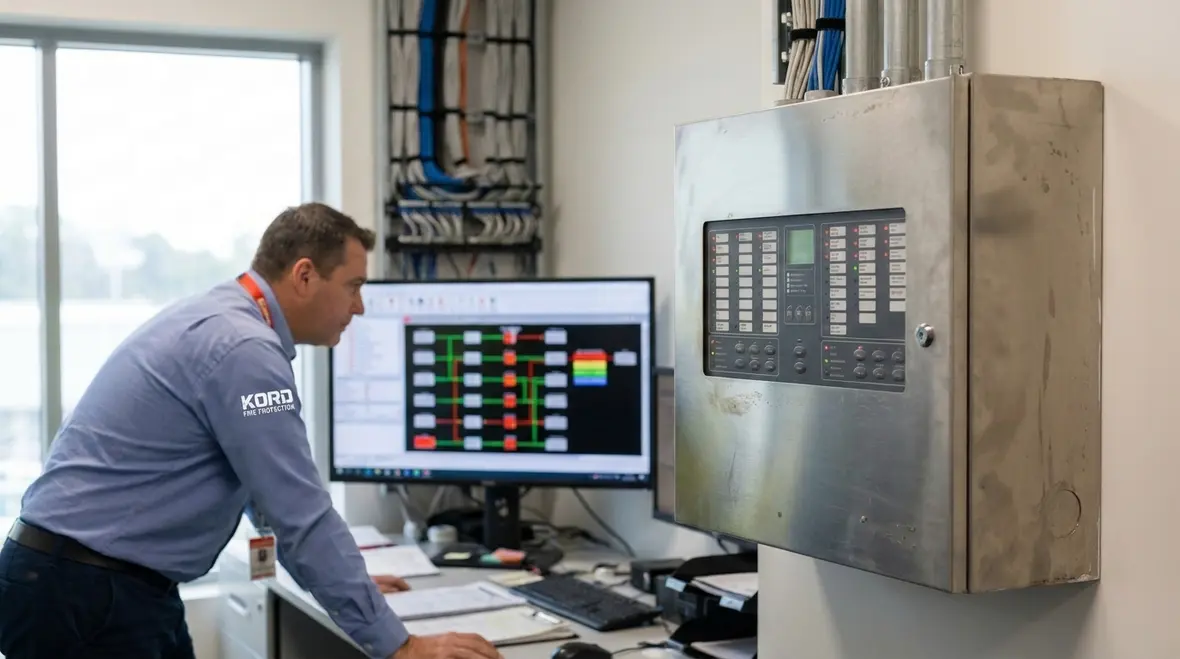
That logic lines up closely with Kord Fire’s discussion of connected panels sharing alarm events, device health, and status data with central platforms used by facilities, security, and service teams. The point is not to make the building feel futuristic for the sake of it. The point is to help the right people see the right signal fast enough to act on it. ([kordfire.com](https://kordfire.com/fire-protection-system-connectivity-with-smart-building-integration/?utm_source=openai))
Map the alarm paths before upgrading anything
Before any change, the job starts with a clear map of how alarms move. This includes panel to monitoring, panel to workstation, panel to BMS, panel to IP devices, and any interface to third party systems. Then the team confirms what happens during normal operation, during a communication outage, and during a power fault. That is where many projects stumble. They focus on the panel but ignore how the message gets delivered.
A practical approach looks like this. First, list each receiving endpoint and define what it must show. Second, confirm how locations get displayed, such as floor, zone, and device type. Third, document timings, like how quickly a remote alarm screen updates. Finally, review logging and acknowledgement flows, because a fast signal that cannot be acknowledged wastes time.
By doing this up front, the site avoids rework and prevents “connectivity upgrades” that break older reporting assumptions.
What a useful alarm path map should capture
- The originating panel, loop, or interface point
- Every destination that receives alarm, trouble, and supervisory data
- How the receiving endpoint labels floors, zones, and device types
- Expected update timing during normal conditions and during outages
- How operators acknowledge, escalate, and document each event

Design network stability so alerts never wait in line
Connectivity optimization often boils down to network discipline. Instead of relying on vague “it has internet” statements, the team should control latency, packet loss, and congestion points. Fire signals should sit on predictable paths and use settings that prioritize critical traffic.
Key actions typically include separating traffic where appropriate, using managed switches, and setting stable addressing. Additionally, the team should avoid unnecessary hops between panel and key receivers. If the alarm data has to travel through too many intermediary systems, it can slow down or fail in unexpected ways.
Also, the job should include a plan for link redundancy. If one route fails, another must take over without confusing the panel event state. During real incidents, confusion is the enemy. So the system should behave consistently, even when hardware does not.
Secure integrations without slowing event delivery
Smart sites integrate alarms with monitoring platforms, building management, and sometimes access control. However, security adds steps. That is fine, as long as it does not delay alarms. The goal is to protect data and access while keeping event delivery quick and predictable.
Teams should implement secure communications, strong authentication, and controlled permissions. At the same time, they must verify that encryption and handshakes occur in ways that do not stall event propagation. When engineers test this, they should simulate realistic conditions, such as intermittent network interruptions and delayed responses from remote services.
In the real world, a fire event should not depend on someone approving a login at the last second. So, the system must be set up to work automatically, securely, and reliably.
Kord Fire’s smart integration guidance makes a similar point: the smart layer should share information, not replace the core life safety logic inside the certified fire equipment. That separation helps sites modernize visibility without letting convenience features trip over emergency performance. ([kordfire.com](https://kordfire.com/fire-protection-system-connectivity-with-smart-building-integration/?utm_source=openai))
Reduce false delays with device addressing and monitoring logic
Even with a strong network, poor device planning can slow response. Smart fire alarm panel connectivity includes the “human readable” layer. If the system identifies an alarm as “something somewhere,” teams lose time. Therefore, the job should standardize device addressing, zone naming, and location conventions across the site.
Next, the monitoring logic should handle the right priorities. For example, a device report should not get treated like a low priority status message. Instead, the integration should ensure that alarms jump to the top of the queue for receiving consoles and duty managers. Then the system should log events so supervisors can review what happened, what the panel reported, and what the receiving endpoint acknowledged.
When this is done properly, crews do not waste minutes verifying what triggered. Instead, they move. And if they move faster, the safety outcome improves.
| Optimization Area | Rapid Response Impact |
|---|---|
| Clean network routing and priority traffic | Helps alarms reach consoles with less latency and fewer dropped messages |
| Stable addressing and consistent naming | Speeds recognition of location and device, reducing on scene confusion |
| Redundancy and failover testing | Maintains alarm delivery during link or component issues |
| Secure integration checks | Protects systems without delaying event propagation |
| Logging, acknowledgement, and review workflows | Improves accountability and shortens time to confirm response actions |

How kord fire protection supports continuity after installation
Most connectivity problems do not appear the day the system goes live. They show up later, when changes happen, devices get replaced, networks get reconfigured, or new integrations get added. That is where a partner becomes valuable. kord fire protection can act as a vital partner by helping teams keep Smart fire alarm panel connectivity aligned with the real operation of the site, not just the original design.
In practical terms, that partnership can include routine verification, scheduled inspections, and structured testing of communication paths. When the team checks that alarms still reach monitoring and workstations as intended, it catches drift early. It also confirms that naming conventions and zone mapping remain consistent after any upgrades.
And because Australia has varied facility types, from large retail chains to industrial warehouses and complex commercial sites, support matters across multiple facets of operations. kord fire protection helps keep those systems current, so connectivity does not become tomorrow’s surprise.
That ongoing support theme appears throughout Kord Fire’s fire alarm resources, including monitoring guidance and related blog articles collected in the Kord Blog. Their fire alarm monitoring pages also emphasize behind the scenes signal handling that helps make sure the right notification chain starts when trouble strikes. ([kordfire.com](https://kordfire.com/what-is-fire-alarm-monitoring-and-how-it-works/?utm_source=openai))
Test like an incident is already happening
Testing should not be a checkbox exercise. It should be an incident style exercise. Teams can validate end to end delivery by simulating alarm events, verifying panel reporting, and confirming what consoles and logs receive. Then they should test how the system behaves during partial failures, such as a dropped connection to a receiver or a delayed service response.
Finally, they should document outcomes and close gaps. If a delay occurs, the team should identify where it happens, such as in network routing, integration processing, or endpoint display. After that, the system updates and retests until behavior meets the performance goal.
Yes, it takes time. But so does calling someone at 2 a.m. to ask why the alarm screen is blank. That call is always a bad comedy sketch. The testing prevents it.
A practical test routine for rapid response performance
- Trigger representative alarm, trouble, and supervisory events
- Verify exact labels, locations, and timestamps at each receiving endpoint
- Simulate partial failures such as dropped links or slow remote services
- Confirm acknowledgements, escalations, and logging behavior
- Retest after adjustments until the response path is consistent
FAQ
CTA: Lock in fast, reliable response with expert support
Smart fire alarm panel connectivity should deliver alarms quickly today and stay consistent tomorrow. A site gains peace of mind by mapping alarm paths, designing stable networks, securing integrations without delays, and testing like an incident is real.
To keep all of it performing across industrial, retail, and commercial facilities in Australia, engage kord fire protection for ongoing verification and continuity support. Get the right partner on board and reduce risk before the moment arrives.

Join Our Newsletter!
Get the latest fire safety tips delivered straight to your inbox From our Newsletter.