Redundant Emergency Fire System Power for Commercial Sites
Quick Answer: Redundant power strategies for commercial life safety systems keep critical equipment running when the grid fails, sags, or gets noisy. Facilities typically use layered backup like utility, transfer switches, UPS, battery banks, and generators, plus smart monitoring. Kord Fire Protection can partner to design, test, and maintain the full system.
Picture this: the main supply dips, alarms should scream, smoke control should respond, and exit paths must stay lit. If the emergency fire system power falters, the whole plan collapses faster than a pop quiz on a Monday morning. That is why commercial facilities build redundancy into power for life safety systems. In the pages ahead, they will see how redundancy works in real buildings, how teams avoid common failure points, and how Kord Fire Protection can become a vital partner when the job spans design support, commissioning, and ongoing service. For sites reviewing their broader alarm setup, fire alarm service systems support can fit naturally into the same long term reliability strategy. Facilities with industrial needs can also explore Irwindale fire alarm systems for industrial safety when redundancy planning extends to large operational spaces.
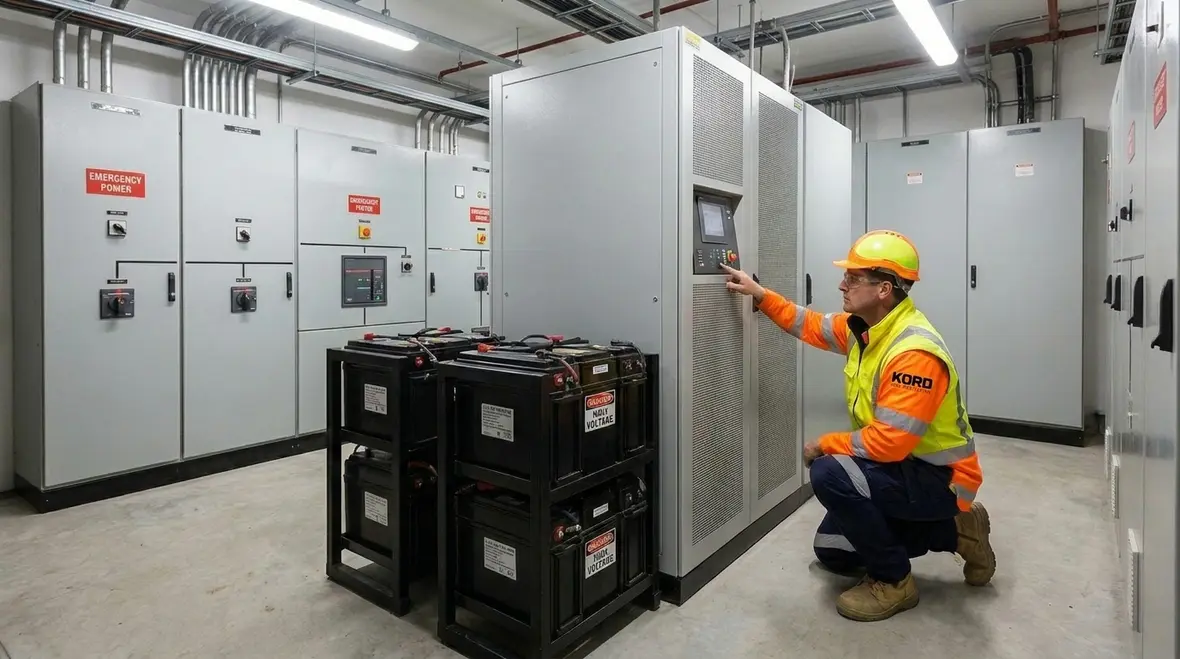
How redundant power protects life safety systems
Redundant power does not just mean “more batteries.” It means layered protection so a single fault does not stop the job. Commercial life safety systems include fire alarms, voice evacuation, smoke detection, and in many sites, fire pumps, door release modules, and related controls. When they plan redundancy well, the equipment gets stable power even during outages, brownouts, switching events, or equipment failures.
Moreover, redundancy buys time and confidence. Therefore, it helps teams meet performance expectations during emergencies. And yes, emergencies tend to arrive with less notice than a surprise cameo at the office party. The practical goal is simple: keep critical devices awake, stable, and ready while the rest of the building may be dealing with electrical chaos. In real facilities, that means separating mission critical loads from convenience loads, documenting the intended power path, and making sure everyone from the electrician to the service technician understands how the sequence is supposed to behave.
This matters because life safety systems are not judged by how they perform on a calm Wednesday afternoon. They are judged when the lights blink, the building gets noisy, and people need clear signals immediately. A redundant design gives the system more than a backup. It gives it a second chance, and sometimes a third, which is exactly what they want when stakes are high and patience is low.
Common power events that break non redundant setups
Many failures happen without a full blackout. Utilities can experience brief voltage dips, frequency changes, surges, or brief interruptions that reset sensitive electronics. In warehouses and retail zones, electrical loads can also spike when refrigeration compressors start or motors cycle. Consequently, systems that run on a single supply can drop out or reboot at the worst moment.
In addition, transfer mechanisms can fail if they rely on outdated wiring, incorrect load calculations, or poor maintenance. Even if the equipment is fine, loose terminations or corroded connections can create a “ghost fault” that shows up only during stressful conditions. That is why teams treat power reliability as a life safety requirement, not an afterthought.
Another common problem is false confidence. A building may appear healthy because nothing has failed during ordinary use, yet nobody has tested it under realistic switching conditions. Then an outage arrives, the transfer event stutters, a panel resets, and suddenly the site learns that “probably fine” is not a real engineering method. If that sounds harsh, good. Fire protection has never been the ideal place for wishful thinking.
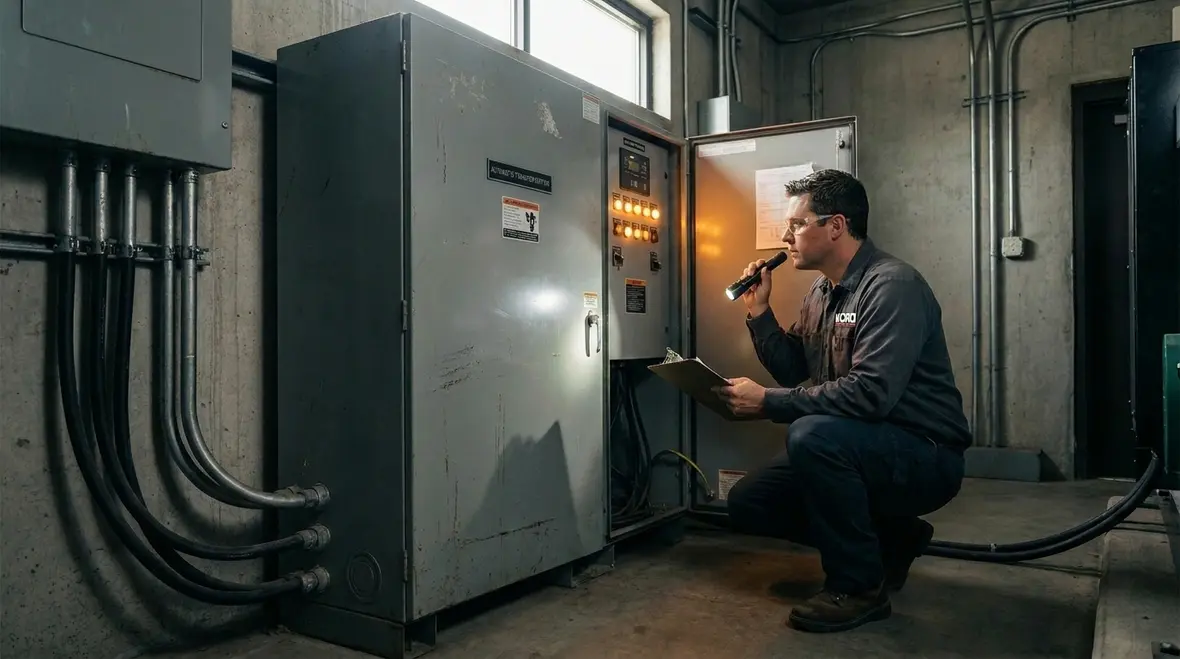
Layered architecture: utility, UPS, batteries, and transfer switches
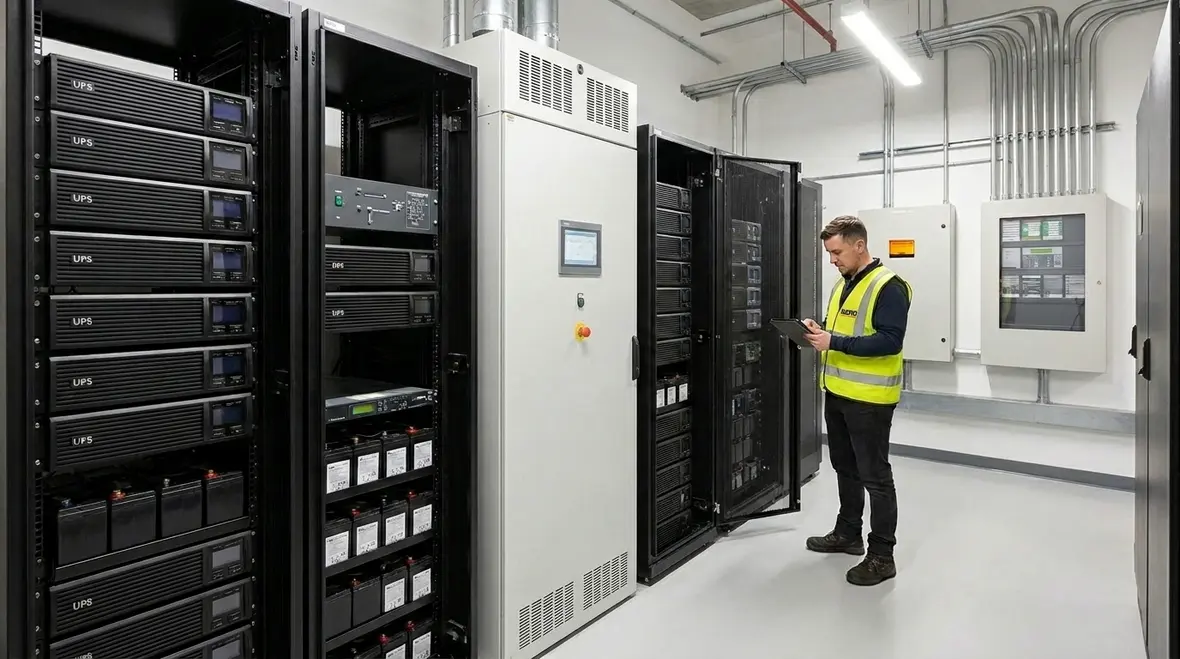
A strong redundant power strategy uses layers that cover different failure modes. Typically, facilities keep the main utility feed as the first line. Next, they add an uninterruptible power system to handle fast interruptions and clean up voltage issues. Then they back it with battery banks sized for the required hold up time. Finally, they design transfer paths so critical circuits switch safely to backup power during outages.
When done properly, each layer fills a specific gap. For example, a UPS covers the micro gaps that can occur during switching. Meanwhile, generators cover longer outages. At the same time, correct distribution design prevents “single breaker” problems where one device can take down multiple life safety loads.
Also, facilities should separate circuits where appropriate. Doing so reduces the chance that a non critical load drags down the same panel feeding emergency fire system power components. In other words, they do not want the exit signage to share luck with a storefront server rack.
What each layer actually does
The utility feed handles normal operation, but it is only the start of the story. A UPS smooths out dirty power and bridges split second interruptions. Batteries provide standby capacity for the equipment tied to them. Transfer switches move selected loads to alternate sources. Generators cover the long haul when an outage drags on beyond what battery support can reasonably sustain. The magic is not in owning all these parts. The magic is in making them cooperate.
- Utility service supports daily operation under normal building conditions
- UPS equipment carries the short gaps and cleans up unstable incoming power
- Battery banks sustain alarm and control loads for required standby periods
- Transfer switches move essential circuits safely to alternate sources
- Generators support extended outages when short term backup is no longer enough
Design choices that reduce switching risk
Switching events can introduce risk if the design ignores real world behavior. Therefore, engineers and technicians focus on transfer switch type, switching time, and load compatibility. They also verify that the UPS and generator logic work together instead of fighting each other like rival movie villains.
Key design actions include these:
- Break down life safety loads by priority, so only the necessary circuits ride through each stage
- Select transfer equipment that supports the required interruption time and power quality
- Use correct cable sizing and routing to reduce voltage drop and interference
- Verify grounding and bonding so sensitive panels do not see unwanted noise
- Plan for inrush currents so fans, pumps, and control systems start cleanly
Furthermore, commissioning matters. A plan that looks perfect on paper can fail in the field if test procedures do not match the real configuration. Proper testing proves the system transitions as intended when they simulate faults.
Teams also benefit from identifying what absolutely must stay online versus what merely would be nice to keep running. This keeps backup capacity focused on life safety first. Once that hierarchy is clear, they can write test scripts that mirror actual operating conditions, confirm alarms report correctly, and verify that recovery after the event is just as smooth as the transfer itself. Because yes, coming back from backup power can create its own drama if nobody planned for the return trip.
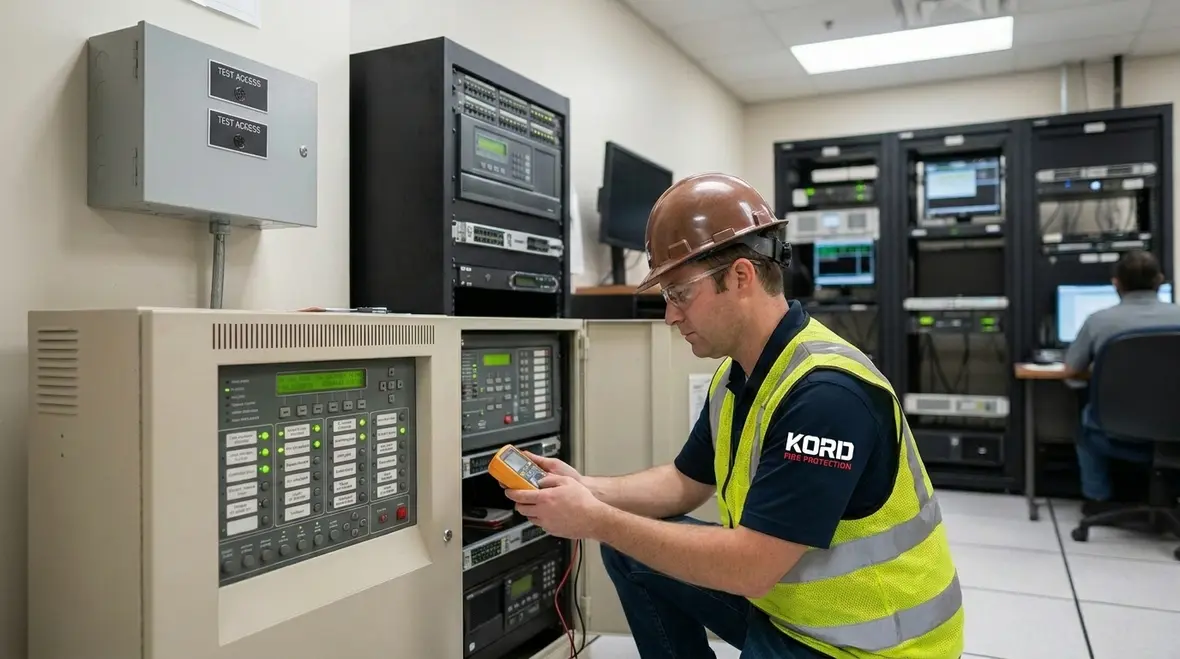
Monitoring, test access, and service records that stand up
Redundancy only helps if it stays healthy. That is why monitoring and scheduled testing form the backbone of an effective approach. Facilities should track battery condition, UPS output health, charger performance, and transfer switch operation. When teams use alarms and status signals that feed back to supervision, they catch issues early rather than waiting for an emergency.
Also, test access must be practical. If maintenance staff cannot safely test under real conditions, they will either delay testing or conduct it poorly. Therefore, they should design maintenance friendly locations for panels, terminal blocks, and test points.
When Kord Fire Protection supports the job, they can help ensure the documentation and service cadence match the actual equipment plan. In addition, they can coordinate system checks so the emergency fire system power network stays consistent with the alarm and detection strategy already in place. That partnership reduces gaps between fire design intent and on site reality.
Service records matter for another reason too. They create a timeline of what changed, what was tested, and what passed or failed. Without that trail, troubleshooting becomes a guessing contest with expensive consequences. With it, teams can spot battery decline, repeated transfer anomalies, charger drift, or nuisance resets before those patterns turn into emergency failures. Good records may not look glamorous, but neither does explaining to leadership why a preventable fault slipped through because nobody wrote anything down.
Where redundant power pays off in commercial sites
Commercial buildings face a mix of grid behavior, weather impact, and load patterns unique to retail, industrial, and mixed use facilities. For example, a retail centre has many small loads that change throughout the day. Meanwhile, an industrial facility has large motor loads and heavy starting currents. Both environments can challenge life safety electronics unless the power design accounts for the site profile.
In practice, redundant power helps sites meet operational expectations during:
- Local outages caused by utility switching or storm events
- Voltage dips that reset panels and control boards
- Maintenance activities where power must remain safe and stable
- Unexpected equipment failures where one component cannot shut down the whole chain
Additionally, the power plan should align with the facility’s fire safety strategy, including how alarms, evacuation messaging, and controls interact. That is the part that often gets overlooked when teams focus only on equipment names and not on how they behave together. And yes, equipment can have excellent resumes but still perform badly as a team.
How Kord Fire Protection becomes a vital partner
Redundant power is only one piece of the life safety puzzle. Kord Fire Protection can help facilities treat power reliability as part of the overall fire and emergency response system. They can support system understanding, coordination during commissioning, and service that keeps the emergency fire system power chain dependable over time.
Specifically, their involvement helps teams:
- Align power redundancy with alarm, detection, and control supervision needs
- Coordinate practical testing so transitions and reporting match the design
- Maintain records that support audits and continuous compliance
- Reduce rework by addressing field realities early
Here is one way teams often organize responsibilities during a project. It keeps communication clear and avoids the classic “who owns the batteries” debate that can turn a simple job into a long lunch.
| Project area | Typical focus |
| Power design and standby | UPS, batteries, transfer switching, generator coordination, load calculations, testing plan |
| Fire and life safety integration | Fire alarm circuits, supervision, interfaces, evacuation control, commissioning checks tied to system logic |
| Service and upkeep | Status monitoring, battery health checks, UPS performance, scheduled tests, documented findings |
FAQ about redundant power strategies
Conclusion
Redundant power strategies keep commercial life safety systems ready when the grid does not behave. By combining utility, UPS, batteries, transfer switching, monitoring, and strong testing, facilities reduce the risk of shutdowns during outages and dips. The result is a system that performs more reliably under pressure and gives building teams a clearer path for maintenance, upgrades, and emergency response.
If this job involves fire systems, interfaces, and ongoing compliance, Kord Fire Protection can support the full lifecycle with a steady, professional hand. From design coordination to practical testing and ongoing service, the goal is dependable performance without unnecessary drama. Reach out to plan a redundancy and maintenance approach now, before the next power event decides to make itself the main character.

Join Our Newsletter!
Get the latest fire safety tips delivered straight to your inbox From our Newsletter.