
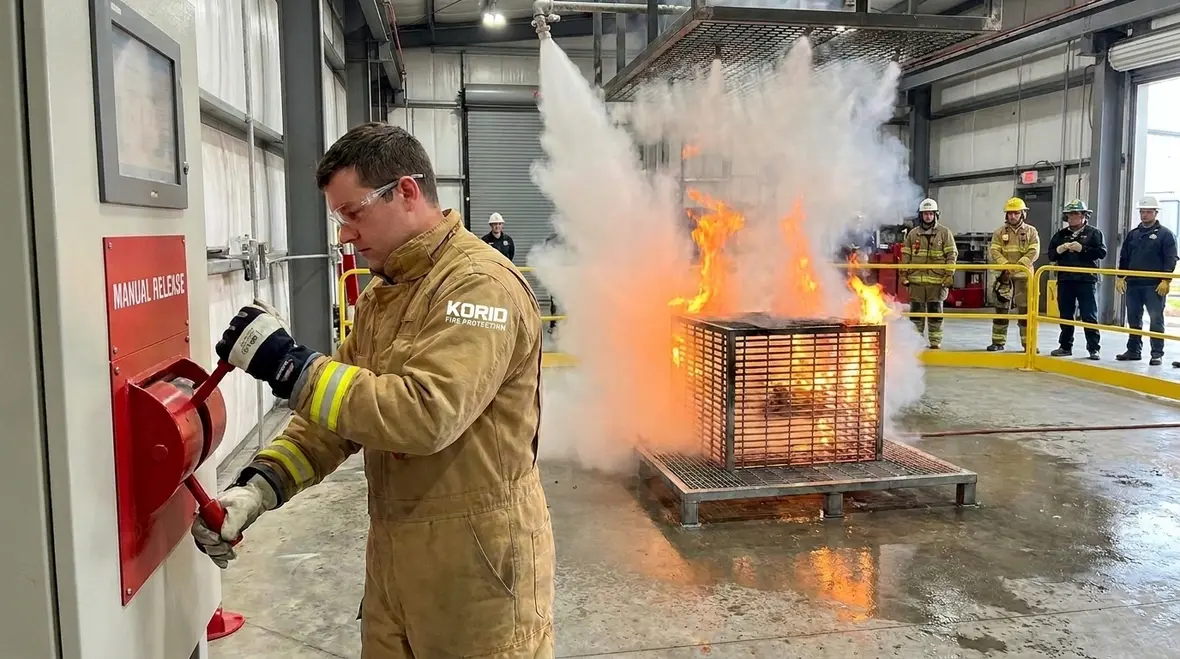
NFPA 18A Section 7.4: Three-Dimensional Fuel Fire Test for Manual Application
Quick Answer
NFPA 18A Section 7.4 describes how to evaluate a suppression system using a three-dimensional fuel fire test when the system is manually applied. The method verifies realistic fire behavior, correct agent delivery, and reliable performance under practical operating conditions.
For facilities building a stronger maintenance and compliance plan around these hazards, commercial fire suppression systems and services can help connect testing expectations with inspection, repair, and long-term readiness.
What NFPA 18A 3D Fuel Fire Test Manual Application Actually Verifies
In commercial fire protection engineering, NFPA 18A 3D fuel fire test manual application matters because it targets real-world suppression reliability. Section 7.4 focuses on whether a manual actuation process can deliver the fire-extinguishing performance required for a three-dimensional fuel fire scenario. Unlike simpler studies that may only confirm component operation, the three-dimensional test checks system integration: actuation timing, agent discharge characteristics, coverage consistency, and the ability to control and suppress the target fire.
Facilities typically implement manual activation where automated initiation cannot meet operational needs, where zoned control is required, or where the hazard profile demands human confirmation prior to discharge. In these cases, compliance and safety depend on how consistently trained personnel can trigger the correct sequence and how the system responds under the test conditions.
Scope and Test Intent Under Section 7.4
Section 7.4 emphasizes three-dimensional fuel fire conditions to reflect how burning fuel can expand, spread, and interact with suppression agent application in a spatially complex environment. The test intent aligns with key engineering questions:
- Does manual actuation initiate the correct control sequence without excessive delay?
- Does the agent discharge reach the intended envelope of the burning fuel?
- Does the system overcome early-stage flame development and sustain suppression long enough to prevent reflash?
- Do operational variables, such as actuation location and operator workflow, affect performance?
For commercial, industrial, and retail facilities, this verification is especially important where fuels, ignition sources, or process geometry create non-uniform fire behavior. Common examples include flammable liquid storage and handling areas, equipment bays with complex layouts, and loading or service spaces where manual intervention is practical.
For broader code context and compliance support, organizations can review NFPA codes and guidelines solutions for fire protection and life safety.
Manual Application Workflow: Where Compliance Usually Fails
Manual application introduces a human and operational layer that automated systems may not face. NFPA 18A 3D fuel fire test manual application requires the system to perform as designed when actuated manually, which means the full workflow must be tested and maintained.
1) Actuation readiness and sequence control
Manual systems often include control panels, manual release stations or valves, status indications, and interlocks that ensure the discharge sequence only runs under safe and intended conditions. Common failure points include out-of-tolerance component behavior, tamper conditions, mispositioned valves, or interlocks that prevent release during a test scenario.
2) Operator workflow and time-to-initiate
Even when the hardware functions, manual response can degrade if personnel do not follow standardized steps. Facilities should ensure operators understand:
- Where the actuation devices are located and how access is maintained
- How to identify the correct hazard zone or application control
- What the system indications mean before and after actuation
Auditors frequently see performance gaps when training is informal or when maintenance schedules change staffing and shift coverage without updating training records. A robust compliance program ties training frequency and verification to the facility’s risk and operating schedule.
3) Discharge timing, pressure, and agent availability
Manual operation does not excuse mechanical limitations. If discharge timing or pressure does not match the tested profile, suppression can fall short. Typical technical contributors include:
- Degraded cylinders or compressors, including pressure loss or valve issues
- Blocked nozzles or filters that restrict agent flow
- Delays from control logic settings, annunciation delays, or unintended interlock states
- Improper alignment of discharge direction or distribution components
For commercial sites, these issues often surface during seasonal shutdowns, construction changes, or post-repair reassembly where configuration details get overlooked.
Equipment Mechanisms and Inspection Requirements That Support Section 7.4
Successful outcomes in a three-dimensional fuel fire test depend on system mechanics that must remain stable between maintenance cycles. Facilities should treat Section 7.4 readiness as a maintenance-driven performance target, not a one-time acceptance event.
Distribution and application hardware
The physical arrangement of discharge devices, manifolds, piping runs, and nozzle or outlet components affects how suppression agent interacts with the fuel geometry. Inspections should confirm that:
- Discharge pathways are free of obstructions, contamination, and corrosion
- Nozzles and distribution devices maintain correct orientation and coverage patterns
- Recent renovations did not introduce changes to ceiling obstructions, partitions, or airflow that alter agent delivery
Control components and actuation stations
Manual actuation stations, associated wiring, and control panels must function as an integrated release system. Kord Fire Protection typically validates that system status indicators match expected states and that annunciation, release authorization, and discharge initiation operate within the tested tolerances.
Agent integrity and mechanical performance
Agent systems depend on stored energy or pressurization mechanisms. Inspections and maintenance should address:
- Pressure monitoring and cylinder health checks
- Valve seals, maintenance history, and evidence of leakage
- Operational verification of release components without compromising reliability
Commercial facilities often need maintenance documentation that demonstrates continuity of performance, especially when auditors request evidence of inspection intervals, corrective actions, and post-repair verification.
Test Preparation and Operational Controls Before a 3D Fuel Fire Test
Preparation influences results. Even when equipment is correctly designed and installed, practical test conditions can distort outcomes if operational controls are weak.
Pre-test coordination and hazard controls
Before testing, teams should confirm that the site is configured to support safe and repeatable performance. This includes securing access routes, establishing fire watch coverage, confirming ventilation assumptions, and ensuring test fuel handling follows approved procedures. Where manual application devices are located in areas that can become obstructed during emergency conditions, access planning becomes part of compliance.
Configuration verification and change management
Because Section 7.4 evaluates integrated behavior, facilities should conduct a configuration audit immediately before the test to confirm that:
- Any recent construction or equipment changes did not alter the hazard layout
- Interlocks and control settings remain in the authorized configuration
- Distribution hardware retains the same configuration as the test basis
Change management is a frequent compliance pressure point in retail and industrial settings, where maintenance windows and contractors operate on tight schedules. Kord Fire Protection supports commercial owners and operators by aligning inspection, maintenance, and verification steps with the hazards and system configuration that the test depends on.
How to Document Compliance and Maintain Audit-Ready Records
NFPA 18A Section 7.4 outcomes should be traceable to system documentation and maintenance records. Documentation should show that the manual actuation pathway and discharge performance remained within expected parameters.
Audit-ready documentation typically includes:
- Inspection and maintenance schedules, logs, and corrective action reports
- Records of component condition checks tied to system release performance
- Training records for personnel responsible for manual application
- Configuration change records, including post-maintenance verification outcomes
When records are incomplete, auditors and insurers often require additional testing or remediation, which increases downtime and operational disruption. A structured program reduces surprises and supports safer, faster compliance decisions.
Frequently Asked Questions
Next Step: Build Section 7.4 Test Readiness Into Ongoing Service
Facilities that treat manual application performance as an ongoing maintenance standard reduce compliance risk and minimize operational downtime. Kord Fire Protection can help owners and operators confirm that manual actuation pathways, distribution hardware, agent integrity, and documentation stay aligned with the performance expectations tied to NFPA 18A 3D fuel fire test manual application. Contact Kord Fire Protection to schedule a readiness review, corrective action plan, and audit-ready maintenance documentation.

Join Our Newsletter!
Get the latest fire safety tips delivered straight to your inbox From our Newsletter.



