
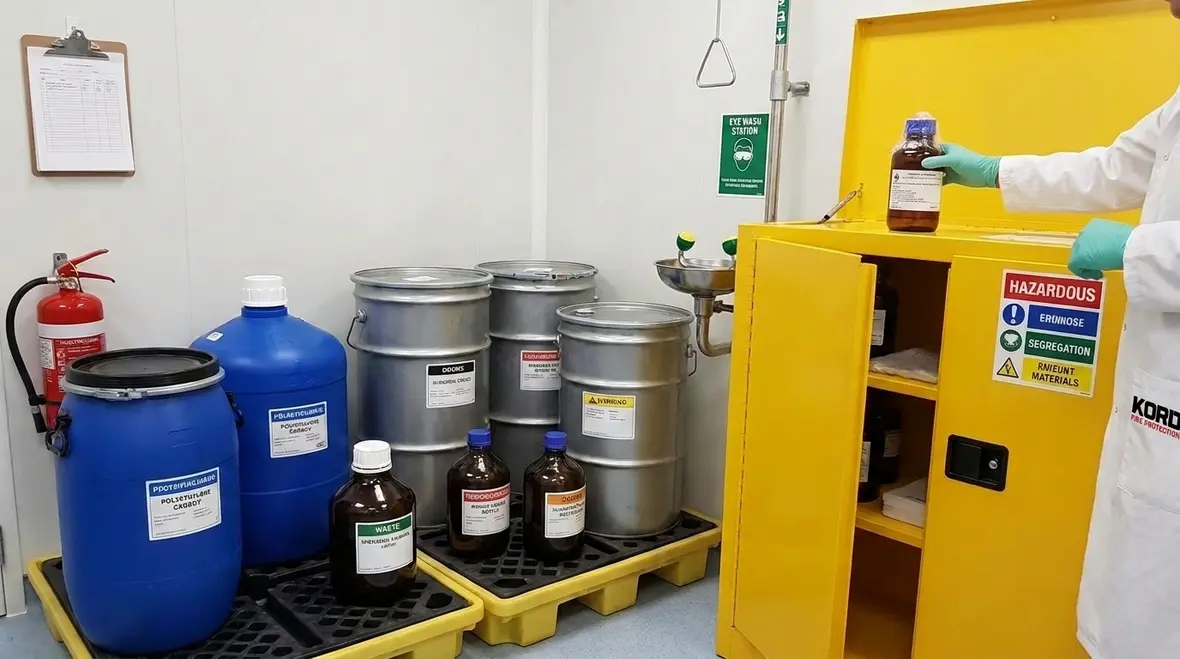
NFPA 45 Section 8.4: Chemical Waste Handling and Disposal
Quick Answer: NFPA 45 Section 8.4 sets practical fire and life safety expectations for how laboratories collect, store, label, and dispose of chemical waste. It focuses on hazard control before waste leaves the work area, including container integrity, compatible storage, and safe removal procedures for NFPA 45 laboratory chemical waste disposal programs.
For broader inspection readiness and ongoing system support, facilities can also review Kord Fire Protection’s fire protection services guide to connect laboratory waste controls with site-wide inspection, testing, and maintenance planning.
What NFPA 45 Section 8.4 Requires for Chemical Waste
NFPA 45 Section 8.4 addresses the controls that reduce fire, exposure, and escalation risks created by accumulating chemical waste. For commercial and industrial facilities, this section operates as a bridge between daily lab operations and the broader fire protection strategy. It assumes that waste is not treated like generic trash. Instead, it requires structured handling that keeps incompatibles separated, maintains container integrity, and uses disposal workflows that prevent uncontrolled releases.
From an operational standpoint, NFPA 45 laboratory chemical waste disposal programs succeed or fail based on routine behaviors: how staff label containers, how waste is staged, how long it sits before removal, and how the facility verifies safe conditions over time.
How Waste Is Collected: Containers, Labeling, and Compatibility
Section 8.4 emphasizes that waste collection must prevent leaks, corrosion, and dangerous chemical reactions. In practice, facilities typically implement the following controls:
- Approved container types: Use containers intended for chemical waste service, selected for chemical compatibility, sealing reliability, and physical stability.
- Primary container integrity: Ensure lids remain closed, valves or pour points function properly, and containers show no bulging, cracking, or corrosion.
- Accurate labeling: Labels must identify waste contents clearly enough to support safe storage and disposal decisions, including hazard-relevant identifiers.
- Compatibility management: Segregate waste by chemical classes and reactivity profiles so that storage does not create ignition sources, reactive heat, or toxic gas potential.
- Containment and spill control readiness: Keep secondary containment or absorbent systems available where waste is generated, sized to manage credible small releases.
Common failure points: unlabeled or “temporary” containers, mismatched container materials, and cross contamination during staging. These failures often appear during peak throughput periods when staffing is tight or waste pickup schedules are inconsistent.
Where Waste Is Stored: Control of Accumulation and Segregation
NFPA 45 Section 8.4 drives facilities to manage accumulation rather than allowing waste to become a long term storage condition. Commercial laboratory environments often struggle with this due to workflow realities. When waste removal logistics lag, waste staging areas become de facto storage areas without the safeguards expected for that duration.
Segregation controls that withstand real audits
Effective chemical waste staging uses physical and procedural controls. For example:
- Spatial separation: Designated areas and distance controls that prevent contact between incompatible waste streams.
- Secondary containment: Bunded or tray based arrangements to limit spread from container leaks.
- Container orientation and closure: Storage configurations that reduce valve leakage and cap loosening.
- Lot or stream tracking: Waste handling documentation that aligns with labeling and pickup schedules.
Time and volume controls
Facilities should treat waste staging as time sensitive. A robust NFPA 45 laboratory chemical waste disposal program defines maximum reasonable accumulation periods and sets trigger points for pickup based on volume or hazard class. When these triggers are missing, the facility often finds itself with oversized waste volumes that increase the potential severity of an incident.
Disposal Workflow: Pickup, Transfer, and Avoiding Release Events
Section 8.4 requires safe transfer practices that reduce the likelihood of container damage during movement and prevent releases during staging transitions. For commercial, industrial, and retail facilities that operate shared laboratory spaces, disposal workflow consistency becomes a major compliance factor.
Transfer practices that reduce risk
- Movement controls: Staff should use carts or approved handling equipment to prevent drops, impacts, and cap damage.
- Inventory and verification: Confirm container condition and labeling prior to pickup.
- Route planning: Use safe paths that avoid high traffic congestion and minimize time the waste is exposed in transitional spaces.
- Loading protections: Protect containers from tipping, vibration damage, and contact with incompatible materials in transport.
- Post transfer closure: Confirm the waste staging area returns to a controlled state with correct segregation maintained.
Commercial compliance challenge: Waste pickup often involves multiple vendors and recurring schedule changes. When the facility does not align internal staging rules with vendor requirements, labeling errors and delayed pickups become frequent corrective actions.
Inspection and Maintenance: Turning Section 8.4 into Measurable Performance
NFPA 45 Section 8.4 expects facilities to maintain controls, not simply document them once. A measurable inspection program helps commercial operators demonstrate ongoing conformance.
What to include in recurring inspections
- Container condition checks: Verify closure mechanisms, absence of leaks, and signs of chemical attack.
- Label verification: Confirm waste identity matches actual contents and hazard communication requirements.
- Segregation verification: Confirm incompatibles remain separated, and secondary containment is intact.
- Spill preparedness: Ensure spill kits and compatible absorbents are available, within service condition, and sized appropriately.
- Staging area housekeeping: Check for residual waste, mixed containers, and obstructed access to controls and emergency equipment.
Where maintenance work typically fails
Maintenance failures often appear in secondary containment systems, absorbent inventory control, and inspection documentation gaps. Containers might pass a quick visual check but still have compromised seals, hardened residues, or degraded cap materials that increase leak probability over time.
Kord Fire Protection supports commercial facilities by providing inspection, testing, and maintenance planning that aligns fire protection life safety systems with daily compliance realities. For ongoing assurance, a coordinated service approach reduces the likelihood of “paper compliance” that falls apart during walkthroughs.
To strengthen broader fire and life safety readiness alongside your waste program, Kord Fire Protection can also help with site-wide systems planning. See Kord Fire Protection.
Implementation Playbook: Building an NFPA 45 Laboratory Chemical Waste Disposal Program
Facilities typically see the best results when they implement Section 8.4 controls as an operational system with clear ownership and feedback loops.
Step 1: Define waste streams and hazard classes
Standardize how waste is categorized, including compatibility groupings. Train staff to apply consistent labeling and segregation rules even when formulation details change.
Step 2: Establish staging area rules and limits
Write clear rules for what may be staged, where it may be staged, and how long it can remain before scheduled removal. Include audit-friendly triggers tied to volume, hazard category, and occupancy conditions.
Step 3: Standardize transfer and verification
Use checklists at container closeout and pickup. Require verification of label accuracy, container condition, and segregation integrity prior to moving waste out of the lab area.
Step 4: Audit continuously, not annually
Run frequent internal checks and track corrective actions. Focus corrective efforts on repeat offenders such as labeling omissions, container compatibility issues, and segregation drift.
Step 5: Integrate with maintenance and emergency readiness
Ensure spill response materials, containment arrangements, and access pathways remain available. Align training with credible release scenarios that could arise from container failure during routine handling.
Frequently Asked Questions
Conclusion: Take Action on Section 8.4 Controls Now
NFPA 45 Section 8.4 succeeds when chemical waste handling becomes a repeatable, auditable operating system: compatible containers, accurate labeling, controlled accumulation, and disposal workflows that minimize release events. Facilities should review staging limits, verify segregation practices, and tighten inspection frequency to catch failure points early. For commercial readiness beyond checklists, partner with Kord Fire Protection to support ongoing testing, inspections, and maintenance planning.

Join Our Newsletter!
Get the latest fire safety tips delivered straight to your inbox From our Newsletter.



