
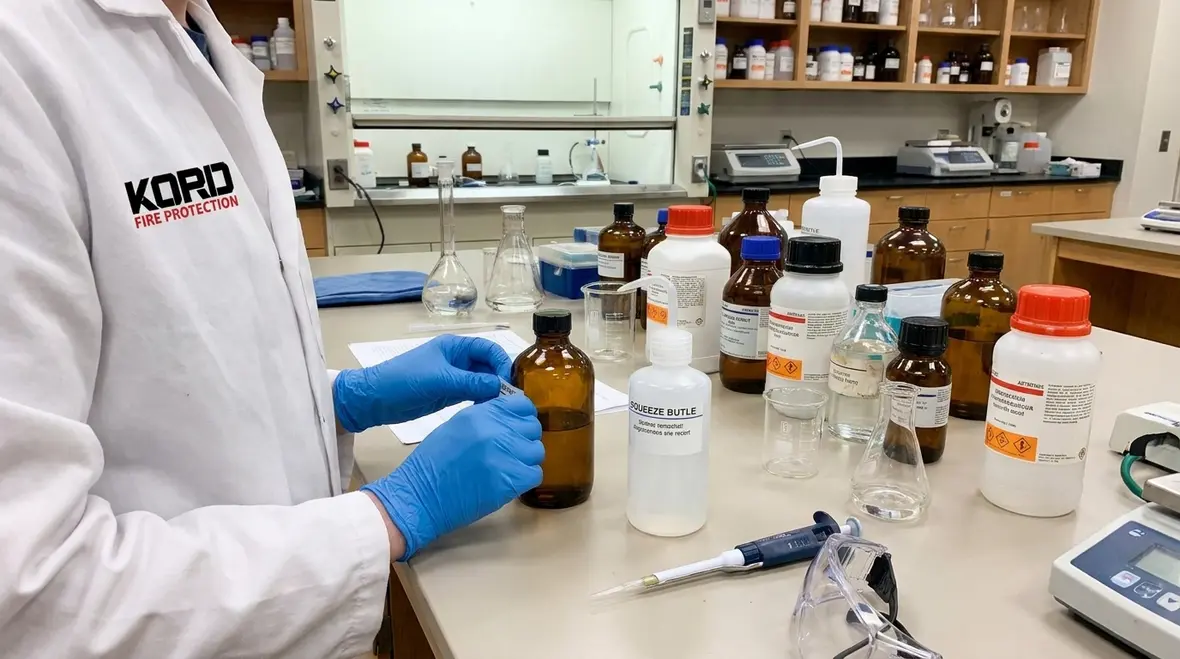
NFPA 45 Section 13.4: Labeling of Chemical Containers in Labs
Quick Answer: NFPA 45 Section 13.4 requires clear, durable labeling of chemical containers to prevent misuse, support safe handling, and enable quick hazard identification. Effective NFPA 45 laboratory container labeling reduces incident risk, supports inspections, and improves emergency response performance.
For facilities reviewing adjacent lab safety controls, it also helps to compare container labeling practices with NFPA 45 chemical waste handling and disposal requirements, since waste streams, transfers, and temporary containers are where labeling discipline tends to get sloppy fast. ([kordfire.com](https://kordfire.com/nfpa-45-section-8-4-chemical-waste-handling-and-disposal/?utm_source=openai))
What NFPA 45 Section 13.4 requires for chemical container labels
NFPA 45 Section 13.4 focuses on the practical reality that laboratory environments mix chemicals, containers, and frequent handling. The standard expects each container to be labeled so staff, contractors, and responders can quickly identify what is inside and apply the correct controls. In practice, NFPA 45 laboratory container labeling must survive normal lab use, transfers, and routine workflows without becoming illegible or misleading.
Why labeling is an operational safety control, not just documentation
In commercial labs and industrial research environments, chemical labeling failure creates a chain reaction: unknown compatibility risks during transfers, incorrect PPE selection, delayed spill response, and preventable exposures. Section 13.4 supports incident prevention by ensuring hazard information stays with the container from procurement through use and storage.
Common compliance challenges include:
Decanted chemicals placed into secondary containers without equivalent hazard identification.
Worn labels from chemical splash, autoclave conditions, abrasion, and frequent handling.
Temporary containers left unlabeled after pipetting, sampling, or short term staging.
Outdated labels remaining after container contents change or concentration updates occur.
To address these risks, facilities should align labeling practices with how the lab truly operates, including common equipment, transfer points, and routine inspection cadence.
How to build labels that pass real-world inspection
NFPA 45 Section 13.4 emphasizes labeling that remains usable. That means the label must provide the right information clearly enough for day to day decisions, not just for recordkeeping. Facilities should develop labeling standards that include:
Identity: The chemical name or accepted identifier that unambiguously matches the substance.
Hazard communication: Sufficient hazard information to support safe handling and emergency awareness consistent with the facility’s chemical management program.
Durability: Label materials and printing methods that resist chemical exposure and abrasion encountered in the lab.
Container control: A clear method for labeling when contents are transferred to smaller vessels, bottles, beakers, or specialized lab containers.
Durability and placement: the detail inspectors expect
Labels that fail during normal use often fail in predictable ways. Facilities should verify that labels adhere to glass, metal, HDPE, and other container surfaces used in the lab. They should also ensure placement does not get covered by caps, clamps, secondary sleeves, or racks. In wet benches or splash risk areas, labels require chemical resistant stock and an attachment approach suited to that environment.
What good NFPA 45 laboratory container labeling looks like in daily operations
Strong compliance depends on procedures that are easy to follow and hard to bypass. The following approach supports Section 13.4 in commercial, industrial, and retail adjacent facilities that operate labs, testing rooms, or production support chemistry areas.
1) Label at point of transfer, not later
When staff decant, dilute, or prepare working solutions, the container receives the required label immediately. This prevents unlabeled or misidentified interim stages that occur when teams attempt to label “when time permits.” A point of transfer workflow also reduces confusion during shift changes and during contractor access.
2) Use a controlled labeling system for consistency
Facilities should standardize label templates, printer settings, and required fields. Consistency improves comprehension and reduces the probability that two departments apply different formats to the same chemical. It also simplifies audits because the facility can demonstrate uniform application rather than relying on individual technician practices.
3) Perform label legibility checks as part of inspections
Label quality degrades over time. Tie labeling verification into routine rounds and documented inspections. Pay attention to high use areas such as:
Sampling stations and prepared reagent drawers
Storage refrigerators and freezers where condensation and cycling can damage adhesives
Dispensing bottles and reagent reservoirs
Areas with frequent handling, splashes, or rapid bench turnover
4) Train staff on the “labeling stop rules”
Training should include stop rules such as: do not use an unlabeled container, do not rely on memory, and do not assume a label remains accurate after concentration changes. When facilities enforce stop rules consistently, NFPA 45 laboratory container labeling becomes an active safety control rather than a passive requirement.
Inspection and enforcement readiness: common failure points under Section 13.4
During compliance evaluations, the most frequent issues relate to container control and label survivability. A label may exist but still fail because it cannot be read, it mismatches the contents, or it applies to the wrong container.
Top failure patterns
Secondary containers without equivalent labeling after transfers for convenience.
Labels damaged by chemical contact, making hazard identification unusable.
Missing identifiers on prepared solutions, dilutions, or mixed reagents.
Label information not aligned to the facility chemical management program, causing confusion during response.
How Kord Fire Protection supports ongoing compliance
Kord Fire Protection helps commercial and industrial facilities maintain safer chemical handling through coordinated fire and life safety program support. While Section 13.4 focuses on labeling, real inspections often bundle multiple safety expectations across risk controls, storage practices, and emergency readiness. Kord Fire Protection partners with facilities to keep systems and documentation aligned through practical, schedule driven service and maintenance support. Facilities that want to broaden their lab compliance planning can also review what laboratories NFPA 45 covers to confirm where related requirements may also apply. ([kordfire.com](https://kordfire.com/nfpa-45-section-1-1-scope-what-laboratories-the-standard-covers/?utm_source=openai))
Frequently Asked Questions
Take action now
Facilities should review NFPA 45 laboratory container labeling procedures, confirm labels at every transfer point, and implement documented legibility checks that catch adhesive or print failures early. Standardize label formats, train staff on labeling stop rules, and tighten container control for prepared solutions. Then engage Kord Fire Protection to align ongoing fire and life safety readiness with your lab operations so compliance does not erode between audits.

Join Our Newsletter!
Get the latest fire safety tips delivered straight to your inbox From our Newsletter.



