
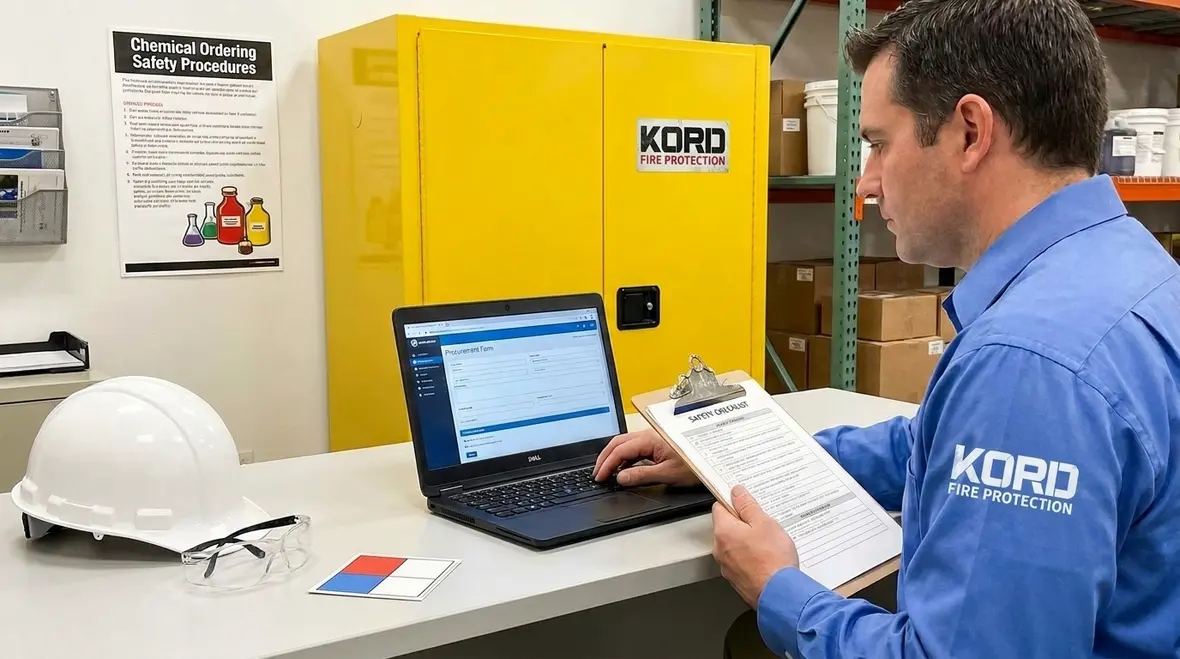
NFPA 45 Section 8.2: Chemical Ordering Procedure Requirements
Quick Answer: NFPA 45 Section 8.2 establishes how facilities must order chemicals to support safe storage, handling, and fire prevention. Effective NFPA 45 chemical ordering procedures control quantities, container types, and documentation so the facility can verify compatibility with installed safeguards before delivery and use.
Facilities building a stronger compliance workflow often pair purchasing controls with ongoing fire protection inspection, testing, and maintenance so changes in chemical inventory do not outpace system readiness.
Why Chemical Ordering Procedures Matter Under NFPA 45 Section 8.2
NFPA 45 Section 8.2 focuses on preventing uncontrolled increases in fire and explosion risk by treating chemical purchasing as a safety-critical process. For commercial, industrial, and retail operations that use hazardous materials, ordering changes the risk profile before any on-site storage improvements are made. When procurement adds incompatible chemicals, exceeds storage design limits, or introduces container and concentration mismatches, the facility can face immediate gaps in protection, delayed engineering controls, and noncompliant storage conditions.
In practice, NFPA 45 chemical ordering procedures connect procurement to safety documentation, container verification, storage capacity planning, and operational readiness. This includes ensuring that the facility can accept and safely handle the ordered material using the existing engineering controls and operating procedures required throughout NFPA 45.
What NFPA 45 Section 8.2 Requires in the Ordering Workflow
Section 8.2 governs the process by which chemicals are ordered so the facility can evaluate fire and hazard impacts before chemicals arrive. While the exact implementation details depend on the specific facility hazards and chemical types, the operational expectation is consistent: procurement must not bypass safety review.
1) Pre-approval of hazardous materials before purchase
NFPA 45 Section 8.2 requires a controlled approach where chemical orders are reviewed for safety impacts prior to ordering or receiving. This prevents a common failure pattern in which a buyer places an order based on production needs, while safety controls lag behind.
2) Ordering controls must support storage limits and protection design
Chemical ordering must align with the storage plan and protection systems already in place. If installed systems, storage arrangements, or spill mitigation plans cannot support the ordered quantities, the ordering process must stop and trigger corrective actions.
- Quantity and concentration must match what the facility can store safely.
- Container configuration must match what the facility can manage and store.
- Compatibility review must consider segregation, incompatibles, and transfer risks.
3) Documentation must be available and accurate at the point of ordering
Good compliance depends on correct, current information. Ordering procedures should require the buyer to collect and verify the hazard documentation needed for safe handling and storage, including key data used for risk evaluation and planning.
Operational Implementation: How Facilities Put NFPA 45 Chemical Ordering Procedures Into Practice
Commercial facilities often struggle with translating a compliance requirement into day-to-day purchasing behavior. NFPA 45 chemical ordering procedures work best when they are implemented as a clear, repeatable workflow tied to responsibilities, approvals, and evidence.
Build a procurement review step into purchasing systems
Facilities typically implement a “safety gate” before a purchase order is released. This safety gate should include a defined reviewer role such as Fire Protection, Safety, EHS, or a designated competent person trained on hazardous materials handling. The reviewer verifies that the chemical can be stored and managed using the facility’s existing protection and operating procedures.
Define acceptance criteria for shipments and containers
Procurement requirements must carry forward to receiving. The facility should require that the received product matches the approved order, including concentration, form, and container size. Common receiving failures include accepting substitutions, partial deliveries with different concentrations, or mislabeled containers that do not match pre-approved documentation.
Link ordering to storage capacity planning
Ordering procedures must account for real storage capacity, not just theoretical design. Storage limits can be consumed by current inventory, seasonal production changes, or ongoing maintenance of storage areas. NFPA 45 chemical ordering procedures should ensure the purchasing decision updates available capacity and does not exceed protected storage assumptions.
Common Compliance Gaps and Failure Points During Chemical Ordering
NFPA 45 enforcement typically focuses on whether the facility can demonstrate control over hazardous materials arriving at the site. The most common gaps occur when procurement is not integrated with hazard review, when evidence is incomplete, or when receiving overrides the approved chemical list.
- No pre-order review: Chemicals are purchased based on operational demand without a safety approval step.
- Storage mismatch: The order quantity exceeds what protected storage areas can manage.
- Incompatibility oversight: Incompatible chemicals are ordered without confirming segregation requirements.
- Documentation gaps: The buyer does not collect hazard documentation or cannot validate accuracy at approval time.
- Receiving substitutions: Vendors substitute products, and receiving accepts changes without re-review.
- Change control failures: Additions and plan adjustments are not updated when operational needs change.
These gaps are preventable when facilities adopt a structured ordering program, train purchasing and receiving teams, and maintain an audit trail that shows approvals and capacity confirmations. For ongoing program effectiveness, maintenance and inspection of related fire protection systems must also keep pace with chemical use patterns.
How Kord Fire Protection Supports Ongoing NFPA 45 Compliance
NFPA 45 compliance relies on both documented controls and reliable fire protection performance. Kord Fire Protection helps commercial facilities maintain alignment between chemical hazards and the fire protection systems that mitigate those risks. This includes supporting program readiness through inspection support, testing coordination, and maintenance planning that reduces the likelihood of system readiness gaps when ordering changes introduce new operational conditions.
To strengthen your chemical ordering controls and your fire protection readiness, facilities often benefit from integrating service schedules with procurement cycles and inventory changes. Kord Fire Protection can assist with establishing a practical maintenance rhythm so the facility remains audit-ready rather than reacting after a problem is found.
For related fire protection program support, review this resource on full fire protection services, or explore NFPA 45 mandatory extracts explained for a closely related compliance topic.
Frequently Asked Questions
Call to Action
Facilities that rely on ad hoc purchasing often discover compliance gaps only after hazards shift. Implement NFPA 45 chemical ordering procedures with a documented approval workflow, enforce receiving acceptance criteria, and connect approvals to fire protection readiness. Contact Kord Fire Protection to support ongoing inspection and maintenance planning so your systems remain aligned with your chemical inventory and operational risk profile.

Join Our Newsletter!
Get the latest fire safety tips delivered straight to your inbox From our Newsletter.



