
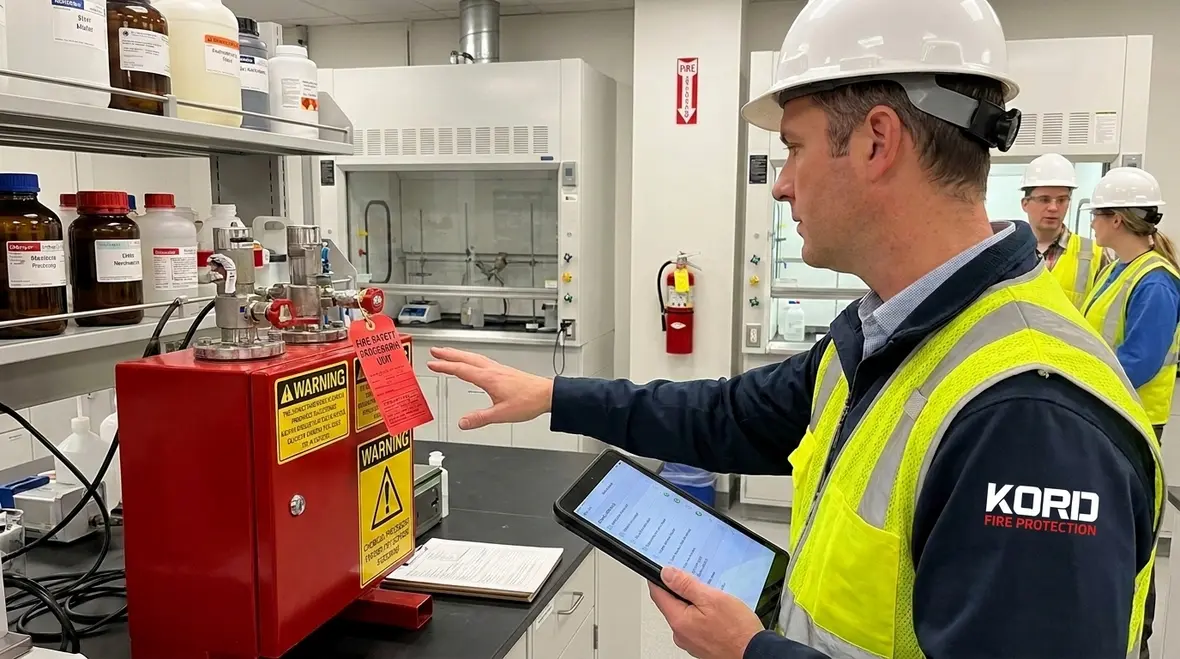
NFPA 45 Section 2.4: Extracts in Mandatory Sections Explained
Quick Answer
NFPA 45 Section 2.4 explains how extracts are treated when they appear in mandatory sections. They are not optional commentary. They function as enforceable requirements, meaning facilities must align procedures, inspections, and documentation accordingly to meet compliance expectations and reduce enforcement risk.
For teams tightening documentation early, Kord Fire Protection’s fire safety system documentation for compliance is a useful companion read before you start mapping code language into inspection records and maintenance workflows.
Why NFPA 45 Section 2.4 matters to commercial compliance
NFPA 45 applies to fire protection and life safety practices for laboratories, healthcare facilities, and other special-purpose occupancies that use hazardous processes, chemicals, or industrial equipment. In those environments, inspectors often focus on two things: whether required controls are implemented and whether the facility can prove compliance.
That is exactly where NFPA 45 mandatory section extracts references become critical. Section 2.4 clarifies that when an NFPA 45 document presents “extracts” inside mandatory sections, those extracts operate as part of the requirement, not as background material. Commercial facilities that treat extracts as informational risk gaps in training, inspection scope, maintenance frequency, and recordkeeping.
What Section 2.4 means by “extracts” in mandatory sections
NFPA 45 Section 2.4 establishes a compliance rule of interpretation. When the code includes extracts in mandatory sections, the extracts carry the same compliance weight as the surrounding mandatory text. In practical terms, facility owners and contractors must treat extracted passages as enforceable requirements tied to the intent of the section in which they appear.
Commercial operations typically encounter Section 2.4 issues in four recurring ways:
- Procedure drift: Staff follow an internal SOP that paraphrases the extract without preserving the required steps, frequency, or acceptance criteria.
- Inspection mismatches: Testing is performed, but the documented scope does not align to what the mandatory extract specifies.
- Maintenance documentation gaps: Records fail to reflect the exact system, component, or condition described in the extract.
- Training shortfalls: Training covers general fire safety but does not address extract specific actions, response expectations, or inspection responsibilities.
How facilities should implement mandatory extract requirements
Operational compliance requires more than reading NFPA 45 once during design or commissioning. Facilities should build an “extract to action” workflow so that every mandatory extract reference maps to a controlled process, measurable checks, and retained records.
1) Translate the extract into a controlled task
For each mandatory extract, facilities should define:
- Who performs the task (job roles and backups).
- When it is performed (initial, periodic, after changes, after incidents).
- What “pass” looks like (observable conditions, test results, acceptance criteria).
- What documentation is required (log format, retention time, required fields).
2) Align inspection and testing plans to the extract language
Mandatory extracts often reference specific performance expectations. Facilities should verify their inspection plans cover the described scope. If the extract implies a particular system state, pathway condition, or inspection method, the facility should confirm that the field procedure and the test evidence support it.
Common failure point: a facility tests a system but captures evidence that does not prove the element referenced in the extract. For example, a log entry may show “inspection completed” without recording the condition items required by the extract.
3) Lock the requirement into maintenance and quality systems
Commercial facilities typically use computerized maintenance management systems or manual maintenance binders. Section 2.4 expectations become easier to sustain when extract requirements are embedded as:
- Work order templates that include the extract scope.
- Checklists that require completion of extract defined observations.
- Training prerequisites for the personnel who execute the checks.
- Escalation triggers for deficiencies, shutdown decisions, or interim risk controls.
Inspection and enforcement: what auditors look for when extracts are involved
When inspectors reference mandatory sections, they generally validate that the facility implements the requirement and can demonstrate it through objective evidence. Section 2.4 reinforces this approach for extracts. Facilities that rely on “intent only” interpretations tend to fail because enforcement decisions often depend on documented alignment.
In practice, auditors frequently ask for:
- Crosswalk documents that show where each mandatory extract reference is addressed in the facility procedures.
- Recent inspection or testing records tied to the specific required checks.
- Corrective action history demonstrating how deficiencies are handled, resolved, and verified.
- Staff qualifications and training records proving that personnel understand their extract specific responsibilities.
For commercial and industrial operations, the biggest risk is inconsistent evidence across departments. A lab may maintain detailed chemical and process records, but the fire protection discipline may not have an extract driven mapping for each required inspection item.
Where commercial facilities get stuck, and how to prevent recurring noncompliance
Section 2.4 can create “hidden complexity” because extracts may appear as embedded statements within mandatory sections. Facilities often miss them when they treat NFPA 45 as a narrative document rather than a structured compliance checklist.
Common extraction related failure points
- Overgeneralized SOPs: SOPs use broad language that does not preserve extract requirements such as frequency, method, or required conditions.
- Incomplete equipment coverage: Some systems or components receive service while others are excluded even though the extract reference requires broader coverage.
- Documentation formats that omit required fields: Logs do not record all elements needed to show compliance with extract requirements.
- Change management failures: When equipment is replaced or processes change, the facility updates operations but does not update inspection plans to reflect the mandatory extract expectations.
How Kord Fire Protection supports extract driven compliance
Kord Fire Protection helps commercial facilities operationalize NFPA 45 requirements by connecting code interpretation to field execution. That support typically includes inspection planning support, testing coordination, documentation review, and maintenance execution that aligns with the scope implied by mandatory extracts. This approach reduces audit friction by ensuring that records reflect the actual extract requirements, not just general compliance intent.
For additional guidance on audit preparation and evidence mapping, refer to Fire Protection Compliance Auditing Guide by Kord or explore Kord Fire Protection.
Frequently Asked Questions
Call to action
If your facility depends on NFPA 45 and you need defensible compliance evidence, perform an extract to action review now. Kord Fire Protection can help confirm your inspection scope, maintenance documentation, and recordkeeping align with mandatory extract requirements. Contact Kord Fire Protection to schedule a compliance focused evaluation and reduce audit risk before the next inspection cycle.

Join Our Newsletter!
Get the latest fire safety tips delivered straight to your inbox From our Newsletter.



