
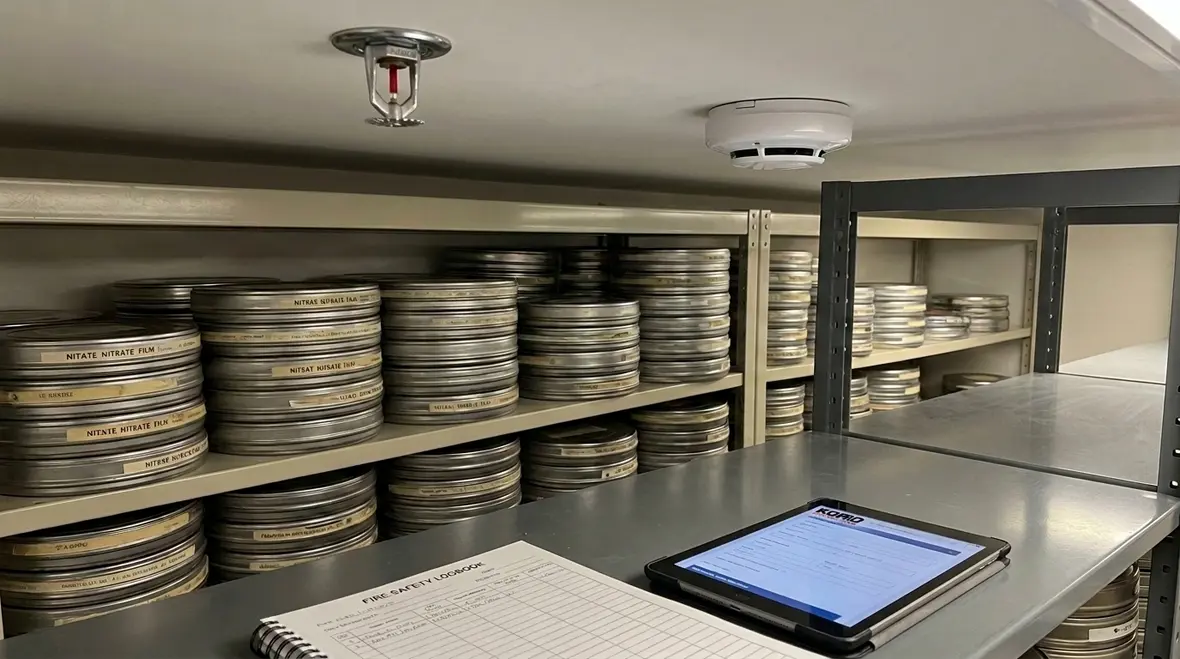
NFPA 40 Section 1.5 Equivalency: Alternative Compliance for Nitrate Film Facilities
Quick Answer
NFPA 40 Section 1.5 allows nitrate film facilities to seek “equivalency” when an alternative design or method provides protection that is at least equivalent to the intent of the standard. Proper documentation, hazard analysis, and approval steps are essential for acceptance.
If your team is trying to turn an equivalency concept into something an authority can actually review without rolling their eyes into another dimension, it helps to connect the engineering narrative with practical fire protection services in Southern California that support inspections, repairs, testing, and documentation readiness.
What “equivalency” means in NFPA 40 Section 1.5
For operators managing nitrate film inventories, NFPA 40 sets baseline requirements intended to control fire and life safety risks associated with nitrate materials. Under NFPA 40 Section 1.5, a facility may propose an NFPA 40 equivalency alternative compliance nitrate film approach when it can demonstrate that the alternative method provides protection equal to, or greater than, what NFPA 40 would require.
This concept matters in real commercial environments where space constraints, legacy layouts, tenant fit ups, or operational realities can make strict conformance difficult. However, equivalency does not remove the need for a rigorous safety case. It changes how compliance is demonstrated, not whether meaningful protection is provided.
When facilities typically pursue equivalency (and why)
Nitrate film facilities often face compliance challenges that are operational, architectural, or regulatory in nature. Common scenarios include:
- Building constraints: Limited compartment sizes, unusual room geometry, or shared walls that complicate installation of required protective features.
- Legacy storage configurations: Existing racking, floor conditions, ventilation patterns, or drainage approaches that cannot be replaced on the desired schedule.
- Process changes: Shifts in film handling, staging, recovery workflows, or batch storage timelines that alter how hazards manifest day to day.
- Equipment availability and integration: Constraints on water supply, detector placement feasibility, power reliability, or compatibility with the site’s fire alarm and suppression architecture.
- Tenant or retail adjacency: Co-location with office, retail, or mixed use occupancy that raises practical barriers to meeting prescriptive separation or protection requirements.
In these cases, the owner’s objective is usually to maintain equivalent protection while reducing downtime, major construction scope, or operational disruption. A successful equivalency submittal typically ties each deviation to a hazard control outcome, not just a “swap” of one component for another.
What an equivalency package should include
NFPA 40 equivalency submittals succeed when they are technically complete, auditable, and aligned with fire protection engineering principles. While the exact format varies by authority, a strong package generally includes:
1) Clear identification of the prescriptive requirement
Document the specific section or requirement you cannot meet as written. Describe how the facility differs, including drawings and current construction details.
2) Hazard analysis tied to nitrate film risks
Equivalency must demonstrate protection that addresses the core hazard profile of nitrate film, including ignition potential, fire growth behavior, heat exposure management, and limitations of mitigation measures under realistic storage and handling conditions.
3) Technical rationale for the alternative method
Explain what the alternative does, how it performs, and why it achieves at least the same level of safety. This often includes design basis information such as:
- Detection and notification concept, including coverage and response time assumptions
- Suppression or protective features, including activation basis, flow or discharge requirements, and expected performance conditions
- Compartmentation or containment strategies, including integrity expectations during abnormal fire scenarios
- Fire department access and operational constraints that affect the ultimate outcome
4) Inspection, testing, and maintenance plan
Equivalency is only defensible if the alternative remains reliable over time. Include a maintenance and test regime that aligns with commercial facility standards: inspection intervals, acceptance criteria, recordkeeping, and corrective action triggers for impairments.
5) Implementation and management controls
Document operational controls that support the design, such as inventory management processes, housekeeping standards, staff training expectations, and emergency procedures for damaged or degrading film.
For nitrate film facilities, authorities commonly expect a full “life cycle” view: the facility does not just meet a snapshot at installation. It demonstrates ongoing performance through commissioning, periodic inspections, and prompt remediation.
How equivalency decisions impact real inspection and maintenance workflows
Equivalency planning often improves engineering flexibility, but it also increases the importance of disciplined field execution. The most common failure points in commercial operations include misalignment between the approved concept and day to day maintenance.
Common operational gaps
- Detector placement deviations: Changes during construction or renovations without updating the equivalency documentation can lead to coverage holes.
- Unmanaged impairments: Frequent bypasses, delayed repairs, or incomplete restoration after test cycles can degrade performance and invalidate the safety rationale.
- Water supply uncertainty: Inadequate verification of flow capacity, valve supervision, or hydrostatic testing can undermine suppression effectiveness assumptions.
- Compartmentation drift: Penetrations, cable tray additions, or minor repairs that alter fire stopping integrity often go unnoticed until an inspection.
- Maintenance schedule shortfalls: Facilities frequently keep documentation, but fail to follow the test frequency required to maintain equivalency.
Why this matters to authorities having jurisdiction
Authorities typically evaluate equivalency based on both design intent and credible assurance that the alternative will perform. That assurance depends on the facility’s inspection and maintenance controls, including documented inspections, acceptance testing, and operational readiness verification.
Kord Fire Protection supports commercial nitrate film and other industrial high risk facilities by helping owners maintain documented compliance through commissioning support, periodic testing, and corrective action management. For practical guidance on creating a maintainable compliance posture, see Kord Fire Protection services and service resources.
Design and operational strategies that often pair well with equivalency
Equivalency frequently centers on achieving the same protective outcomes through alternative means. While each submittal depends on conditions, the following strategies commonly form part of a credible equivalency rationale:
Detection and annunciation adjustments
Alternative layouts can use a documented detection concept that ensures timely recognition. The key is demonstrating that detection performance and coverage support the overall safety objective.
Suppression or protective action modifications
When suppression design differs from prescriptive text, the facility must show equivalent protective action. This includes assurance that components remain operational, supervised where appropriate, and tested to verify expected performance.
Compartmentation and containment reinforcement
When compartment sizes or configurations vary, an equivalency package often relies on containment and integrity performance assumptions. Fire stopping quality, penetration sealing, and repair procedures become critical.
Management of film condition and hazard controls
Operational controls that reduce the probability of escalation can strengthen an equivalency argument. Facilities frequently include inventory controls, segregation of degraded film, rapid response triggers for suspect materials, and maintenance of emergency procedures.
In each category, equivalency should remain traceable to measurable outcomes, such as detection lead time, protection system readiness, and documented integrity of passive features.
How to move from equivalency concept to approved compliance
A practical path reduces delays and prevents rework. A structured approach typically includes:
- Gap assessment: Identify each prescriptive element that cannot be met and define the hazard control objective for each.
- Draft equivalency engineering report: Compile calculations, basis of design, and performance expectations tied to the alternative method.
- Pre meeting with stakeholders: Engage the authority having jurisdiction and relevant facility stakeholders early to validate what level of documentation is expected.
- Design development and drawings: Ensure field conditions match the assumptions used in the equivalency analysis.
- Commissioning and acceptance testing plan: Lock test procedures and acceptance criteria into the compliance documentation.
- Ongoing maintenance and recordkeeping: Establish a schedule that matches the approved concept, with clear impairment handling and corrective action triggers.
Kord Fire Protection plays a key role after approval by supporting the operational phase, including testing coordination, documentation readiness, and maintenance verification that aligns with how commercial facilities are actually inspected.
Frequently Asked Questions
Conclusion and call to action
NFPA 40 Section 1.5 equivalency can be a practical compliance pathway for nitrate film facilities, but it only works when engineering intent and field execution stay aligned over time. Kord Fire Protection helps commercial operators document, test, and maintain the systems needed to sustain equivalent protection. Contact Kord Fire Protection to plan a compliant equivalency roadmap, commission the solution, and keep inspection readiness consistent through ongoing maintenance.

Join Our Newsletter!
Get the latest fire safety tips delivered straight to your inbox From our Newsletter.



