
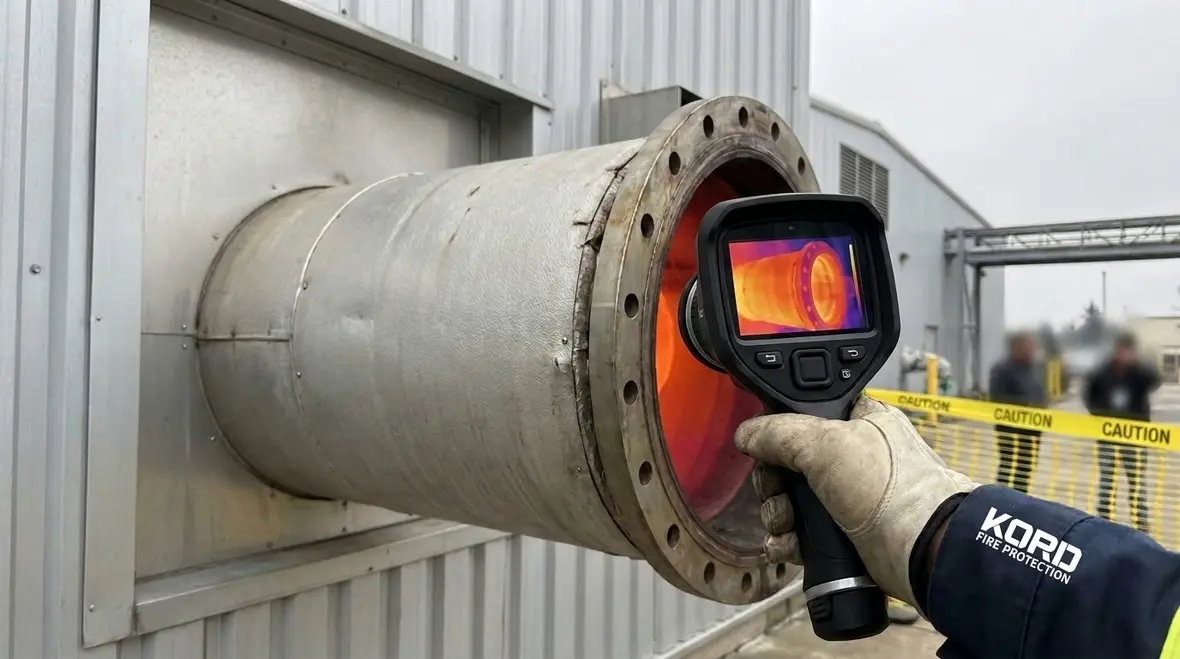
NFPA 37 Section 8.4: Exhaust Clearances at 760°C (1400°F) and Above
Quick Answer
NFPA 37 Section 8.4 sets requirements for maintaining safe exhaust clearances when gas turbine or similar high temperature exhaust reaches 760°C (1400°F) and above. Facilities must control proximity to combustibles, ensure proper insulation and supports, and verify clearances remain during operation, shutdown, and maintenance.
For a practical framework on documenting findings and staying inspection ready, review fire protection compliance auditing guidance.
What NFPA 37 Section 8.4 Is Trying to Prevent
NFPA 37 addresses public and industrial fire safety for high temperature processes by controlling how close exhaust components can be to materials that can ignite or degrade. When exhaust surfaces or gases reach 760°C (1400°F) and higher, the risk shifts from routine thermal exposure to credible ignition scenarios, including smoldering, charring, and radiant heat transfer.
These NFPA 37 high temperature exhaust clearance requirements focus on maintaining a defensible separation distance between exhaust systems and combustibles or heat sensitive assemblies, even as equipment heats up, expands, and vibrates. For compliance teams, the challenge is not only “as installed” clearances, but also how the system behaves during full load operation and routine upkeep.
NFPA 37 Section 8.4 Scope: When the Rule Applies
Section 8.4 applies to exhaust situations where the exhaust temperature is 760°C (1400°F) and above. In practical terms, this typically includes certain gas turbine exhaust arrangements, high temperature exhaust streams, or installations where exhaust gas or exhaust duct surface temperatures can reach that threshold.
Compliance teams should treat Section 8.4 as a “temperature triggered” requirement. That means the facility must be able to demonstrate that the relevant exhaust section truly reaches or exceeds the specified temperature, or that the design accounts for potential conditions that could bring exhaust into that range.
Operational reality check: temperature profiles can change during startup, load transitions, or when fuel quality varies. Facilities that only verify temperatures at steady state often miss risk during non steady operating conditions.
How Exhaust Clearances Are Evaluated at 760°C (1400°F) and Above
At high temperatures, clearances are evaluated with a fire safety mindset. Inspectors and engineers typically look for reliable separation that prevents ignition from:
- Radiant heat transfer from hot duct walls, mufflers, stacks, or exhaust outlets
- Convective heat from hot gases
- Conducted heat through supports and hangers that can act as thermal bridges
- Ignition from residual heat after shutdown, depending on how insulation and ventilation are configured
Common clearance failure points in commercial and industrial facilities
In the field, the most frequent clearance problems are not dramatic. They are incremental:
- Insulation degradation that reduces thermal performance and shifts heat into surrounding materials
- Flexible connections or expansion joints that allow drift, changing clearance during thermal expansion
- Stack or duct supports that settle, causing the system to rotate or sag into protected zones
- Construction modifications after the original commissioning, such as storage additions, shelving, new exterior finishes, or roofing penetrations
- Improper maintenance practices, including replacement of insulation with materials of incorrect thickness or thermal rating
Because NFPA 37 high temperature exhaust clearance requirements are temperature driven, compliance programs should integrate clearance verification with operating condition tracking. This includes checking that clearance is maintained under expected hot conditions and that supporting documentation aligns with the actual operating profile.
Inspection and Documentation: What Compliance Teams Should Verify
Facilities that manage gas turbine systems, high temperature exhaust, or industrial power equipment often need a repeatable workflow for clearance compliance. The best programs combine physical inspection, maintenance records, and performance data.
Field checks that typically matter during audits
- Physical distance verification between exhaust components and combustibles or heat sensitive assemblies
- Insulation condition, including integrity, continuity, and evidence of moisture intrusion or compression damage
- Support and hanger condition, including deformation, missing components, loose anchors, or corrosion that can shift alignment
- Weatherproofing and exterior materials that can change combustibility characteristics, such as updated cladding, siding, or composite panels
- Access doors and maintenance clearances that do not unintentionally store combustibles in restricted zones
Operational evidence that strengthens defensibility
To support NFPA 37 compliance decisions, many facilities use temperature measurements and engineering evaluations tied to actual operating modes. This may include:
- Startup and load ramp temperature verification where exhaust can exceed threshold conditions
- Sensor placement that reflects the relevant exhaust segment for clearance assessment
- Maintenance logs demonstrating insulation and component integrity over time
Teams that want tighter records around recurring inspections can also use a fire protection system documentation checklist to keep evidence organized.
Why Maintenance Practices Control Compliance Outcomes
Exhaust clearance compliance is frequently undermined by maintenance variance. Even when drawings specify clearance values, field execution determines whether those values remain valid after wear, vibration, and component replacement.
Key maintenance mechanisms that can reduce effective clearance
- Thermal expansion drift: systems can change geometry when heated. If supports are replaced incorrectly, the drift pattern can increase heat exposure to nearby materials.
- Insulation replacement errors: incorrect material type, thickness, or installation gaps can convert a safe design into an unsafe one.
- Sealant or refractory changes: failure of high temperature sealing systems can lead to leaks that raise surface temperatures in localized zones.
- Uncontrolled modifications: new piping runs, electrical conduits, or exterior upgrades can introduce combustibles into clearance spaces.
Kord Fire Protection supports commercial facilities with practical, ongoing compliance and maintenance verification. Their role is to help facilities keep clearance intent intact over time through inspection, documentation support, and fire safety program alignment for equipment operating in high temperature conditions.
For related high performance fire and life safety guidance, refer to Kord Fire Protection resources.
How to Reduce Risk in Retail, Office, and Mixed Use Buildings
While NFPA 37 enforcement environments vary, many commercial sites face similar realities: limited exterior staging space, frequent tenant or contractor activity, and aesthetic constraints that can conflict with clearance zones.
Commercial facility standards should therefore include administrative controls:
- Clear signage marking restricted exhaust clearance zones for contractors and grounds staff
- Change control that triggers review of exhaust clearances before any exterior renovation or storage layout change
- Maintenance training that reinforces correct insulation and support replacement practices
- Scheduled verification during peak load seasons or after major repairs
These steps directly support NFPA 37 high temperature exhaust clearance requirements by protecting the as maintained condition, not just the original installation.
Frequently Asked Questions
Conclusion and Call to Action
NFPA 37 Section 8.4 drives strict control of exhaust clearances when exhaust temperatures reach 760°C (1400°F) and above. Compliance succeeds when facilities manage the entire lifecycle: design intent, operational temperature reality, maintenance execution, and change control. Kord Fire Protection can help commercial teams verify conditions, document findings, and keep high temperature exhaust systems aligned with NFPA 37 high temperature exhaust clearance requirements.
Contact Kord Fire Protection to schedule a review of your exhaust clearance program and maintenance records.

Join Our Newsletter!
Get the latest fire safety tips delivered straight to your inbox From our Newsletter.



