
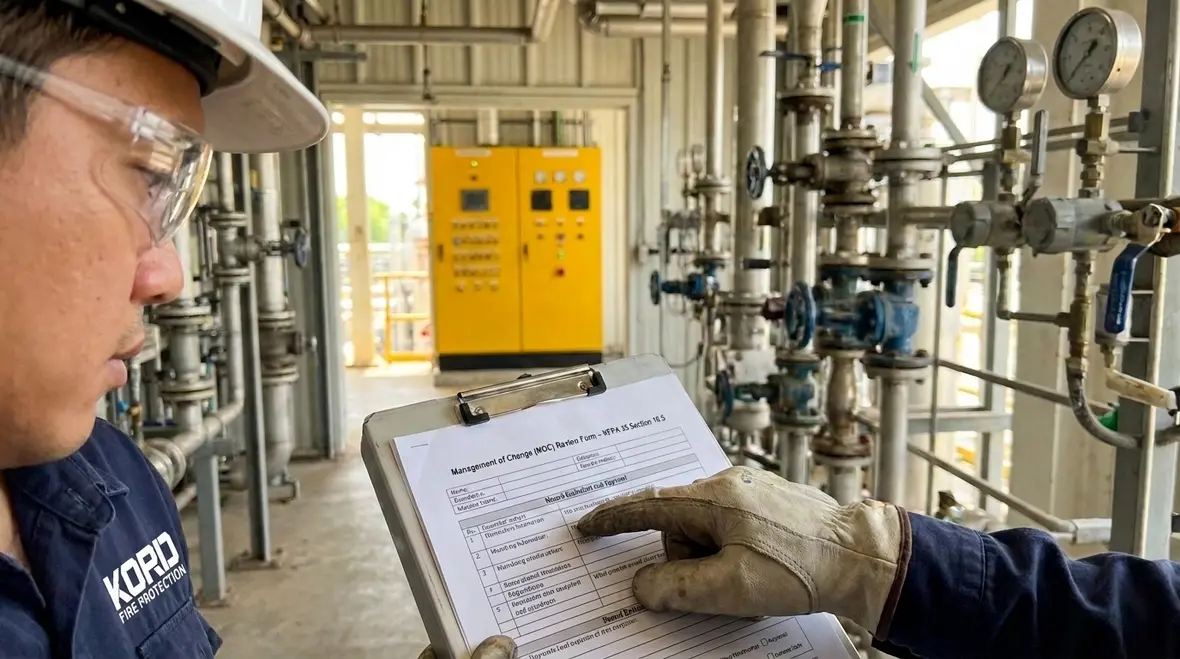
NFPA 35 Section 10.5: Management of Change (MOC) Requirements
Quick Answer
NFPA 35 Section 10.5 requires a documented Management of Change process that evaluates hazards before modifications to chemicals, equipment, procedures, or facilities. It ensures responsibilities are assigned, risk is reviewed, approvals are obtained, and affected systems return to safe operation with verification and training.
What NFPA 35 MOC aims to prevent
Commercial, industrial, and retail facilities that handle hazardous chemicals do not fail from “bad intentions.” They fail from unreviewed changes: a maintenance swap that alters system performance, a control strategy update that changes ventilation behavior, a procedure revision that bypasses a protective step, or a piping reroute that changes pressure relationships.
NFPA 35 management of change MOC requirements establish a structured method to capture those changes early, evaluate fire and safety impact, and document authorization. When implemented correctly, MOC becomes a practical bridge between operations, engineering, maintenance, and safety so modifications do not unintentionally degrade containment, detection, mitigation, or safe work practices.
When MOC is required under NFPA 35 Section 10.5
NFPA 35 Section 10.5 focuses on changes that can affect hazards. In day to day plant and facility operations, MOC typically triggers when a change impacts either the fire and protective systems or the process conditions that those systems protect. Facilities should treat MOC as an “evaluation checkpoint,” not only as paperwork.
Common change triggers in commercial and industrial environments
- Process changes: switching chemicals, changing concentrations, altering addition rates, changing batch sizing, or modifying process temperatures and pressures.
- Equipment changes: replacing pumps, regulators, detectors, valves, or alarms with different models or set points.
- Control and logic changes: updating PLC logic, changing interlock behavior, modifying permissives, or altering fail safe behavior.
- Procedure changes: changing operating steps, abnormal condition response, hot work controls, or maintenance isolation requirements.
- Facility and utility changes: modifying ventilation schemes, rerouting piping, changing electrical classification boundaries, or altering drainage and spill control features.
A key compliance challenge appears when facilities treat “like for like” replacements as exempt. Even when a component seems equivalent, differences in flow, response time, calibration range, wetted materials, or alarm thresholds can affect safety performance. The MOC review must confirm equivalency or document why the change does not increase risk.
What a compliant MOC program should include
Section 10.5 expects facilities to manage change with defined responsibilities, hazard review, approvals, and verification. In practice, strong programs treat MOC as a lifecycle, from request through closure, with evidence built in at each step.
1) Clear roles, accountability, and authority
Facilities should define who can initiate MOC, who performs the hazard review, who approves, and who verifies return to safe operation. In many organizations, engineering and fire protection work together to evaluate protective systems. The operations manager or process owner typically authorizes safe continuation.
Without defined authority, MOC reviews stall, or approvals happen after work begins. Either condition fails the intent of Section 10.5 because hazards remain unassessed during implementation.
2) Documented hazard review before implementation
The hazard review should match the complexity of the change. Typical review methods include checklists for minor changes and more structured evaluation for high impact modifications. The review should address fire and explosion hazards, ignition sources, toxic exposure, containment, and how mitigation systems respond.
Common failure points include:
- Reviewing only the process change and not the protective system changes (alarms, ventilation, suppression, shutdown interlocks).
- Not evaluating maintenance and outage conditions, such as bypassed interlocks during work.
- Assuming existing training and procedures remain valid after a configuration change.
3) Change authorization and pre start controls
MOC approval should occur before work that could impact hazards begins. Where a work scope requires temporary conditions (for example, a system outage or bypass), the MOC record should capture the temporary controls, time limits, monitoring expectations, and compensatory safeguards.
4) Verification, testing, and “safe return” evidence
Section 10.5 aligns with the broader compliance expectation that protective systems remain capable after changes. Verification often includes functional testing, calibration confirmation, alarm verification, and documentation of system performance return to baseline or an approved alternative.
For many facilities, the operational gap occurs at closure. The change may be “installed” but not tested under conditions that confirm safety performance. That gap increases risk and creates inspection findings.
5) Training and procedural updates
When changes alter steps, thresholds, or system behavior, training must occur before operators rely on the updated configuration. Procedures should reflect the change, including startup, shutdown, abnormal operations, and maintenance isolation steps.
Where MOC often breaks: protective system interfaces
Commercial safety programs frequently handle process changes but under manage interfaces with detection, notification, mitigation, and impairment controls. NFPA 35 management of change MOC requirements should explicitly connect each change to the systems that protect people and assets.
Near the top of that workflow, it helps to connect change management with restoring fire protection systems to service so approvals, verification, and return to readiness are not handled like separate departments that refuse to make eye contact.
Detection and alarms
Detector replacements can change sensitivity, response characteristics, and alarm mapping. MOC documentation should confirm:
- Alarm set points and thresholds remain appropriate for the new detection technology.
- Calibration records support correct performance.
- Test procedures confirm that annunciation and escalation pathways operate as intended.
Interlocks, shutdowns, and permissives
Modifying control logic can alter shutdown timing, enable conditions, or fail safe behavior. Even small logic adjustments can affect how quickly a hazardous state is mitigated. The MOC hazard review should verify that interlocks do not get defeated and that any temporary bypass conditions follow a controlled impairment process.
Ventilation and containment support
Ventilation changes often alter contaminant removal rate and pressure relationships. Facilities should evaluate whether new ductwork, fan curves, control modes, or set points maintain the intended protective function. Verification should include evidence that the ventilation behavior returns to safe operation after the change.
Inspection readiness: build evidence, not assumptions
Regulatory and insurer reviews often focus on the ability to demonstrate that hazards were assessed before work and that protective systems were verified after work. To support NFPA 35 compliance, facilities should structure MOC records to show:
- The reason for the change and the specific scope.
- The hazard review outcome and risk basis for approval.
- Who approved the change and when.
- Any temporary conditions, impairments, compensatory measures, and time limits.
- Verification and testing results that confirm safe operation.
- Updated procedures and training completion where applicable.
Facilities that rely on tribal knowledge typically struggle during inspections because they can explain what happened but cannot produce the evidence chain. A well designed MOC workflow reduces that risk by requiring documentation gates.
How Kord Fire Protection supports ongoing MOC compliance
Implementation of NFPA 35 management of change MOC requirements becomes more reliable when fire protection engineering, field inspection, and maintenance teams work from the same evidence standards. Kord Fire Protection helps commercial sites avoid the common gaps that lead to inspection findings by aligning change records with functional testing, calibration confirmation, and system verification.
For additional context on commercial fire protection lifecycle expectations, facilities can review resources on Kord Fire Protection services to understand how testing, maintenance, and compliance support can be integrated into operational change planning.
Teams that want a stronger paper trail can also benefit from a commercial fire safety audit, especially when service records, test logs, and corrective actions need to line up cleanly before anyone with a clipboard starts asking fun questions.
Frequently Asked Questions
Next step
Facilities should audit their MOC workflow for hazard review quality, approval gating, impairment controls, and post change verification evidence. If protective system testing and documentation do not tie directly into your MOC records, risk increases and inspection readiness declines. Engage Kord Fire Protection to align testing, maintenance, and system verification with NFPA 35 management of change MOC requirements so changes stay safe from proposal to closure.

Join Our Newsletter!
Get the latest fire safety tips delivered straight to your inbox From our Newsletter.



