
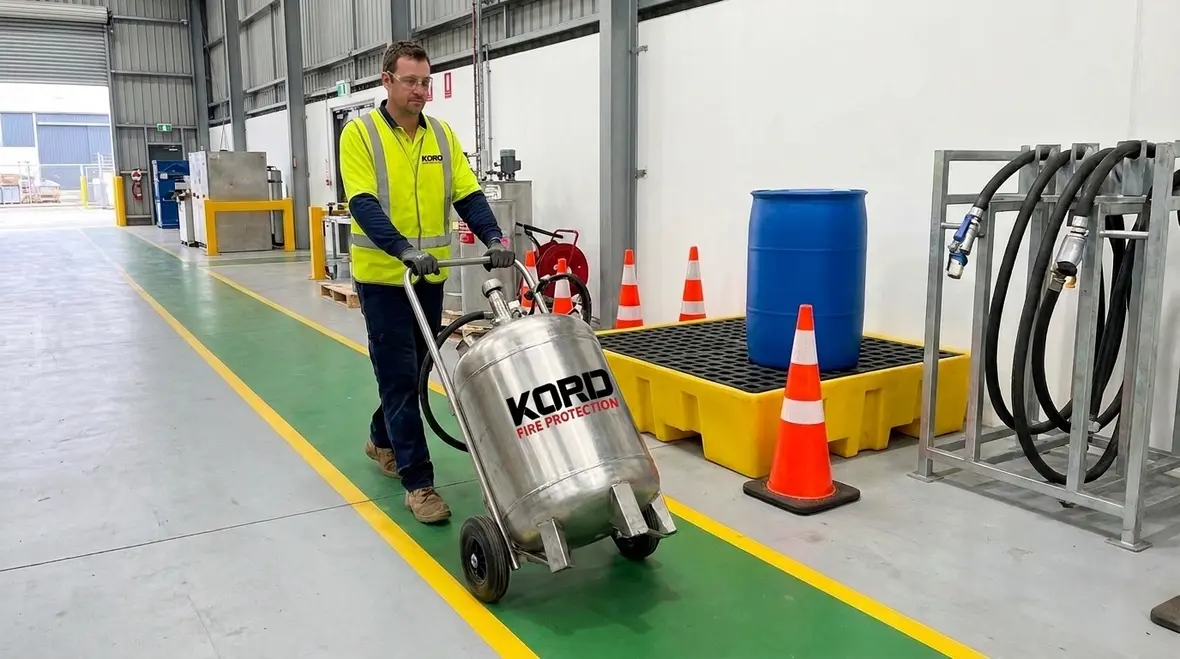
NFPA 34 Section 8.4: Transporting Liquids Within the Facility
Quick Answer: NFPA 34 Section 8.4 sets requirements for safely transporting liquids inside a facility, focusing on preventing ignition sources, controlling spills, and maintaining compatible equipment and procedures. Compliance depends on verified equipment condition, documented operating controls, and ongoing inspection and maintenance.
For broader support with inspections, repairs, and code-compliant fire protection planning, fire protection services in Southern California can help tie liquid handling risks into a more practical facility-wide compliance strategy.
What NFPA 34 Section 8.4 requires when liquids move onsite
Facilities that transport flammable and combustible liquids within plant boundaries must manage hazards during transfer operations, routing, and equipment handling. The NFPA 34 transporting liquids facility requirements emphasize ignition control, container and transfer integrity, spill prevention, and safe operating practices that remain effective under day to day conditions.
For commercial, industrial, and retail sites, the practical compliance challenge is that “transport” often happens in many locations and by multiple teams. Section 8.4 supports a consistent safety baseline across internal logistics, from hose and pump use to vehicle staging and temporary transfer areas.
1) Plan the transport route and control ignition hazards
NFPA 34 Section 8.4 treats internal transportation as an activity that can create new exposure points. Even if the bulk storage area complies, moving liquid introduces additional risks from leaks, static charge, mechanical impact, and ignition sources created during transfer.
Route selection and transfer area controls
Transport routes should minimize proximity to ignition sources and avoid traffic conflicts. Transfer areas typically need control measures that reduce the likelihood of vapor accumulation and ensure rapid response to leaks. Common operational issues that lead to noncompliance include:
- Uncontrolled routing through electrical rooms, boiler areas, or loading docks without documented safeguards.
- Temporary “workarounds” where transfers occur in corners, pits, or near drains without spill planning.
- Missing signage, barriers, or access controls for transfer operations.
Ignition source management during transfer
Practical ignition hazard controls include preventing damaged hoses from spraying, limiting hot work exposure during transfers, and ensuring that equipment used for pumping or agitation matches the liquid hazard profile and area classification. Where hot surfaces, energized components, or sparks can occur, safety controls must not rely on informal operator judgment.
2) Use compatible equipment and verify transfer integrity
Section 8.4 requires equipment used to transport liquids to be suitable for the specific service and maintained to prevent leakage or unsafe conditions. “Compatible” goes beyond chemical resistance. It also includes mechanical performance, pressure capability, and integrity over time.
Hoses, fittings, pumps, and closures
Common failure points during onsite liquid transport include:
- Hose degradation from chemical exposure, weathering, or abrasion.
- Loose or incompatible fittings that increase leak probability during vibration and movement.
- Worn pump seals that discharge vapor or liquid, especially under changing flow rates.
- Improper closures on containers or portable tanks that fail under transport handling.
To sustain compliance, facilities should implement inspection checks tied to equipment type and use frequency. Visual checks alone often miss early seal or coupling wear. Documented inspection and condition tracking reduce the risk of repeated failures and support auditable compliance.
Static electricity and grounding discipline
Static generation becomes a credible hazard when liquids flow, splash, or fill containers. While facility practices may vary by liquid properties, NFPA 34 principles require that transfer methods and equipment configurations do not create unsafe charging conditions. Grounding and bonding procedures must be operationally consistent, including verification that connections are clean and secure.
3) Prevent spills and manage releases where transport occurs
Transporting liquids onsite increases the number of potential leak locations. NFPA 34 Section 8.4 focuses on spill prevention and release control measures that keep small leaks from escalating into a vapor driven incident.
Containment, drainage control, and cleanup readiness
Facilities often treat spill response as an afterthought, but transport operations require readiness before liquid moves. Compliance expectations commonly align with having:
- Containment compatible with the transported liquid and transfer method.
- Drainage controls that prevent flammable liquids from reaching ignition sources through sewers or sumps.
- Spill kits positioned for fast access, with trained personnel and procedures aligned to the specific hazards.
When employees carry containers across the facility or connect hoses in areas with uneven floors or obstructions, minor spills become harder to control. A compliance review should include walk through validation of where connections, decanting, and temporary placement actually occur.
Labeling and vessel condition during transport
In practice, transport failures often involve vessel condition and identification. Facilities should confirm that containers and portable tanks maintain integrity, appropriate labeling, and closure functionality throughout movement, not only at the storage location. If labeling fades or becomes detached, operators may use incorrect procedures, increasing the chance of incompatible transfers.
4) Control operating procedures, training, and supervision
Even when equipment is correct, unsafe outcomes often come from inconsistent procedures. NFPA 34 transporting liquids facility requirements expect that transfer operations follow defined practices, including how workers start, monitor, and stop transport activities.
Operating steps that prevent common human errors
Procedures should address:
- Pre transfer checks, including hose condition, fitting tightness, and closure verification.
- Controlled connection and disconnection methods that reduce splashing and release risk.
- Monitoring flow rates, pressure limits, and transfer duration to prevent overfilling.
- Clear stop criteria for leaks, abnormal noises, or unexpected odors.
Training aligned to the specific transport tasks
Training should match the facility’s reality. Workers need task based instruction, including what to do when a connection begins to leak, how to isolate the transport, and how to initiate spill controls. Supervisors should audit procedure adherence, especially where multiple contractors or shift teams conduct transfers.
For ongoing program maturity, Kord Fire Protection supports commercial clients with practical compliance services that connect inspection findings to operational improvement. This approach helps facilities move from checkbox compliance to repeatable safety performance.
5) Inspection, testing, and maintenance to keep compliance current
Section 8.4 compliance is not static. Equipment wears, hoses age, fittings loosen, seals degrade, and transfer practices drift. A defensible compliance program includes inspection intervals, documented maintenance, and periodic verification that controls still function as designed.
What to inspect during internal transport operations
A strong inspection program should include targeted checks for transport specific hazards:
- Hose integrity and coupling condition, including signs of cracking, blistering, or abrasion.
- Pump seals and discharge points, verifying no seepage and correct operating behavior.
- Grounding and bonding continuity where applicable.
- Spill containment condition, absorbent availability, and drainage control compatibility.
- Transfer area housekeeping that prevents vapor ignition risk and maintains clear access.
Maintenance records and audit readiness
When inspectors request records, facilities must show that inspections and corrective actions connect directly to transport equipment and procedures. Maintenance history should demonstrate that recurring failures are addressed through root cause controls, not repeated patching. This is where Kord Fire Protection often helps clients systematize compliance and maintain documentation quality.
To support related hazard awareness and program structure, clients may also review fire safety system documentation for compliance and coordinate service planning through Kord Fire Protection. For facilities where water based systems and inspection records overlap, fire pump inspection and testing services can also fit naturally into a broader compliance routine.
Frequently Asked Questions
Get expert support from Kord Fire Protection
NFPA 34 transporting liquids facility requirements demand ongoing, operationally grounded compliance. Kord Fire Protection helps commercial and industrial facilities assess transfer practices, verify equipment condition, and build maintenance and documentation routines that stand up to audits. Contact Kord Fire Protection to schedule a compliance review and create a practical improvement plan tailored to your transport routes, equipment, and staffing reality.

Join Our Newsletter!
Get the latest fire safety tips delivered straight to your inbox From our Newsletter.



