
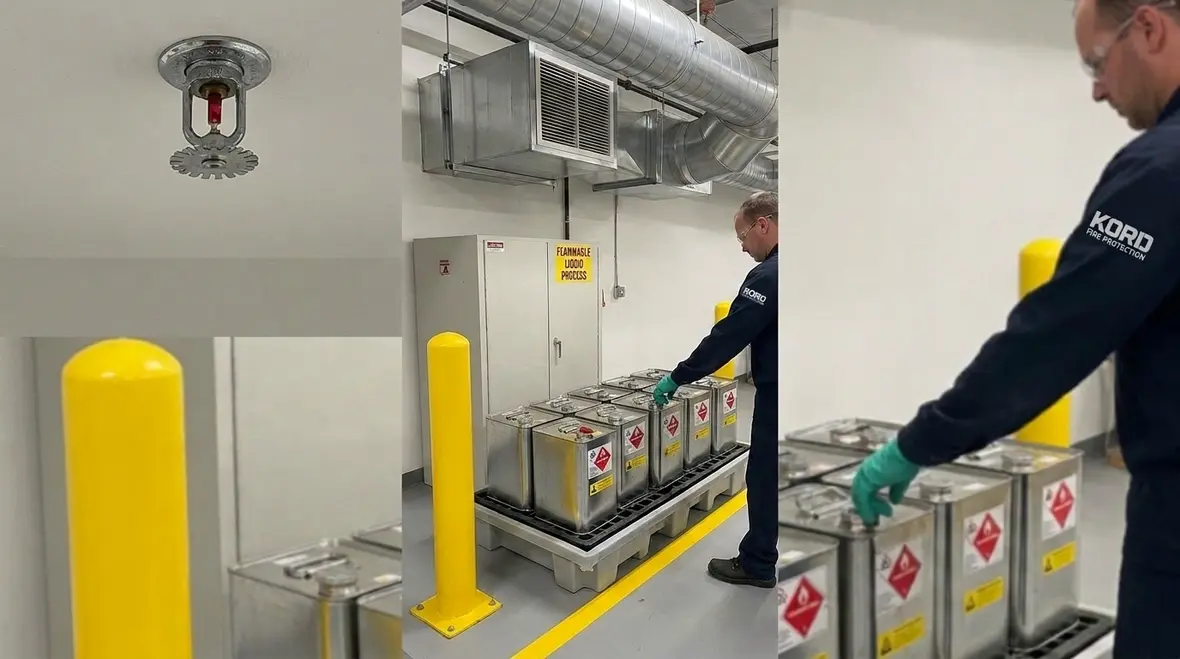
NFPA 34 Section 8.3: Storing Flammable Liquids in Process Areas
Quick Answer
NFPA 34 Section 8.3 sets practical requirements for NFPA 34 process area flammable liquid storage where liquids are used in operations. It focuses on controlling quantities, protecting containers, maintaining safe separation, preventing ignition sources, and supporting reliable detection, ventilation, and fire protection performance.
What Section 8.3 is trying to prevent
In process areas, flammable liquids are not just “stored” in the ordinary sense. They are present to support ongoing production, cleaning, refueling, mixing, and transfer. NFPA 34 Section 8.3 addresses the higher risk profile created when flammable vapors can form near normal work activities, traffic patterns, and energized equipment. The intent is to minimize the chance that a release becomes an ignitable event and that an event escalates faster than designed controls can respond.
Facilities typically discover the compliance challenge is not a single missing item. Instead, it is how multiple elements interact: storage location choices, container conditions, transfer practices, housekeeping, ventilation performance, and how the site actually maintains and tests its protective systems over time.
Where Section 8.3 applies in real facilities
NFPA 34 process area flammable liquid storage applies to areas where flammable liquids are kept available for use in the process, including day tanks, small containers for line feeding, and operational storage tied to daily activities. Commercial and industrial operators often blur the boundary between general storage rooms and process areas, then struggle to demonstrate that the process-area controls are in place.
If your team is tightening documentation and recurring inspections around these areas, Kord Fire Protection’s inspection, testing, and maintenance program is a natural next step for keeping process risks from turning into inspection surprises.
Common “process area” misclassifications
- Liquid containers placed near point-of-use equipment but without defined limits and protective measures.
- Temporary staging during maintenance that lasts long enough to function as permanent storage.
- Mixed-use rooms where production and maintenance share ventilation and ignition risks.
- Warehousing-like accumulation in process corridors because it is “more convenient.”
When inspectors evaluate these areas, they focus on whether the site controls resemble a designed process environment rather than ad hoc storage.
Key compliance requirements: quantity, containers, and condition
Section 8.3 centers on limiting the amount of flammable liquid in process areas and ensuring containers remain reliable. Compliance documentation must align with the actual operating state, including normal production levels and expected peak operations.
Practical controls that reduce risk
- Defined maximum quantities: Sites establish maximum permitted amounts per area and per process unit to limit vapor load.
- Approved container integrity: Containers must be compatible with the liquid, maintained in good condition, and closed when not actively transferring.
- Secondary containment and spill control: Process areas use spill control methods appropriate to the liquid and activity to prevent spread.
- Labeling and identification: Correct chemical identification and condition tracking supports safe handling and reduces the chance of incompatible mixtures.
One frequent failure point is container “drift.” Over time, lids do not seal, gaskets harden, hoses degrade, and transfer hardware becomes difficult to keep closed. Even when the initial storage plan was correct, deterioration can defeat the risk-based assumptions.
How facilities manage ignition risk and vapor accumulation
In process areas, vapor control depends on the environment. NFPA 34 aligns with the concept that ignition sources and vapor concentrations must be managed through controls such as ventilation strategy, electrical equipment selection, and operational housekeeping.
Operational ignition controls
- Electrical and equipment suitability: Use equipment and wiring methods appropriate for the hazard classification and operating conditions.
- Hot work and temporary ignition sources: Enforce permits-to-work and define segregation from flammable liquid handling.
- Static electricity management: Implement bonding and grounding practices during transfers where required.
Ventilation and vapor control checks
Even when ventilation is installed, many commercial facilities struggle to maintain performance. Filters load, airflows change after renovations, and control sequences drift. A compliance program should include inspection and testing of ventilation operation, exhaust effectiveness, and interlocks where used. Documenting calibration and corrective actions matters during audits.
Housekeeping that inspectors recognize
Housekeeping is not cosmetic. It verifies that spills and residue do not accumulate, that floors support safe movement, and that waste containers do not become an unintended reservoir. Typical issues include oily absorbents left in open containers, waste staging in process corners, and improper disposal containers.
Fire protection readiness and impairment management
NFPA 34 process area flammable liquid storage compliance depends on fire protection and emergency systems that can perform when the area is most likely to be challenged. In many sites, the systems exist but do not remain “ready” due to maintenance practices, missed inspections, or prolonged impairments.
Systems commonly evaluated in process areas
- Detection and alarms: Gas detection, vapor monitoring, or other initiating devices where applicable.
- Fire extinguishing systems: Sprinkler protection where required and other suppression methods for specific hazards.
- Emergency response readiness: Clear access, trained personnel, and communication practices.
- Control of combustibles: Limiting combustibles near storage to reduce fire growth rate.
A strong compliance program treats impairments as a risk event. Procedures should define duration limits, compensatory measures, and authority to restore service. The operational reality is that process schedules often tempt teams to postpone repair work, which increases exposure and can create noncompliance findings.
What to document for ongoing inspections
Inspections reward traceability. Facilities typically need documented evidence that storage practices, container condition, ventilation performance, and fire protection readiness remain consistent.
Commercial documentation packages that hold up
- Area inventory records: Quantities by process unit and updates reflecting operational changes.
- Container inspection logs: Frequency, criteria, and corrective actions.
- Transfer and spill procedure records: Training, PPE requirements, and spill response drills where used.
- Ventilation performance documentation: Inspection results, testing records, and maintenance history.
- Fire protection inspection and maintenance history: Including impairment tracking and restoration verification.
Kord Fire Protection supports these needs by providing inspection, testing, and maintenance programs designed for commercial facilities with complex operational schedules. That service focus helps organizations sustain compliance rather than “resetting” only when an inspection is imminent.
For related guidance on compliance planning and ongoing service, see this commercial fire safety audit step by step process and review how the team can assist with inspection and maintenance readiness.
Frequently Asked Questions
Get Section 8.3 ready before the next walk through
NFPA 34 process area flammable liquid storage requirements succeed when controls are built into daily operations and verified through maintenance and documentation. Kord Fire Protection can help commercial teams validate storage practices, test and maintain protective systems, and manage impairments so compliance remains stable. Contact Kord Fire Protection to schedule a targeted assessment and build a practical maintenance and inspection plan aligned with your process realities.

Join Our Newsletter!
Get the latest fire safety tips delivered straight to your inbox From our Newsletter.



