
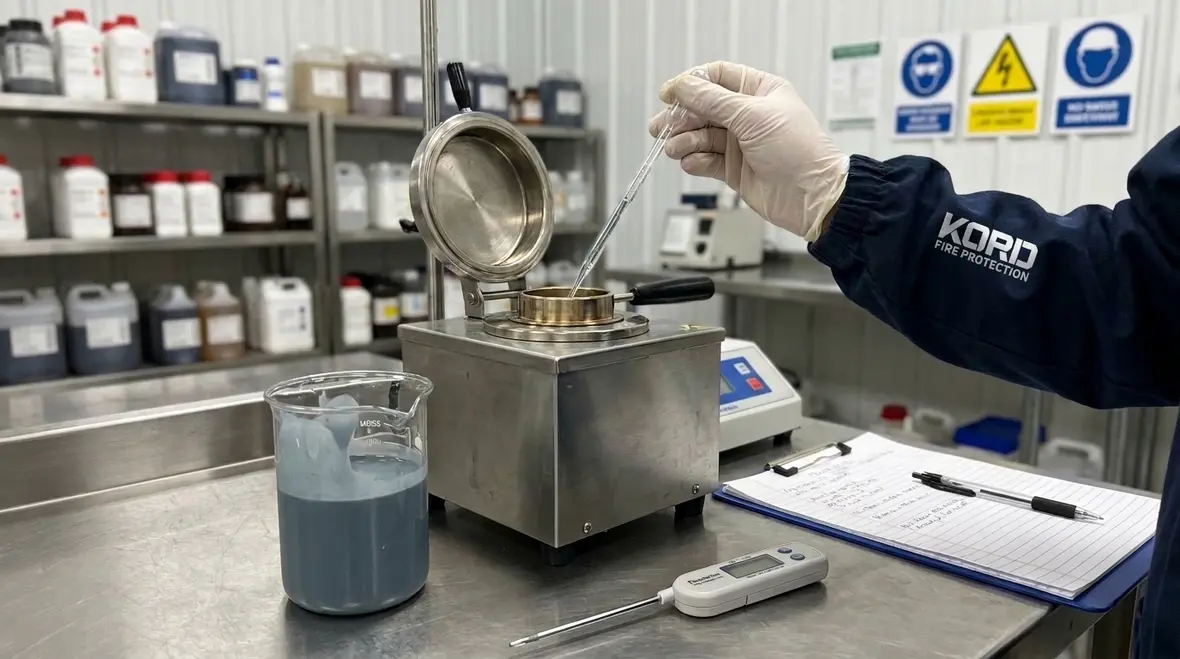
NFPA 34 Section 4.8: Determining Flash Point of Coating Liquids and Mixtures
Quick Answer: NFPA 34 Section 4.8 provides the technical basis for determining the flash point of coating liquids and mixtures. It focuses on selecting appropriate test methods, preparing samples correctly, controlling conditions, and documenting results so facilities can classify fire hazards and maintain compliant storage and handling.
If your team is reviewing coating hazard documentation as part of a broader compliance effort, it helps to coordinate that work with a commercial fire suppression systems service program so records, readiness, and protection planning stay aligned.
Why NFPA 34 flash point determination coating liquid mixtures matters in real facilities
In commercial, industrial, and retail coating operations, flash point data drives classification of flammable and combustible liquids, informs electrical area decisions, and supports safe design for storage, mixing, and application. The NFPA 34 flash point determination coating liquid mixtures requirement under Section 4.8 exists to make flash point testing defensible, repeatable, and usable by inspectors and risk managers. When testing is performed loosely, facilities often end up with inconsistent classifications, documentation gaps, and rework during safety audits.
Operationally, the hardest compliance challenges usually involve mixed products, sampling variability, and uncontrolled test conditions. Kord Fire Protection supports facility teams by aligning testing and records with inspection expectations, and by maintaining ongoing fire protection readiness through practical compliance support.
What Section 4.8 is trying to control, not just measure
Section 4.8 focuses on a single objective: determining the flash point of coating liquids and mixtures using methods that produce credible results under controlled conditions. Flash point is not a marketing number. It is a laboratory outcome influenced by formulation composition, temperature history, sample handling, and the test apparatus operation.
Key intent areas facilities must respect
- Correct method selection: Facilities must use a procedure appropriate to the liquid or mixture, and ensure the apparatus and operating steps match the standard used for the flash point measurement.
- Representative sampling: If the sample does not reflect the bulk product, the flash point can shift enough to affect classification and mitigation requirements.
- Controlled test conditions: Ambient conditions, sample temperature, ignition system performance, and timing controls influence results.
- Traceable documentation: Inspectable records should show what was tested, how it was tested, and what conditions applied.
How facilities typically execute NFPA 34 flash point testing for coatings
Coating products often include solvents, resins, thinners, and additives. Mixtures can behave differently than single-component liquids. A disciplined procedure reduces variability and improves defensibility during compliance reviews.
1) Identify the specific product and mixture boundaries
Before any test, the facility should define what constitutes the tested mixture. For example, a “ready to spray” mixture may differ from “base resin” and “thinner” stored separately. The flash point determination coating liquid mixtures requirement typically becomes operationally important when a formulation is changed, thinned, or combined per a job or process standard.
2) Ensure sample representativeness and prevent formulation drift
Sampling failures are common. Solvent evaporation, stratification, or incomplete mixing can skew results. Facilities should establish sampling points, mixing steps (if permitted), and container practices that maintain the formulation close to the expected composition at the time of intended use.
- Use sealed containers and minimize headspace exposure time when the formulation contains volatile constituents.
- Follow a documented mixing and sampling sequence that reflects how the product is prepared in production.
- Verify container labeling so the test sample matches procurement batch identification and intended process mixture ratios.
3) Control temperature history and measurement conditions
Flash point testing depends on the relationship between sample temperature and ignition conditions. Facilities should verify that the test lab or in-house technician controls pre-test stabilization time and that the apparatus is calibrated and operating within required limits.
- Confirm the sample temperature equilibration process before beginning the test.
- Maintain test area controls, including ventilation and drafts, that can affect ignition behavior and temperature stability.
- Record ambient conditions that could influence repeatability.
4) Use reliable apparatus performance and operator practice
Even with correct sample handling, apparatus and operator execution drive outcomes. A defensible flash point record typically includes identification of the test method used, key equipment identifiers, and evidence of calibration or maintenance.
- Verify that the ignition mechanism operates as specified by the test method.
- Confirm that the heating rate and timing controls meet the method requirements.
- Ensure the measurement process is consistent across repeat tests, if performed.
When coating liquids become “mixtures”: the compliance pressure point
Section 4.8 becomes especially relevant when a facility uses thinners, additives, multi-part systems, or blends products to meet project specifications. In these cases, a tested flash point for a base component may not reflect the flash point of the final mixture used on the floor or in spray operations.
Common failure points during coating mixture flash point determination
- Testing only the base product: Facilities sometimes rely on supplier data for a component and assume the mixture result will align.
- Uncontrolled dilution ratios: Small changes in solvent ratio can move flash point enough to impact classification.
- Inconsistent mixing procedures: If the mixing method differs from production practice, the sample is not representative.
- Outdated documentation: Product formulations change over time, and in-house records do not always track rebranded or reformulated materials.
Best practice is to treat flash point as part of a formal change control process. When formulation, supplier, lot, or mixing ratio changes, the facility should evaluate whether the mixture needs retesting and whether impacted documentation must be updated for safety and inspection readiness.
What inspectors and auditors expect to see in your records
During inspections, the gap is rarely about whether a flash point number exists. The gap usually involves traceability, consistency, and the ability to explain how the facility determined and used the flash point value for hazard classification.
Record elements that strengthen compliance defensibility
| Record element | Why it matters |
|---|---|
| Product and mixture identification | Links flash point to the exact formulation used for storage and operations. |
| Test method identification | Shows the procedure used and allows comparison to applicable standards. |
| Apparatus identification and calibration status | Supports reliability and repeatability of results. |
| Sampling method and handling notes | Demonstrates representativeness and minimizes volatility or stratification bias. |
| Test conditions and temperatures | Supports accuracy of the temperature control aspects of ignition testing. |
| Results and uncertainty or repeatability notes (if available) | Improves risk interpretation and supports consistent classification decisions. |
| Hazard classification and document update process | Shows how flash point data flows into electrical, storage, and operational controls. |
To align this documentation workflow with broader fire protection responsibilities, many facilities coordinate their compliance program with Southern California fire protection services for ongoing readiness. While fire suppression systems serve a different function than flash point testing, strong documentation discipline and maintenance planning reduce the risk of broader compliance gaps.
Frequently Asked Questions
Next step: tighten flash point defensibility before inspection pressure arrives
Facilities that handle coating liquid mixtures should standardize sampling, test conditions, and record traceability so flash point determination supports consistent hazard classification. Kord Fire Protection helps commercial and industrial sites maintain inspection-ready fire safety documentation and ongoing readiness across systems and maintenance schedules. Contact Kord Fire Protection to review your flash point records workflow, mixture change control practices, and related fire safety compliance needs.

Join Our Newsletter!
Get the latest fire safety tips delivered straight to your inbox From our Newsletter.



