
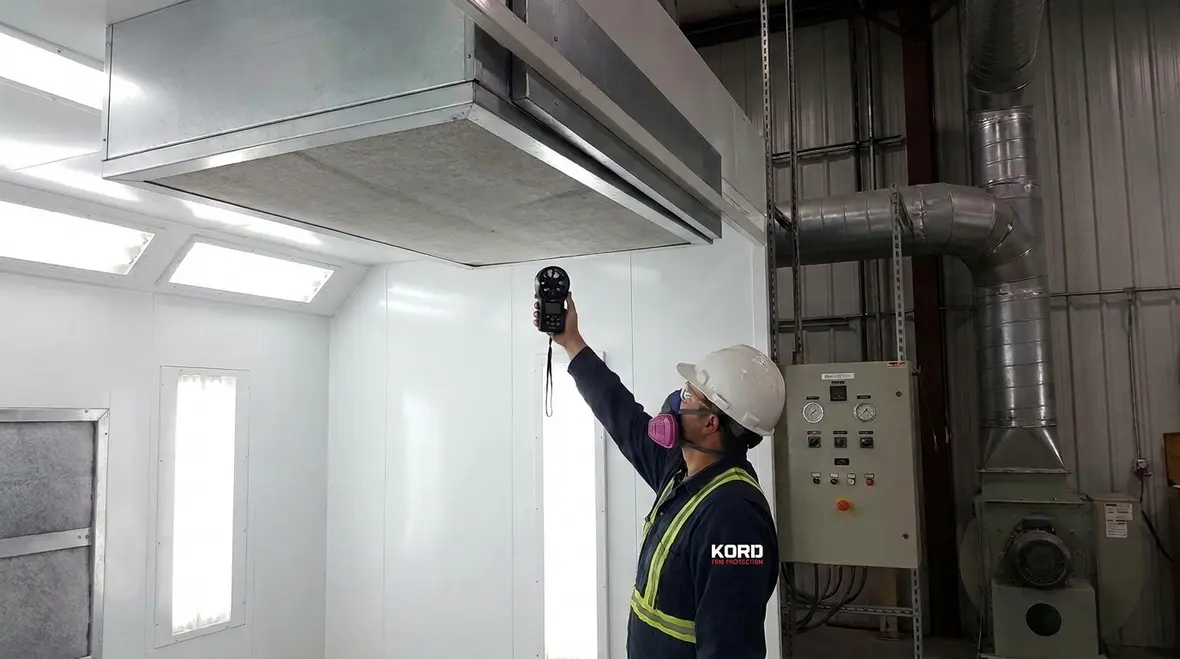
NFPA 33 Section 7.3: Make-Up Air for Spray Operation Exhaust Systems
Quick Answer
NFPA 33 Section 7.3 addresses how spray operations must receive sufficient make-up air to support safe exhaust performance and stable capture. Compliance focuses on proper airflow balance, controlled distribution, and documented inspection and maintenance of make-up air and exhaust components.
What does NFPA 33 Section 7.3 require for make-up air?
Spray booths and spray operation exhaust systems rely on more than ducting and fans. NFPA 33 make-up air spray operation requirements ensure the space receives the correct volume and distribution of replacement air so the exhaust system maintains intended performance, containment, and ventilation stability.
In commercial and industrial facilities, this requirement directly affects worker exposure control, overspray capture, and the effectiveness of controls that manage airflow during different operating modes.
Why make-up air matters for spray capture and control
Exhaust systems remove contaminated air generated by spray application. Without adequate make-up air, the booth or room can experience negative pressure beyond design intent, leading to loss of capture, door infiltration turbulence, and inconsistent face velocity at openings. Conversely, excessive make-up air can dilute contaminants, reduce capture effectiveness, and create eddies that move overspray toward clean areas.
Operational failure points commonly seen during compliance checks
- Imbalanced airflow between exhaust and make-up air, causing capture inconsistency at the booth opening or at transfer doors.
- Uncontrolled make-up air distribution, leading to short-circuiting near supply diffusers or ceiling returns that bypass the spray zone.
- Leaking dampers and seals that degrade performance during idle versus active spray cycles.
- Fan speed drift in variable air volume systems, resulting in airflow mismatch after filter loading changes.
- Control system misconfiguration where interlocks do not verify exhaust status before make-up air changes state.
How facilities typically implement Section 7.3 compliant make-up air
NFPA 33 Section 7.3 is implemented through design and control strategies that keep airflow stable and predictable during spray operation. While exact configurations vary by facility and booth design, successful compliance programs share the same technical approach: match make-up air to exhaust requirements, deliver it where it supports capture, and verify the relationship through test and documentation.
Facilities reviewing booth hazards and ventilation controls often also benefit from understanding spray booth fire suppression for safer paint operations, especially when airflow, ignition control, and maintenance planning all have to behave like adults in the same room.
Key design and control elements
- Airflow balance strategy: make-up air volume and pressure are controlled to maintain stable negative pressure without over-penalizing capture performance.
- Distribution method: diffusers or air curtains are positioned to support uniform air movement across the spray zone and reduce turbulence at openings.
- Interlocked operation: make-up air controls coordinate with exhaust system start, stop, and any staged operation so the system does not enter unsafe states.
- Mode tracking: airflow settings reflect operational modes such as spraying, standby, maintenance, and cleaning cycles.
- Filtration and conditioning: if filtration or heating is used for make-up air, the design addresses pressure drop so airflow does not silently fall out of tolerance.
Common equipment components and what to inspect
| Component | What it does | Common compliance issues |
|---|---|---|
| Make-up air fan or air handling unit | Provides replacement air volume and pressure | Speed drift, failed VFD tuning, clogged coils or intake screens |
| Dampers (motorized or backdraft) | Controls airflow direction and quantity | Leaking seals, stuck blades, missing position feedback |
| Air diffusers and air curtains | Shapes air movement around the spray zone | Misalignment, damaged vanes, short-circuiting |
| Pressure and airflow sensors | Monitors system state and supports control logic | Sensor drift, clogged ports, calibration gaps |
| Exhaust monitoring and control | Ensures exhaust operation matches spray demand | Interlocks bypassed, alarm logic ineffective, mode setpoints not verified |
What “good compliance” looks like during inspections
Compliance with NFPA 33 make-up air spray operation requirements typically depends on more than presence of equipment. Inspectors and internal safety audits look for evidence that the make-up air and exhaust system operate as a matched ventilation control. That means measured performance, functional checks, and documented maintenance history.
Verification practices that stand up in audits
- Airflow verification: field measurements confirm replacement air supports stable spray capture. Results should align with design assumptions and current system condition.
- Control logic verification: interlocks and sequencing prove make-up air follows exhaust operation and responds properly to alarms and staged modes.
- Functional damper and leakage checks: technicians verify damper actuation and that leakage does not undermine airflow balance.
- Sensor calibration checks: pressure and airflow measurements reflect actual conditions, especially after filter changes or seasonal adjustments.
- Documented maintenance: filter servicing, duct inspection, fan maintenance, and control component replacement records show the system stays within operational parameters.
For many facilities, the most common audit gap is stale setpoints or unverified control sequences after upgrades. A change in booth layout, ductwork modifications, or control system commissioning can shift airflow balance while operators still assume “the system is working.”
Maintenance and seasonal challenges that cause drift
Make-up air systems often appear stable until operating conditions change. Seasonal weather swings, filter loading, and recurring maintenance tasks can alter pressure relationships between make-up air and exhaust. Facilities that treat make-up air as a “set and forget” component often encounter intermittent compliance issues during routine inspections.
High-risk maintenance scenarios
- Filter replacement cycles: as filters load, static pressure increases and airflow drops unless controls compensate.
- VFD and fan maintenance: firmware updates or motor changes can reset airflow curves, changing delivered volume.
- Ductwork modifications: minor additions, seal repairs, or boot replacements can change air distribution patterns at the spray zone.
- Operational overrides: maintenance mode bypasses interlocks that later return to production settings without airflow verification.
- Thermal effects: heating coils and outdoor air changes shift density and airflow under the same control signal.
To manage these risks, facilities should adopt a recurring testing cadence matched to operating schedules and known system sensitivities. Kord Fire Protection supports commercial sites with compliance-driven testing, inspection coordination, and maintenance recommendations that help prevent airflow drift from becoming an operational liability.
For related fire safety ventilation guidance, refer to fire pump room ventilation for reliable fire protection. Use anchor text “fire pump room ventilation for reliable fire protection” to align internal service capabilities with NFPA-aligned ventilation compliance work.
Frequently Asked Questions
Next step: confirm airflow balance before the next inspection
NFPA 33 make-up air spray operation requirements succeed when make-up air and exhaust operate as a matched system, with verified performance, reliable interlocks, and maintenance-driven control stability. Kord Fire Protection can support your commercial spray facility with inspection coordination, testing, and ongoing maintenance planning so airflow balance does not drift out of compliance between scheduled checks. Schedule a compliance review today to identify gaps early and protect both workers and production continuity.

Join Our Newsletter!
Get the latest fire safety tips delivered straight to your inbox From our Newsletter.



