
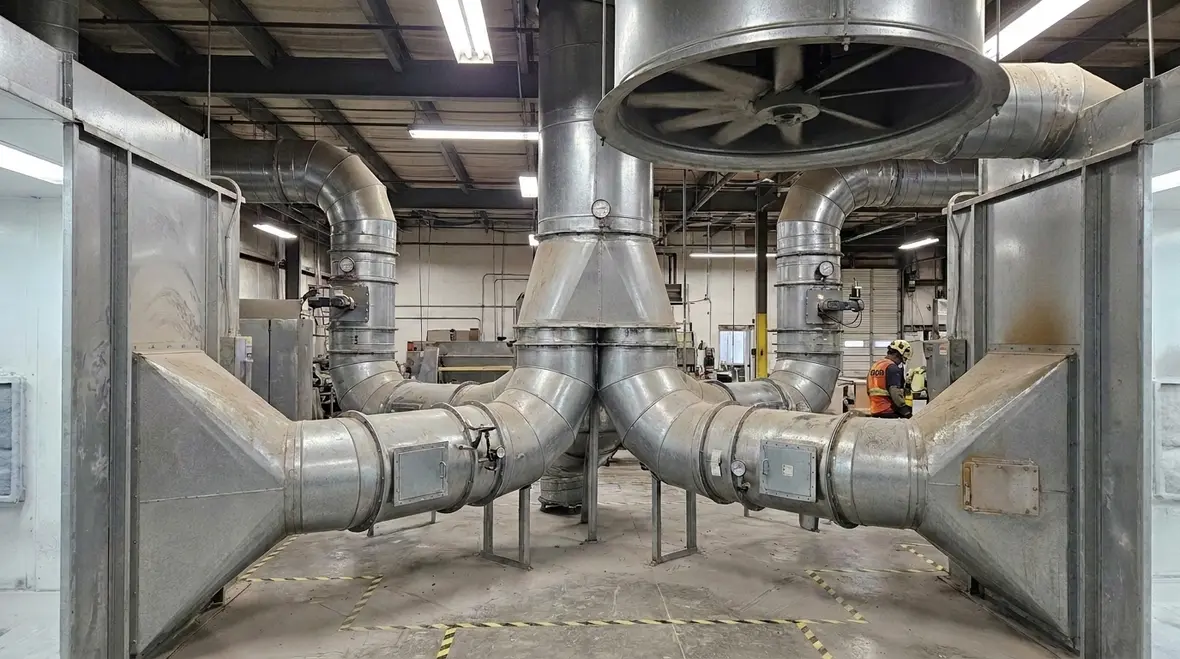
NFPA 33 Section 7.7: Manifolding Exhaust Ducts From Multiple Spray Areas
Quick Answer
NFPA 33 Section 7.7 governs how facilities combine exhaust from multiple spray areas into a shared duct or manifold system. Compliance hinges on controlling airflow direction, preventing cross contamination, maintaining pressure and velocities, and documenting inspection and maintenance practices for reliable, safe operation.
Facilities reviewing shared spray exhaust layouts often also benefit from a closer look at spray booth fire suppression for safer paint operations, especially when ventilation behavior, interlocks, and maintenance planning all need to work together.
Why manifolded exhaust systems require tighter controls
When a facility combines spray area exhaust into a common duct manifold, it changes how fire, flammable vapor, and overspray behave within the ventilation network. In practice, the primary risk is not only transporting hazardous vapors, but also enabling unintended movement between spray zones during normal operation, startup, shutdown, filter loading, or equipment failure. NFPA 33 exhaust duct manifold multiple spray areas can therefore only be considered safe when the ducting design, dampers, controls, and maintenance program prevent reverse flow and manage changing exhaust demand.
NFPA 33 exhaust duct manifold multiple spray areas is commonly required to reduce ducting complexity and floor congestion in commercial and industrial facilities, including paint booths, coating rooms, and retail refinishing areas. However, regulators and insurers typically expect strict evidence that the manifold arrangement does not compromise hazard control across each spray location.
What Section 7.7 is trying to prevent
Section 7.7 focuses on the ability of the exhaust system to keep each spray area connected to the control of hazardous vapors without allowing an exhaust path that could spread those hazards into spaces not intended to be ventilated at that time. The key operational hazards commonly show up in real-world commissioning and ongoing use:
- Backflow or reverse airflow when one spray area stops and another starts, or when fans ramp up and down.
- Cross contamination from one spray process to another, including differences in solvent type, temperature, and particulate loading.
- Unequal airflow caused by duct leakage, poor balancing, or filter loading, resulting in conditions outside the required exhaust performance.
- Accumulation and ignition risks when downstream components such as filters and collectors become overloaded or improperly maintained.
For compliance, the facility must demonstrate that the system behaves predictably under both steady state and transient conditions, not only when commissioning is fresh and filters are clean.
Common manifold configurations and where systems fail
1) Shared manifold with segregation at the takeoffs
Most facilities using a manifold system maintain separate duct connections to each spray area before the lines join. This configuration can be compliant when the design includes safeguards that stop undesired airflow between branches. Common safeguards include:
- Backdraft or check dampers at each branch takeoff to prevent reverse flow.
- Positive pressure management through controlled fan operation and duct sizing.
- Airflow balancing so each spray area receives the expected exhaust performance even as filters load.
Typical failure points: dampers that stick due to particulate buildup, misaligned damper linkages after maintenance, warped damper blades, and loose seals at damper frames that create leakage paths.
2) Ducting shared downstream of multiple spray areas
Some designs join branches earlier to reduce duct complexity. This can increase the consequence of failure because cross contamination pathways shorten. Compliance depends on whether the arrangement still prevents the manifold from acting like an uncontrolled collector of multiple hazardous atmospheres.
Typical failure points: missing branch separation devices, inadequate duct slope and drain provisions where required, and fan or damper control sequences that do not account for transient operation.
3) Interlocked systems tied to spray activity
Facilities sometimes interlock exhaust fans and dampers to spray equipment start and stop. This can reduce the likelihood of hazardous atmospheres traveling where they should not. The control logic must also handle:
- Delayed fan start after spray begins.
- Run-on periods after spray stops.
- Alarm and fault states such as fan failure, damper failure, or airflow deviation.
Typical failure points: control software changes without a formal hazard review, insufficient verification of damper position feedback, and bypass switches that defeat interlocks.
How to verify compliance after installation and during ongoing operations
Most compliance problems for manifolded systems surface during inspection and maintenance. An acceptable program should cover both physical and operational checks, supported by records that show the system continues to perform as intended.
Operational performance checks
- Airflow confirmation at each spray area connection during operating conditions, including when filters are partially loaded.
- Damper operation verification for each branch, including evidence that dampers close promptly during stop conditions.
- Fan control sequencing review to confirm run time, ramping behavior, and failure response align with the safety intent.
Inspection of components that drift out of compliance
In commercial and industrial environments, these items commonly degrade faster than the duct itself:
- Filters and collectors that load unevenly due to branch airflow imbalance.
- Dampers affected by overspray deposits, vibration, and corrosion.
- Seals and joints that loosen during routine access, booth cleaning, or vibration.
- Exhaust hoods and transitions that shift during maintenance, creating turbulence and airflow losses.
Maintenance documentation that inspectors look for
Facilities often assume that “cleaning the booth” equals maintaining the exhaust system. NFPA 33 related expectations typically require maintenance traceability for the exhaust network, including:
- Filter change and cleaning logs tied to operating hours or differential pressure indicators.
- Damper inspection intervals, functional testing results, and corrective actions.
- Inspection reports for duct integrity and connections, including leak checks where applicable.
For facilities standardizing their compliance workflow, Kord Fire Protection supports ongoing testing, inspection readiness, and maintenance support. They help teams keep manifolded exhaust systems aligned with NFPA 33 requirements without waiting for the next audit cycle.
What changes in retail, industrial, and multi-tenant facilities
The same manifold concept behaves differently across facility types because operating schedules, occupancy patterns, and maintenance staffing vary.
Retail and small commercial refinishing areas
Smaller spaces often have limited service access, which can lead to deferred damper servicing and slower detection of airflow imbalance. A single shared exhaust manifold may be installed to reduce space conflicts, but the facility still must prevent cross flow between processes, including periods when one booth is idle.
Industrial paint and coating lines
Industrial environments typically run longer shifts and see heavier particulate loading. This accelerates filter and damper degradation, increasing the likelihood of unequal branch airflow. A robust differential pressure strategy, filter life tracking, and periodic performance verification become essential to keep NFPA 33 exhaust duct manifold multiple spray areas functioning within design intent.
Multi-tenant or shared infrastructure settings
In shared buildings, teams sometimes assume exhaust systems are isolated by walls and fans. Manifolded ducting creates shared pathways, so the fire safety plan and maintenance responsibilities must clarify who verifies damper function, who monitors airflow deviations, and how changes to any branch are communicated and evaluated.
Frequently Asked Questions
Next step: confirm your manifolded system performs as designed
Manifolding exhaust ductwork from multiple spray areas can be compliant, but only when dampers, controls, balancing, and maintenance prevent cross flow and performance degradation over time. Kord Fire Protection can help your team validate inspection readiness, evaluate manifold components, and support a maintenance program that protects people, processes, and assets. Contact Kord Fire Protection today to schedule a compliance-focused review of your NFPA 33 exhaust duct manifold multiple spray areas system.

Join Our Newsletter!
Get the latest fire safety tips delivered straight to your inbox From our Newsletter.



