
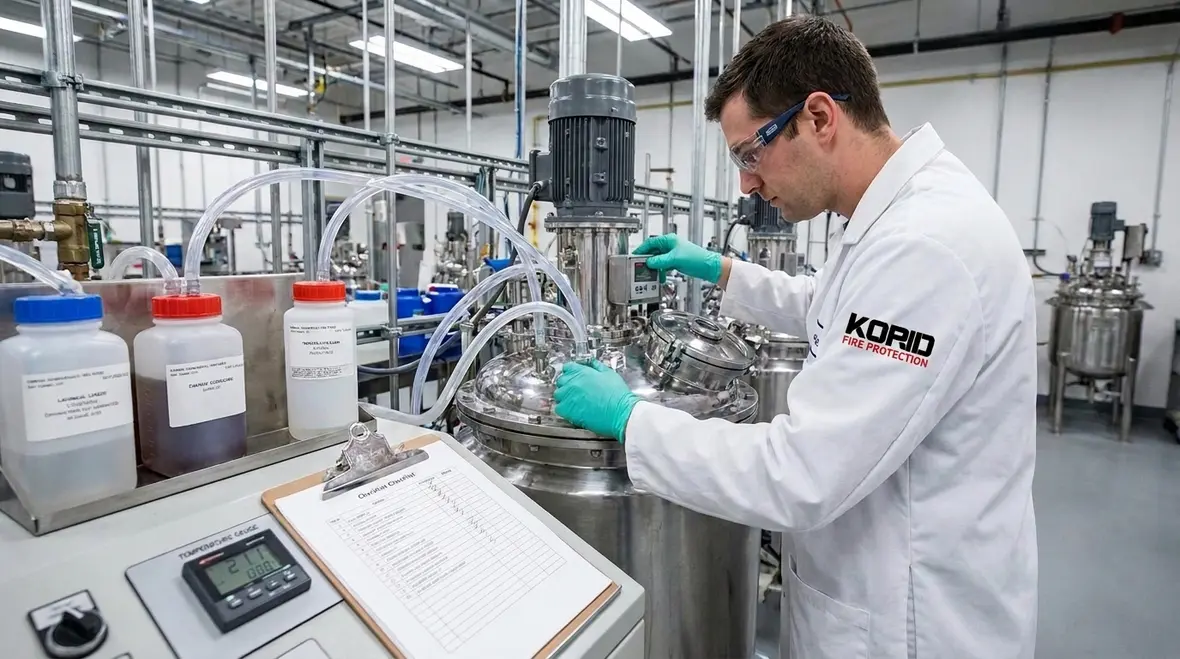
NFPA 33 Section 16.6: Mixing Organic Peroxides With Promoters
Quick Answer
NFPA 33 Section 16.6 governs how organic peroxide formulations are combined with promoters to control reaction risk. Following the NFPA 33 organic peroxide promoter mixing rules means using approved formulations, correct order of addition, compatible equipment, and documented procedures to prevent runaway decomposition, poor initiator performance, and unsafe conditions during batch operations.
Facilities looking to connect peroxide handling areas with broader inspection readiness can also review fire protection services in Southern California for a practical overview of inspections, repairs, maintenance, and compliance support across active commercial and industrial properties.
What Section 16.6 is really trying to prevent
NFPA 33 Section 16.6 exists to reduce three high consequence failure modes that commonly occur during organic peroxide blending and activation: uncontrolled or accelerated decomposition, inadequate polymerization or crosslinking due to incorrect promoter concentration, and unsafe physical conditions such as overheating or incompatible contact that can trigger rapid escalation.
In commercial and industrial settings, these failures often do not come from a single obvious mistake. They arise from cumulative process drift: the wrong transfer equipment, inaccurate dosing, mixing steps executed out of sequence, or promoter addition performed in a way that creates localized heating. Facilities that run multiple product lines and use different suppliers also face challenge: promoter systems may look similar, but their compatibility and sensitivity can vary.
NFPA 33 organic peroxide promoter mixing rules: core compliance practices
Facilities that align to NFPA 33 organic peroxide promoter mixing rules typically establish a controlled framework rather than relying on “best effort” blending. The practical compliance baseline centers on approved formulations, verified concentrations, and disciplined batch controls.
1) Use approved promoter concentration targets
Most compliant blending programs target promoter concentration within a defined operating window, frequently in the range of 0.5% to 1.0% depending on the peroxide chemistry and the manufacturer’s instructions. The key compliance requirement is not the numeric range alone; it is the facility’s ability to prove the actual concentration stays within the approved specification for each peroxide and promoter pair.
Operationally, this means batch records that capture measured mass or volume, calibration status of dosing devices, and the method used to verify concentration.
2) Control the order of addition and mixing sequence
Mixing organic peroxides with promoters can create rapid changes in local temperature and concentration if the promoter is introduced unevenly. Compliant procedures therefore specify the order of addition, whether the peroxide is charged first or the promoter is introduced under controlled conditions, and the mixing duration and agitation method that produces uniform distribution without hot spots.
Where facilities struggle during inspections, the gaps often include incomplete step logging, missing hold points for temperature checks, and mixing instructions that are not tied to the exact equipment used in production.
3) Protect against incompatibilities and unintended reactions
Promoters can be reactive, and organic peroxides can be sensitive to heat, contamination, and certain materials. The mixing rules translate into strict controls on what the peroxide and promoter contact. This includes cleaning practices for transfer hoses, gasket selection, vessel coatings, and avoidance of cross contamination between product families.
Common failure points include residual cleaning chemicals in lines, reusing flexible hoses without documented decontamination verification, and changing seals or elastomers without an engineering approval process.
4) Use equipment designed for controlled peroxide handling
NFPA 33 requirements drive use of compatible mixing and transfer equipment and a process that supports predictable heat removal and uniform mixing. Facilities typically implement engineering controls such as temperature monitoring, controlled agitation, and covered transfer to reduce exposure to oxygen, contamination, and physical instability.
For commercial and retail operations that store and blend small batches, the inspection focus often remains on evidence. Inspectors expect to see documented procedures and verification that the mixing system behaves consistently across shifts.
How to operationalize Section 16.6: batch workflow and controls
Compliance becomes practical when the facility builds a step by step workflow that can be followed consistently by trained operators. A typical compliant mixing workflow includes preparation, controlled addition, verification, and release criteria.
Pre batch readiness checks that reduce risk
Confirm the exact peroxide and promoter identities using receiving records and labeling. Do not rely on “similar look” substitutions.
Verify promoter concentration target and the permitted range, commonly aligned with a 0.5% to 1.0% window when specified by the product system.
Check equipment compatibility including gaskets, seals, hose materials, and vessel coatings, and confirm cleaning verification status.
Validate instrumentation such as temperature probes and metering devices, including calibration documentation.
Controlled mixing steps that prevent localized overheating
Maintain prescribed addition sequence and avoid promoter slugs that can create localized concentration and heat generation.
Use mixing parameters tied to the batch record such as agitation rate and mixing time, matched to the vessel geometry.
Monitor temperature during key steps and stop, hold, or adjust per the written procedure if temperature trends exceed limits.
Verification and release criteria inspectors look for
At the end of the batch, facilities should demonstrate that the mixed material meets the specification and that the process did what it claimed. Release criteria commonly include concentration verification and record completeness. Inspectors frequently review consistency across batches, not just a single successful run.
For facilities with multi shift production, the most effective approach includes operator training records, competency checks, and a mechanism to detect and correct drift in dosing performance.
Common inspection gaps in commercial and industrial peroxide mixing
Many facilities pass only the “visible” portion of the compliance review but fail the deeper process validation questions. The most common gaps tend to be documented in training, maintenance, and change control.
1) Batch records that do not match the actual setup
Records may reference one mixing vessel configuration but operators use a different one due to availability. Even small changes in piping, hose routing, or gasket selection can alter contact compatibility and mixing dynamics.
2) Dosing devices without documented calibration intervals
When metering pumps, weigh systems, or flow meters lack current calibration verification, the facility cannot confidently demonstrate promoter concentration control. This directly undermines adherence to NFPA 33 organic peroxide promoter mixing rules, including the typical 0.5% to 1.0% operating window where specified.
3) Maintenance that does not include peroxide compatible checks
Maintenance is often treated as general mechanical housekeeping. For peroxide mixing, maintenance must also verify that components remain peroxide compatible and that cleaning procedures remove residues that can trigger reaction or instability.
Where Kord Fire Protection fits: practical compliance support
NFPA 33 compliance demands more than signage and basic storage practices. Commercial facilities need a continuing program that verifies systems, maintains readiness, and supports safe operations across production schedules. Kord Fire Protection supports facilities with ongoing fire safety compliance services tied to the realities of industrial and commercial workflows, helping reduce avoidable process risk through structured inspection readiness, documentation support, and maintenance coordination.
If your program includes peroxide blending areas, Kord Fire Protection can help align your broader fire protection readiness with the operational expectations that come with handling reactive oxidizers and their promoter systems.
For facilities tightening records, maintenance trails, and inspection prep, it also helps to review fire safety system documentation for compliance so the paperwork actually matches what is happening on the floor instead of becoming that one binder everyone points at and nobody trusts.
For additional guidance on related commercial fire safety planning, facilities can also review resources at Kord Fire Protection using anchor text that matches your internal tracking goals, such as “ongoing fire safety support for industrial operations.”
Frequently Asked Questions
Next step
Facilities that blend or activate organic peroxides should review mixing SOPs against NFPA 33 Section 16.6 expectations, confirm promoter concentration control within the approved window, and verify equipment compatibility through maintenance and documentation. Engage Kord Fire Protection to strengthen ongoing compliance readiness and maintenance coordination for commercial and industrial operations handling reactive materials.

Join Our Newsletter!
Get the latest fire safety tips delivered straight to your inbox From our Newsletter.



