
NFPA 32 Section 5.3 Solvent and Chemical Handling: Safe Handling Rules
Quick Answer
NFPA 32 Section 5.3 establishes practical safe handling rules for solvents and chemicals, focusing on approved containers, transfer procedures, labeling, bonding and grounding, ventilation, and ignition control. Facilities reduce fire and exposure risk by maintaining written procedures and verifying compliance through inspections and maintenance.
Facilities that handle flammable liquids can also benefit from a broader layered fire protection system for flammable liquids, especially when daily handling tasks overlap with storage, transfer, and ignition source concerns.
What do NFPA 32 solvent chemical handling requirements demand in Section 5.3?
NFPA 32 solvent chemical handling requirements in Section 5.3 require facilities to manage ignition sources, contain and identify chemicals properly, prevent spills and leaks, and protect employees during storage, handling, and transfer. Commercial operations often struggle not with theory, but with real world execution such as incomplete transfer checklists, degraded bonding jumpers, and ventilation controls that fail verification during routine maintenance.
How Section 5.3 structures safe handling across commercial workflows
Section 5.3 rules apply to everyday tasks that create the highest risk windows: receiving, staging, transferring, dispensing, cleaning, and temporary storage. Most compliance failures trace to process gaps where controls are present “on paper” but missing or inconsistent at the point of work.
1) Containers, closures, and labeling controls
NFPA 32 expects containers to remain suitable and closed when not actively in use. Labels and identification must match the actual material and support correct segregation. In retail and light industrial settings, unlabeled secondary containers and mixed residue in wash stations commonly undermine hazard communication and increase the likelihood of incompatible chemical combinations.
2) Segregation and compatibility for solvents and chemicals
Solvents and reactive or oxidizing chemicals require separation based on compatibility considerations. Facilities should verify segregation during inspections because storage layouts often change due to space constraints, seasonal workloads, or contractor staging. A frequent failure point involves “temporary” relocations that become permanent without updating controls and signage.
3) Transfer and dispensing procedures that prevent ignition and loss of control
Transfer operations create flammable vapor generation through agitation, splashing, and static charge. Section 5.3 emphasizes operational practices that limit upset conditions. Facilities should implement written transfer steps, require trained personnel, and ensure spill response materials are accessible and compatible with the chemicals in use.
Static electricity, bonding, grounding, and ignition source control
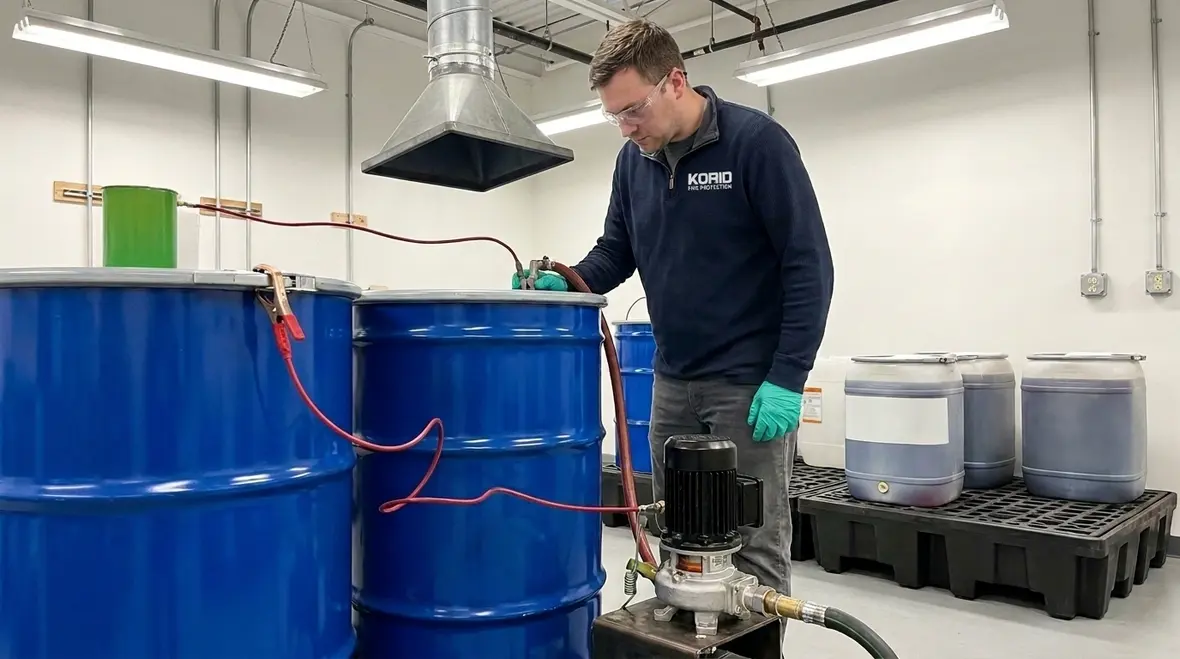
Static discharge and ignition control represent among the most critical execution points for solvent chemical handling. During transfers, flammable vapors can ignite if ignition sources are present. Bonding and grounding must maintain continuous electrical connection between equipment and containers as defined by facility procedures and equipment design intent.
Common failure points during bonding and grounding
- Bonding jumpers stored or replaced with the wrong assembly, resulting in intermittent or loose contact.
- Worn clamps, corroded contact points, or damaged grounding cables that still “look serviceable.”
- Use of nonapproved hoses or fittings that do not support static control.
- Transfer start before bonding is confirmed by procedure, especially during shift changes.
Commercial facilities benefit from periodic verification of bonding and grounding components, documented as part of a maintenance program. Kord Fire Protection supports ongoing compliance by helping facilities plan inspection and maintenance activities that validate the controls used during solvent transfer operations.
Ventilation, vapor control, and equipment conditions that make or break compliance
Ventilation and vapor control influence whether concentrations of flammable vapors remain below ignition risk levels. Section 5.3 safe handling rules typically intersect with ventilation system reliability, ensuring that process areas are managed to prevent accumulation of vapors during normal operations and foreseeable upset conditions.
Where ventilation compliance often breaks down
- Local exhaust systems running intermittently due to scheduling overrides or failed sensors.
- Ductwork obstructions, corrosion, or buildup that reduces airflow performance.
- Changed process output rates after equipment upgrades, without recalculating or revalidating ventilation needs.
- Improper door management that allows vapors to migrate from handling areas into adjacent occupancy.
For facilities seeking a structured approach to related fire protection obligations, Kord Fire Protection also supports integrated compliance planning aligned with broader code expectations. A helpful next step is reviewing commercial fire suppression systems and services to see how inspections, testing, and maintenance programs fit together across commercial sites.
Teams working around solvent recovery equipment may also find it useful to review NFPA 30 Section 19.6 solvent distillation unit requirements, since vapor control, ignition prevention, and documentation often overlap in the real world.
Spill prevention, containment, and emergency readiness
Section 5.3 reinforces the need to avoid uncontrolled releases and to prepare for them when they occur. Safe handling rules include maintaining containment where required, managing transfer lines to prevent rupture or disconnection, and ensuring response actions are immediate and consistent.
Spill control mechanics and inspection checklists
- Containment systems: verify berms, trays, and drain controls remain functional and not blocked by debris.
- Transfer hardware: inspect hoses, gaskets, quick disconnects, and couplings for wear or degradation.
- Drip and residual management: remove residue buildup that can become an ignition or exposure hazard.
- Response readiness: maintain absorbents and compatible neutralization or cleanup materials at the point of use.
Facilities also need to ensure that employees understand which actions to take first during a release. A common commercial issue is that spill supplies exist somewhere in the building but are not staged in the chemical handling area or are not compatible with the solvent being used.
Inspection, documentation, and maintenance practices that sustain compliance
Safe handling rules under NFPA 32 Section 5.3 must remain effective over time. Compliance depends on consistent documentation, periodic verification, and maintenance that addresses aging equipment and operational drift.
What “good” looks like for commercial compliance programs
- Written handling procedures matched to actual equipment and chemical types in service.
- Training records tied to transfer tasks, ventilation operation, and spill response actions.
- Inspection cadence for bonding and grounding components, transfer hardware, and container condition.
- Documented corrective actions when deficiencies are found.
Kord Fire Protection acts as a service partner for commercial, industrial, and retail facilities that need dependable inspection and maintenance support. This reduces the likelihood of control failures during busy operations, shift transitions, and contractor work.
Frequently Asked Questions
Call to action
To keep NFPA 32 solvent chemical handling requirements effective, implement a documented handling program and verify controls through inspections and maintenance. Kord Fire Protection can help commercial sites evaluate safe handling practices, identify control deterioration, and build ongoing support that reduces fire and exposure risk. Contact Kord Fire Protection today to discuss inspection and maintenance options for your solvent and chemical handling operations.

Join Our Newsletter!
Get the latest fire safety tips delivered straight to your inbox From our Newsletter.



