
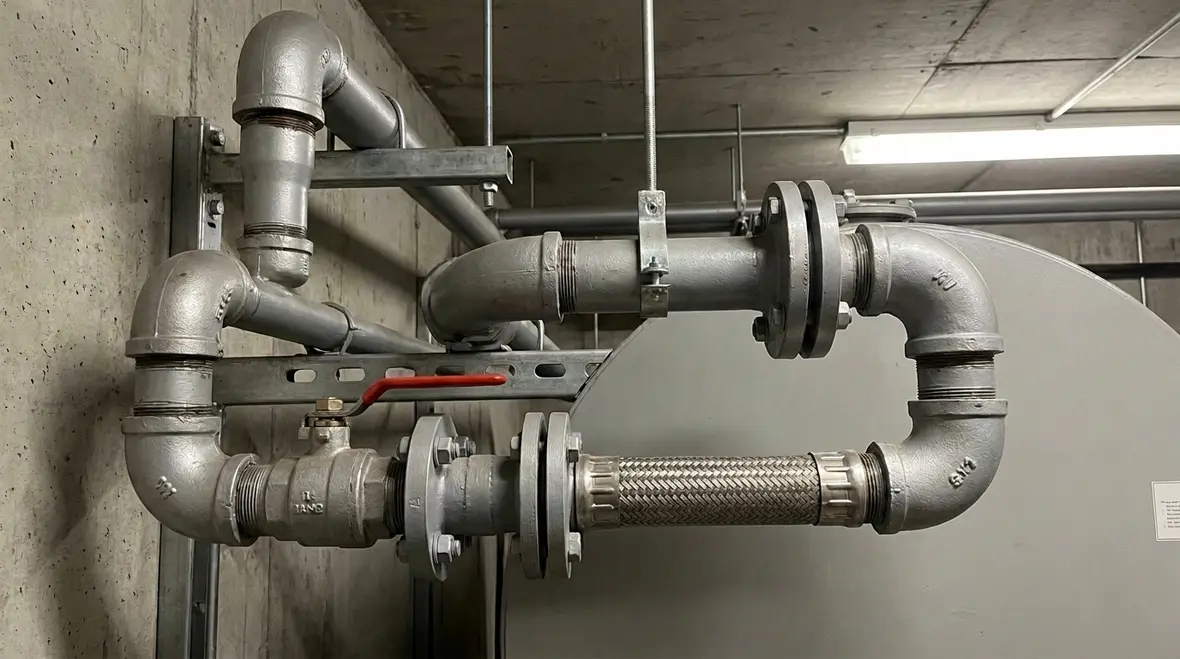
NFPA 31 Section 8.8: Auxiliary Tank Piping Requirements
Quick Answer: NFPA 31 Section 8.8 sets the minimum piping and installation controls for auxiliary oil tanks, including routing, support, protection, valves, bonding and grounding, and system integrity measures. Facilities must implement compliant pipe materials and arrangements to prevent leaks, ignition hazards, and undetected deterioration.
If you are reviewing this section as part of a broader oil-burning equipment compliance program, it helps to start with this practical guide to oil-burning equipment installation, which gives the bigger-picture context for tanks, piping, combustion air, and venting.
For facilities coordinating inspection readiness and corrective action planning, Kord Fire Protection also provides support through engineered fire protection systems services, which fits naturally into ongoing compliance management near the top of the project lifecycle.
Why NFPA 31 auxiliary tank piping rules matter in real facilities
Commercial and industrial sites rely on auxiliary oil supplies for continuity of heating and process operations. When auxiliary tank piping does not meet NFPA 31 auxiliary tank piping rules, the result often shows up later as a maintenance backlog, recurring alarm conditions, or contamination from slow seepage. The inspection effort becomes harder because failures frequently occur at joints, supports, flexible connections, and transition points where corrosion and vibration can develop.
For facilities that operate year round, the piping system also becomes part of the fire safety strategy. It must be installed and maintained so that leaks are limited, ignition sources are controlled, and remedial action remains practical during routine service and emergency response.
Scope of Section 8.8: where auxiliary tank piping controls apply
Section 8.8 focuses on auxiliary tank piping associated with fuel oil storage and transfer to burners or day tanks, depending on the overall installation design. These provisions typically govern the piping system that connects tanks and fuel delivery components, including how the piping enters and exits tank areas, how it is routed to minimize exposure, and how components are arranged to support both safe operation and inspection.
In practice, most compliance gaps come from assumptions about “like for like” replacements. A facility may replace a section of piping due to a leak but reuse fittings, sleeves, or routing methods that do not match the original compliance intent. Even when the oil type and burner remain unchanged, a nonconforming piping arrangement can create a new inspection finding.
Key installation requirements: routing, protection, and arrangement
Routing and accessibility for inspection
NFPA 31 expects piping to be installed so that condition can be evaluated over time. That means routing that avoids hidden damage zones such as unventilated cavities where leaks can accumulate unnoticed. Piping that runs through areas prone to mechanical impact should be protected or positioned to reduce the likelihood of abrasion and puncture.
Common operational reality: after renovations, piping routes that were once accessible become enclosed by tenant works, ceilings, or service covers. When inspection access is removed, the facility may comply with installation intent at commissioning but fail the maintenance and inspection obligations that come later.
Support, anchorage, and vibration control
Piping must remain stable during normal thermal cycling and under system pressure conditions. Poor support can cause rubbing at boundaries, stress at fittings, and fatigue cracking over time. In auxiliary systems, vibration can originate from pumps, burner operation, and adjacent equipment, especially on older buildings with upgraded burners.
When support details do not account for expansion and contraction, the first visible symptom is often a weeping joint. The underlying issue is misalignment at flanges or threaded connections, which can be missed unless a comprehensive visual and functional inspection occurs at defined intervals.
Protection from physical damage and corrosion
Section 8.8 oriented requirements typically address how piping should be protected from damage and how materials should be selected to resist the corrosive effects of the environment. Commercial facility conditions vary widely, including rooftop exposure, warehouse humidity, chemical processing overspray, and coastal salt air.
Facilities frequently underestimate the impact of outdoor setbacks, including freeze thaw cycles. Corrosion and coating failure can shift from cosmetic to operational when a pinhole leak begins to form at seam welds or at fittings where dissimilar metals create galvanic action.
Valves, components, and system integrity checks
Auxiliary tank piping arrangements depend on correct placement and function of shutoff and control components. Noncompliant valve selection, incorrect orientation, or missing isolation measures can prevent safe servicing and can delay corrective action during a leak event. Operationally, the piping system must be configured so that fuel delivery can be isolated without compromising safe burner operation and without creating uncontrolled flow paths.
Another high value inspection focus is the integrity of transition points. These include connections between tank outlet piping and the delivery line, and any interfaces involving flexible sections. Flexible connections can be safe when specified correctly and installed with the right limitations. Incorrect lengths, degraded bellows, or incorrect clamp torque can lead to leaks that appear sporadically with temperature changes.
Bonding, grounding, and ignition hazard control
Auxiliary tank piping systems may require electrical bonding and grounding practices to reduce ignition risk from static discharge or electrical potential differences. Facilities that add electrical upgrades, replace pumps, or alter control panels can inadvertently interrupt existing bonding paths.
Commercial compliance challenge: when electricians or contractors rework conduit runs or replace components, the original bonding wire routing can be omitted or disconnected. The fire safety impact is not always obvious during a brief acceptance test, but it becomes critical if the facility later reviews incident risk or completes a formal inspection.
For practical guidance on installation concepts and compliance expectations in oil burning systems, reference: NFPA 31 practical guide to oil burning equipment installation.
Inspection, maintenance, and common failure points
What inspectors look for during routine checks
Fire safety compliance is not a one time event. Inspection should confirm that piping remains sound, visible where required, and free from conditions that promote deterioration. Inspectors typically prioritize:
- Signs of leakage, wetness, staining, or oil residue at joints, fittings, and valve assemblies
- Pipe support condition, alignment, and evidence of abrasion or stress
- Corrosion, coating breakdown, and corrosion under insulation or coverings
- Bonding and grounding continuity where applicable
- Valve accessibility and that isolation can be performed without unsafe workarounds
Common failure points that create nonconforming outcomes
Across commercial and retail properties, the same patterns recur:
- Weeping threaded joints due to repeated thermal cycling or pipe rework using nonmatching fittings.
- Damaged flexible sections from over extension, incorrect routing, or aged materials.
- Hidden corrosion where piping runs inside service chases with limited inspection access.
- Support failures that lead to misalignment and stress cracking at elbows or flange connections.
- Bonding interruptions after electrical upgrades or pump replacement.
Kord Fire Protection supports facilities by coordinating inspection and maintenance planning that aligns operational realities with code intent. This includes documenting findings, prioritizing repairs, verifying corrective actions, and ensuring that ongoing service work does not unintentionally create new risk areas.
Frequently Asked Questions
Conclusion and next step
Auxiliary tank piping is where small installation shortcuts become long term fire safety and maintenance problems. Facilities should verify that routing, supports, components, and bonding meet NFPA expectations and that the system remains accessible for inspection. Schedule a Kord Fire Protection review of your auxiliary tank piping arrangement, document current conditions, and implement corrective actions with a plan for ongoing service. This approach reduces leak risk, improves inspection outcomes, and strengthens operational continuity.

Join Our Newsletter!
Get the latest fire safety tips delivered straight to your inbox From our Newsletter.



