
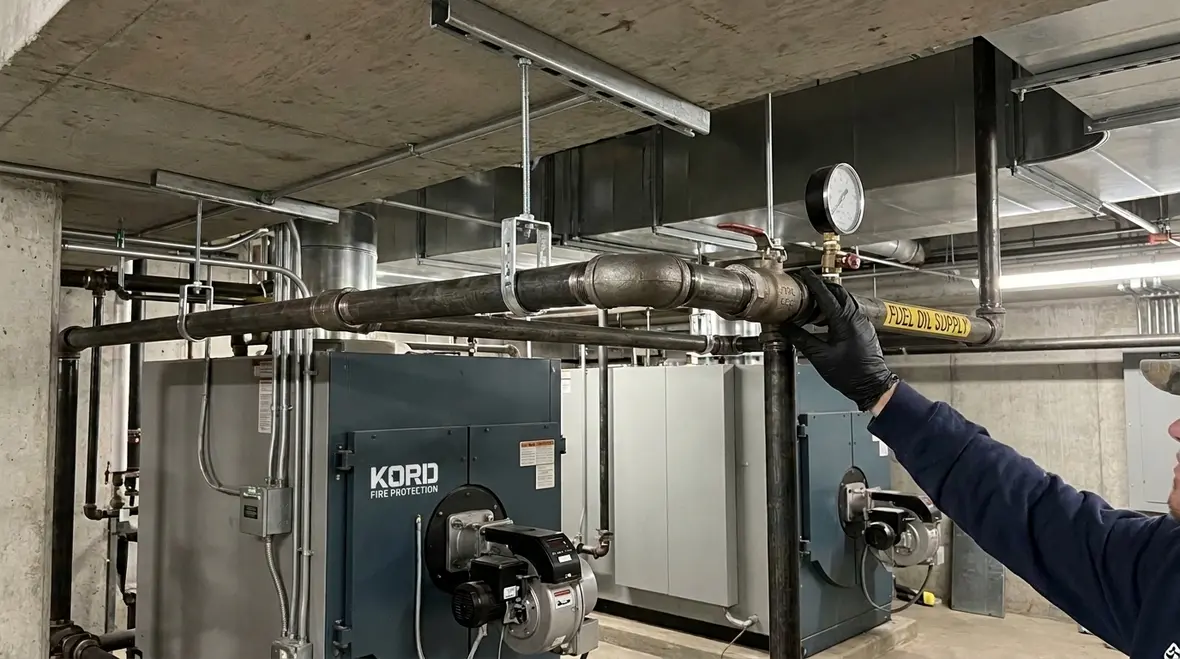
NFPA 31 Section 8.4: Fuel Piping System Design Principles
Quick Answer: NFPA 31 Section 8.4 sets practical design expectations for fuel piping systems to reduce leakage, ignition risk, and operational failures. It focuses on proper routing, materials, supports, valves, fittings, venting, and inspection readiness across commercial and industrial installations.
Why Section 8.4 matters in real installations
Fuel piping systems rarely fail from a single cause. In commercial boilers, burners, and oil fired equipment, failures usually develop through a chain of issues: corrosion, vibration damage, loose supports, incorrect fittings, poor venting, or maintenance practices that do not match the original design intent. That is why NFPA 31 fuel piping system design principles in Section 8.4 concentrate on safe, inspectable, and durable system construction rather than theoretical compliance.
For owners and facility managers, the design principles influence day to day risk. A correctly designed system supports safe start up, stable burner operation, and reliable shutoff behavior. It also makes routine inspections and testing faster, more consistent, and easier to document for regulatory and insurer requirements.
What Section 8.4 is trying to prevent
Section 8.4 aims to control conditions that can lead to fire or explosion hazards involving fuel oil. The most common risk themes in the field include:
- Fuel leakage at threaded joints, flanges, vibration exposed segments, or poorly selected elastomers.
- Air binding or loss of prime due to incorrect piping slope, venting, or suction conditions.
- Overpressure or improper flow control where valves, regulators, or connected piping do not match the system design.
- Ignition sources created by poor routing near hot surfaces, exhaust components, or electrical hazards.
- Undetected deterioration where concealed sections cannot be inspected or where supports fail and stress fittings.
These failure modes show up in commercial and retail mechanical rooms where equipment schedules, tenant turnover, and “make it work” repairs can quietly erode original safety margins.
Core NFPA 31 fuel piping system design principles (and how to apply them)
1) Routing, location, and protection
Section 8.4 emphasizes physical arrangement that supports safe operation. Fuel piping should run in a manner that limits exposure to mechanical damage and heat sources. In practical terms, this means:
- Preventing impact hazards from carts, ladders, and routine cleaning equipment.
- Avoiding unnecessary crossings through areas with high traffic or where ductwork access causes abrasion.
- Maintaining separation from hot surfaces and ensuring any proximity to exhaust or flue components does not create unintended ignition risk.
Facilities commonly miss this requirement during tenant fit outs, when short cuts are taken to simplify routing. Kord Fire Protection helps commercial teams verify that alterations align with the original NFPA 31 fuel piping system design intent and that any modifications remain inspectable. For broader installation context, teams can also review NFPA 31: A practical guide to oil burning equipment installation.
2) Materials, fittings, and joint selection
Material compatibility and fitting selection directly affect leak probability and long term performance. Design discipline in Section 8.4 supports reliable sealing and structural integrity through temperature and vibration cycles. Key practical controls include:
- Using piping and fittings intended for oil fuel service, including appropriate thread standards and sealing methods.
- Avoiding ad hoc substitutions of components with unknown chemical compatibility.
- Ensuring gasket and seal materials tolerate the fuel, temperature range, and cleaning methods used on site.
Common failure points in the field include “temporary” joint repairs, mismatched union types, or replacement parts sourced without documented fuel service suitability.
3) Supports, alignment, and vibration management
Even a well sealed system can fail if mechanical stress pulls on joints. Section 8.4 design principles consider how piping is supported and kept aligned. Best practice implementation typically involves:
- Proper hangers, clamps, and bracketing at appropriate intervals.
- Reducing stress on burner connection points where equipment vibration and thermal expansion occur.
- Avoiding rigid constraints that force the piping to “fight” thermal movement.
When supports deteriorate or are installed after electrical and piping retrofits, vibration can work leak paths open over time. This is a frequent issue during equipment upgrades in industrial and retail spaces.
4) Valves, control points, and functional operation
Fuel piping design must support correct flow control and safe shutoff. Section 8.4 principles drive valve placement and selection so maintenance can occur without unsafe bypassing. Operational outcomes include:
- Clear shutoff capability for service conditions.
- Consistent control response that supports reliable burner operation.
- Installation access so technicians can inspect, test, and replace components properly.
In practice, valves that are hard to reach lead to incomplete maintenance and delayed component replacement, which increases the probability of a failure during seasonal start up.
5) Venting, air elimination, and suction stability
Oil fired systems can be sensitive to trapped air, improper venting, and suction configuration. Section 8.4 design principles support stable operation by controlling how air is managed and how the system maintains prime. Commercial sites benefit when:
- Piping configurations maintain correct slope and flow behavior under operating conditions.
- Venting and air handling components match the specific system arrangement.
- Air release does not create conditions that increase leak risk or degrade burner performance.
Technicians often notice symptoms like delayed ignition, intermittent lockouts, or uneven oil delivery. These symptoms can trace back to design assumptions that no longer match installed piping after modifications.
6) Inspection readiness and maintenance access
Section 8.4 promotes construction that can be inspected. A system that hides all joints behind walls or inaccessible panels undermines compliance and increases hazard persistence. Maintenance access should support:
- Visual inspection of joints, valves, and critical components where deterioration can begin.
- Leak detection practices that do not require disassembly of major sections.
- Documentation of condition for internal risk management and third party audits.
Kord Fire Protection supports ongoing compliance planning for commercial, industrial, and retail facilities by aligning inspection focus with the actual installed configuration and identifying where maintenance access needs improvement.
Where systems fail most often: field checklist for risk spotting
Commercial teams often need a practical way to assess whether existing piping aligns with Section 8.4 design intent. The following items commonly correlate with future leakage or operational instability:
- Reworked piping after burner replacements, equipment swaps, or tenant renovations without matching original routing and support methods.
- Stress on unions and threaded joints due to missing supports or misalignment at equipment connections.
- Corrosion at low points where water or condensation collects and where coating decisions were not matched to the environment.
- Hidden joints that prevent leak discovery until it becomes visible or until the burner exhibits lockout symptoms.
- Improper component substitutions during maintenance, especially when parts are selected for fit rather than fuel service suitability.
- Venting or air handling changes that occur during retrofits and unintentionally alter suction stability.
For additional installation context that affects piping system design decisions, Kord Fire Protection recommends reviewing NFPA 31: A practical guide to oil burning equipment installation. It provides a grounded look at how equipment installation choices influence fuel piping behavior and inspection expectations.
How to keep the system compliant after installation
Section 8.4 principles do not end at turnover. Commercial facilities must maintain safe performance through inspection, controlled maintenance, and repair practices that respect the original design. A sustainable program typically includes:
Documented inspection intervals
Inspection frequency should align with operating conditions, known vulnerabilities, and equipment run time. Systems in high humidity, corrosive environments, or spaces with heavy foot traffic may require more frequent checks.
Leak monitoring and joint verification
Routine checks should focus on high risk points: unions, threaded joints, valve packings, and any areas disturbed by maintenance. Maintenance teams should avoid “treat and forget” approaches that hide early deterioration.
After repair verification
Any repair or modification should trigger a verification process. This includes confirming proper routing, re establishing support integrity, and validating that the piping configuration maintains expected suction stability and venting behavior.
Training for technicians and contractors
Many failures occur because the repair mindset differs from design intent. A targeted training approach helps ensure contractors follow fuel service component selection rules, support placement expectations, and joint integrity practices.
As a service partner, Kord Fire Protection helps facilities operationalize these steps by supporting compliance reviews, identifying drift from design intent after upgrades, and providing maintenance coordination that reduces the probability of recurring issues.
Frequently Asked Questions
Next step for your facility
If your commercial site has older fuel piping, recent burner changes, or tenant fit outs, Section 8.4 drift is a common compliance risk. Kord Fire Protection helps you validate that installed piping supports safe operation and inspectability, then coordinates practical maintenance so issues do not return during start up or audits. Request a compliance review with Kord Fire Protection to confirm alignment with NFPA 31 fuel piping system design principles and your facility standards.

Join Our Newsletter!
Get the latest fire safety tips delivered straight to your inbox From our Newsletter.



