
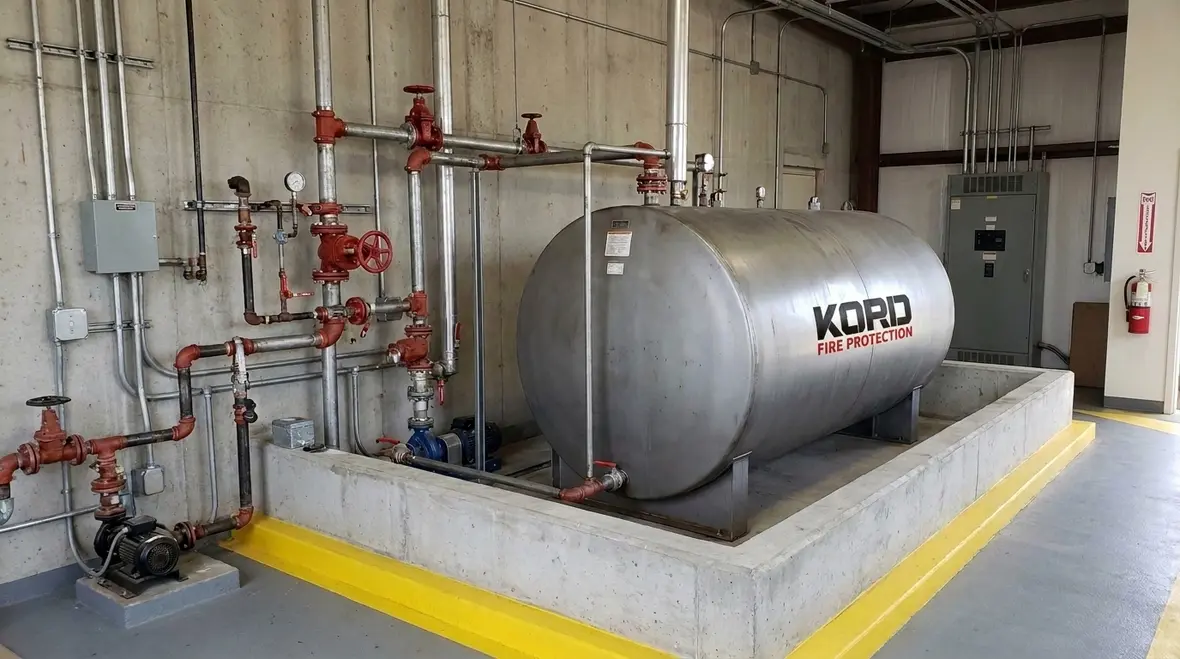
NFPA 31 Section 7.11: Special Fuel Storage Arrangements Explained
Quick Answer: NFPA 31 Section 7.11 governs how facilities store fuel oil and related fuels when the arrangement is not routine. It focuses on spill control, fire separation, venting, protection of components, and how fuel systems remain safe under normal and abnormal operating conditions.
For teams reviewing fuel systems as part of a broader compliance program, Kord Fire Protection also offers fire protection inspection and maintenance services that fit naturally into inspection readiness and ongoing risk management.
What does NFPA 31 Section 7.11 cover?
NFPA 31 Section 7.11 addresses special fuel storage arrangements where the standard storage layout does not fully capture real world conditions at commercial, industrial, and retail sites. This typically includes configurations that introduce added risk such as unusual container geometry, constrained spaces, shared utility corridors, or arrangements that rely on mitigation measures rather than separation alone. In practice, NFPA 31 special fuel storage arrangements require a fire safety strategy that integrates the storage tank or container, transfer piping, spill management, and ignition control into one coordinated system.
Compliance expectations commonly surface during plan review, commissioning, and recurring inspection cycles. The strongest programs treat Section 7.11 not as a checklist but as a design basis for operational reliability and incident prevention.
When do facilities treat fuel storage as “special” under NFPA 31?
Facilities typically enter the Section 7.11 pathway when their fuel storage arrangement does not align with a standard, repeatable installation model. Common triggers include:
- Non standard tank or container locations, such as placing storage equipment in semi enclosed areas, utility rooms, or atypical loading zones.
- Complex piping and transfer routing where hoses, flexible connections, or long runs affect spill likelihood and emergency response.
- Shared spaces that create indirect exposure to ignition sources, electrical equipment, or other heat producing processes.
- Limited secondary containment options that require additional safeguards to maintain spill control effectiveness.
- Operational dependencies such as reliance on pumps, valves, or interlocks that must perform during abnormal conditions.
These situations challenge two core assumptions: containment will always hold and ignition sources will always remain controlled. Section 7.11 pushes the design team to prove both assumptions through layout, engineered safeguards, and maintenance proof.
Key design and operational elements in NFPA 31 special fuel storage arrangements
Section 7.11 expectations often show up as specific, inspectable elements. The following technical categories drive day to day compliance outcomes.
1) Spill control and secondary containment that actually works
Special arrangements frequently increase the probability of a small release that spreads before staff can react. Effective spill control depends on more than the presence of containment walls or trays. It depends on:
- Drainage control so spilled fuel does not migrate into concealed spaces or floor drains that connect to other areas.
- Surface compatibility with fuel oil so containment does not degrade, crack, or allow seepage.
- Capacity and configuration that matches the credible release scenario for the installation scale.
- Inspection and maintenance so containment remains unobstructed and seals remain functional.
Common failure points include blocked containment sumps, missing drain plugs, damaged berm surfaces, and discontinued or bypassed drain routing. These issues rarely show up in design documents, but they consistently appear during operational audits.
2) Fire separation and protection of exposed components
Fuel storage is not only about the tank. It also includes exposed appurtenances such as shutoff valves, gauges, vent lines, and protective fittings. In special arrangements, fire separation may be achieved through layout, barriers, protective cabinets, or placement strategies that reduce exposure to ignition sources.
Practical compliance requires documenting:
- What components are inside or outside protected spaces.
- Whether barriers provide rated separation or rely on distance.
- How access is maintained for routine checks without compromising safety.
During inspections, installers and facility teams often discover that a component moved during tenant work was never re evaluated for separation. Section 7.11 arrangements should include change control so physical changes trigger a safety review.
3) Venting, pressure relief, and controlled release behavior
Uncontrolled venting can turn a small incident into a rapidly escalating event. Special fuel storage arrangements require venting systems that support safe pressure equalization while preventing flame impingement or ignition through vent pathways. Vent termination and any flame arresting strategies must align with the installation environment and fuel properties.
Operational risks include:
- Blocked vents due to construction debris or bird nesting.
- Incorrect vent pipe routing that traps vapors or increases impingement risk.
- Changes to fittings or replacements using non compatible components.
Routine verification of vent pathways supports better ignition control during commissioning and periodic maintenance.
4) Transfer piping, valves, and hose management
Many special fuel storage arrangements fail in the transfer phase. When fuel moves from a delivery vehicle to a tank, or between tanks and day tanks, valves and transfer lines become the critical containment and ignition control points.
Compliance aligned practices typically include:
- Clearly identified shutoff locations and procedures for emergency isolation.
- Leak detection expectations for joints, couplings, and flexible connections.
- Hose storage practices that prevent damage and reduce trip and drag hazards.
- Documented commissioning checks and post maintenance verification.
Facilities that treat transfer equipment as “service items” rather than life safety critical equipment often face repeated failures during audits, particularly where hoses are stored improperly or couplings are replaced without verifying compatibility.
5) Ignition source control across the storage area
Special fuel storage arrangements frequently occur near electrical equipment, building services, parking or retail activity, or mechanical plant spaces. Section 7.11 expectations reinforce that ignition sources must remain controlled through equipment selection, housekeeping, and operating procedures.
Inspectors commonly look for conditions such as:
- Surface contamination that accumulates fuel residues near appurtenances.
- Improper electrical installations or modifications.
- Hot work or maintenance activities performed without fuel isolation and safe hot work permits.
Operational discipline matters because many ignition events originate from activity around the storage area, not from the storage itself.
Inspection, testing, and maintenance expectations
NFPA 31 compliance depends on what the system does between inspections. For special fuel storage arrangements, effective maintenance planning supports containment integrity, valve operability, and vent pathway reliability.
What to include in a practical maintenance and inspection program
- Containment checks: verify drainage control, integrity of berms or trays, and removal of obstructions.
- Vent inspection: confirm vent routes are unobstructed and protective devices remain in place and serviceable.
- Leak and joint verification: focus on transfer points, gauges, and accessible fittings.
- Valve and operability testing: confirm shutoff valves, emergency isolation points, and actuators respond correctly.
- Documentation control: ensure changes to components trigger a re check of separation, access, and protective strategies.
Where commercial teams typically fall behind
In commercial and retail contexts, fuel systems can be managed across multiple contractors and service schedules. The most common breakdowns include:
- Maintenance performed without verifying the current arrangement against the original safety intent.
- Repairs that substitute components without compatibility verification.
- Housekeeping gaps that allow fuel residues to build around vents, valves, and transfer connections.
Kord Fire Protection supports ongoing compliance with structured inspections and maintenance verification tailored to commercial operations, where uptime and consistent risk management are essential.
If your team needs a related maintenance reference, see NFPA 30 Section 21.8: Inspecting and Maintaining Storage Tanks for added context on inspection structure and documentation discipline.
How to align oil burning equipment installation with Section 7.11
Fuel storage and oil burning equipment installation do not operate independently. The storage arrangement influences how equipment starts, how vapors behave, and how emergency isolation is achieved. A strong approach coordinates storage safety with installation practices for burners, piping, controls, and service access.
For facilities upgrading burners or commissioning new oil burning systems, Kord Fire Protection recommends a practical, installation focused review. A helpful resource is NFPA 31: A practical guide to oil burning equipment installation, which supports teams who need to connect installation decisions to real inspection outcomes.
By linking Section 7.11 storage decisions to equipment installation details, facility owners reduce the risk of “compliant components” assembled into an unsafe overall arrangement.
Frequently Asked Questions
Next step
Facilities with oil fuel storage should validate their current layout against NFPA 31 special fuel storage arrangements, then lock in a maintenance and change control process that keeps the arrangement safe over time. Contact Kord Fire Protection to review your storage and transfer setup, support inspection readiness, and maintain ongoing compliance through structured testing, reporting, and practical corrective action planning.

Join Our Newsletter!
Get the latest fire safety tips delivered straight to your inbox From our Newsletter.



