
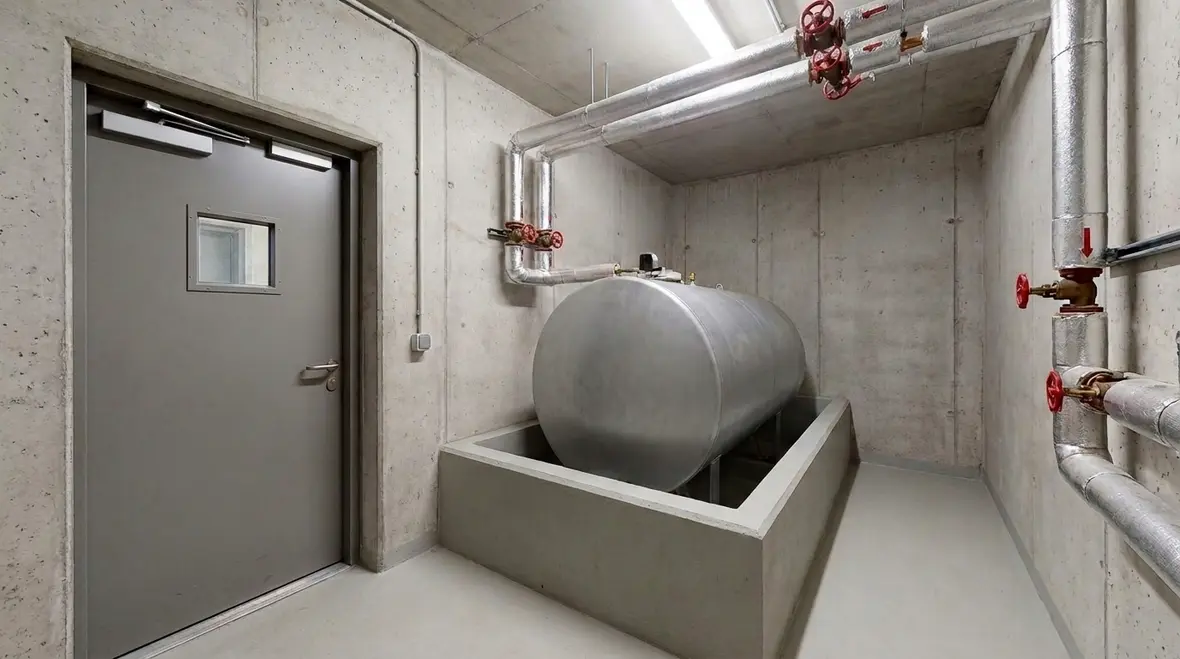
NFPA 31 Section 7.7: Dedicated Tank Room and Enclosure Requirements
Quick Answer
NFPA 31 Section 7.7 sets the enclosure, separation, and protection expectations for dedicated tank rooms to reduce fire spread and ignition risk. Compliance hinges on correct construction, venting behavior, spill control, and ongoing inspection and maintenance of the room and tank interface.
If your facility team is reviewing broader inspection and maintenance needs, Kord Fire Protection’s fire protection services in Southern California provide a practical path for coordinating code-compliant inspections, repairs, and maintenance planning across the building.
What triggers NFPA 31 Section 7.7 tank room controls?
NFPA 31 applies to the installation of oil burning equipment and related components. Section 7.7 becomes critical when a facility uses a dedicated tank room or enclosure for fuel oil supply tanks. The intent is straightforward: keep the flammable liquid hazards contained and limit credible ignition sources, while ensuring engineered pathways for venting and safe operation under normal and abnormal conditions.
For teams managing commercial sites, the core challenge often is not the initial build but the long term performance of the room. Buildings evolve. Access panels change. Maintenance staff add electrical fixtures or piping modifications. Without disciplined configuration management, “dedicated” rooms drift toward general mechanical space conditions, which undermines NFPA 31 dedicated tank room requirements.
How the tank room enclosure supports containment and safe operation
The dedicated tank room and enclosure must function as a protective boundary between the fuel oil hazard and the rest of the building. In practice, this means the enclosure should support three outcomes:
- Limit fire propagation from internal ignition events toward occupied or protected areas.
- Control fuel oil release paths so spills do not migrate into adjacent compartments, equipment cavities, or concealed spaces.
- Maintain safe venting and pressure relief behavior consistent with the fuel system design.
Commercial facility standards frequently intersect with these expectations. A common failure point occurs when a tank room is retrofitted into a multipurpose service closet. Even if the room retains a door and “looks enclosed,” changes to openings, penetrations, and sealing details can create hidden pathways for flame and hot gases.
Penetrations, openings, and doors: where compliance issues hide
Section 7.7 driven inspections usually focus heavily on the integrity of the enclosure. Penetrations for piping, wiring, instruments, and alarms can become the weak link if they are not sealed properly and maintained after service work. Door hardware, closures, and self closing behavior also matters. A door that remains propped open during routine work may still appear “installed correctly,” but it defeats the compartmentation goal.
Ventilation and ignition source control
Tank rooms require attention to how vapors are managed. If ventilation strategies or exhaust equipment are modified, the room can become more vulnerable to vapor accumulation. The ignition control program also becomes part of compliance. Hot surfaces, electrical switching locations, temporary heaters, and poor housekeeping around fittings create recurring risk patterns in retail and industrial occupancies.
Tank room interfaces: piping, fill, vent, and spill management
NFPA 31 dedicated tank room requirements are strongly influenced by what happens at the tank interface. The room must accommodate fuel system components while preventing release from becoming an uncontrolled fuel source.
Fill and transfer areas: prevent uncontrolled spillage
During deliveries and transfer operations, spillage risk increases. Facilities often have procedures on paper, but the real test comes during peak site activity when staffing changes occur. A compliant tank room setup typically includes:
- Clear access for safe filling without awkward line connections.
- Equipment and hoses managed to avoid abrasion and loose couplings.
- Observed housekeeping discipline around connections and fittings.
Piping runs and concealed hazards
Fuel oil lines and their supports must not turn the building structure into a distribution pathway. A frequent issue arises from adding auxiliary lines, drain routes, or sensor wiring without maintaining the compartment integrity at each penetration and without aligning supports to prevent chafing. Over time, vibration and thermal movement can loosen fittings and create weeping leaks that go unnoticed until routine checks are performed.
Inspection, testing, and maintenance: staying compliant after commissioning
Section 7.7 expectations are only effective if the room remains in compliant condition. Maintenance teams should treat the tank room as an asset with an inspection cycle, not as a one time construction requirement.
What auditors and inspectors look for during walkthroughs
In practical compliance reviews, the following are common inspection focus points:
- Enclosure condition: intact walls, ceiling, and floor rated construction where applicable.
- Door operation: correct closure and no defeated latching behavior.
- Sealing of penetrations: no missing firestopping, damaged sleeves, or gaps around conduit and piping.
- Evidence of leaks: staining, odor, wetness at fittings, and residue near the tank and piping interface.
- Vent and vapor management: no blocked vents, altered ducting, or improper dampers.
Common failure points in commercial and retail facilities
Commercial sites often experience “compliance drift” due to schedule based service changes. Common root causes include:
- Unauthorized electrical additions within or near the tank room without assessing ignition risk and enclosure sealing.
- Storage creep, where materials accumulate against walls and reduce access to valves, vents, and shutoff points.
- Insufficient documentation of modifications, making it difficult to prove the room matches the original design intent.
To address these risks, a service partner should support both the technical review and the operational discipline. Kord Fire Protection provides practical compliance support through assessment, documentation, and ongoing maintenance planning that aligns the room, equipment, and inspection records with field reality. For complementary guidance on installing and maintaining oil burning equipment, see NFPA 31: a practical guide to oil burning equipment installation.
Operational procedures that protect the tank room during real work
In many facilities, the tank room is rarely “problem free.” The hazard moment comes during delivery, service, and change out activities. Strong operational procedures reduce the likelihood of ignition sources, uncontrolled releases, or enclosure damage during maintenance.
Delivery and transfer procedure discipline
Effective delivery procedures should cover:
- Pre delivery checks of room condition and access route safety.
- Verification of fill connection integrity and proper hose management.
- Defined response actions for leaks, drips, or overfill indicators.
- Post delivery housekeeping and confirmation that openings and access points remain secured.
Service work control and enclosure repair response
Every time a contractor enters the tank room, the probability of missed sealing or accidental damage increases. A compliance focused workflow includes work permits or job plans that require:
- Immediate reporting of damaged penetrations, seals, or door closures.
- Correct reinstatement of firestopping and sealing after any penetrations are opened.
- Inspection signoff by a competent party before the room returns to normal operation.
Integrating tank room compliance with facility fire protection strategy
NFPA 31 dedicated tank room requirements do not operate alone. A comprehensive commercial fire safety program connects the tank room with the site wide compartmentation approach, hot work controls, electrical maintenance standards, and emergency response procedures. The best outcomes occur when the tank room is included in the facility’s recurring risk walk schedule, not treated as a static compliance item.
Kord Fire Protection supports facility teams by aligning the tank room, oil burning equipment installation practices, and inspection requirements into a single practical compliance plan. This reduces rework, supports audit readiness, and helps prevent “small changes” from becoming major nonconformities.
Frequently Asked Questions
Request a compliance review and maintenance plan
Facilities that treat tank rooms as a living system avoid audit surprises and reduce the chance of enclosure drift. Kord Fire Protection can assess your dedicated tank room setup, identify practical nonconformities, and build an ongoing inspection and maintenance plan aligned with NFPA 31 expectations. Contact Kord Fire Protection to schedule a targeted review and confirm your room and interfaces remain compliant after every service change.

Join Our Newsletter!
Get the latest fire safety tips delivered straight to your inbox From our Newsletter.



