
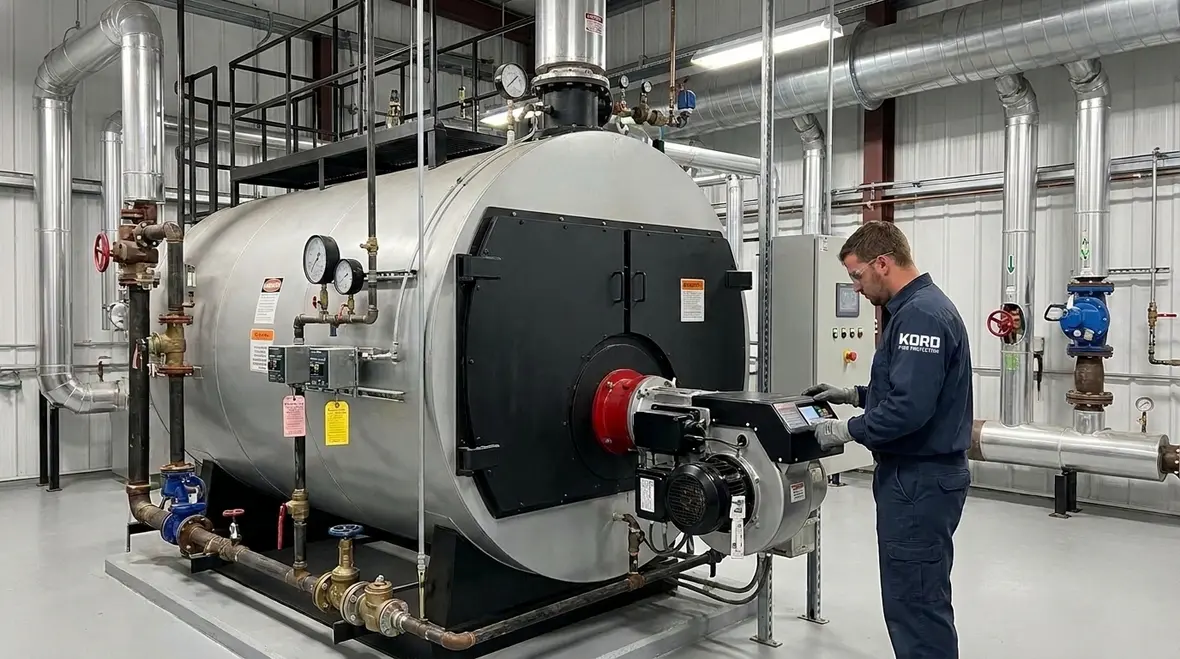
NFPA 31 Section 10.11: Stationary Industrial Furnace and Boiler Rules
Quick Answer
NFPA 31 Section 10.11 sets out how stationary industrial furnaces and boilers must be installed, protected, and maintained when burning oil. It focuses on safe burner operation, venting and combustion air provisions, ignition and controls, and inspection readiness to reduce fire risk and prevent unsafe conditions.
NFPA 31 industrial furnace boiler stationary requirements matter because stationary equipment stays in service for years and accumulates hidden risk through wear, corrosion, burner drift, and maintenance gaps. This article explains what Section 10.11 expects, where teams commonly fail during compliance checks, and how commercial facilities can keep operations aligned through disciplined inspection and service.
For teams building a broader compliance program, Kord Fire Protection also offers inspection, testing, and maintenance fire protection services that fit naturally alongside ongoing burner, venting, and equipment readiness checks.
Why Section 10.11 Applies to Stationary Equipment in Commercial Operations
Stationary industrial furnaces and boilers operate continuously or cyclically with high heat release and complex fuel systems. NFPA 31 Section 10.11 addresses that reality by requiring installation and operational controls that support reliable combustion and reduce abnormal combustion conditions.
For commercial, industrial, and retail occupancies, compliance issues often appear indirectly. A “maintenance only” approach can overlook how burner settings, draft conditions, vent integrity, and electrical control sequencing affect fire safety. The goal is not just a one time pass. The goal is ongoing capability to detect and correct unsafe conditions before they escalate.
Core Technical Expectations Under NFPA 31 for Stationary Furnaces and Boilers
Within NFPA 31, Section 10.11 is commonly interpreted through four practical compliance themes: burner ignition and flame supervision, safe fuel delivery and controls, combustion air and venting integrity, and readiness for inspection and emergency safe operation.
1) Burner operation, ignition reliability, and flame supervision
Stationary burners depend on correct ignition timing, reliable flame detection, and proper control logic sequencing. NFPA 31 industrial furnace boiler stationary requirements place emphasis on maintaining the functioning boundary between normal combustion and abnormal shutdown.
Common failure points include degraded flame sensors, misaligned flame scanners, loose or corroded wiring in burner junction boxes, and improper replacement parts that alter control timing. Teams often only discover these faults during operational anomalies, such as nuisance shutdowns or intermittent flame loss.
2) Fuel system safety and control integrity
Stationary furnaces and boilers require safe oil delivery from storage through piping, valves, and metering components to the burner. Compliance focuses on preventing leaks, maintaining correct pressure and flow, and ensuring controls respond correctly to unsafe conditions.
Commercial facilities face operational drift when equipment is modified over time. Examples include changed piping runs, added fittings, or undocumented valve swaps that affect back pressure or spray pattern. Even minor changes can impact ignition quality and lead to smoky combustion, soot buildup, or delayed flame stability.
3) Venting, draft, and combustion air management
Proper venting and draft support complete combustion and protect against products of combustion entering occupied areas. Unsafe draft conditions can cause backflow, improper combustion, and excessive soot accumulation.
Typical real world issues include obstructed flues, damaged breeching, collapsed liners, deteriorated insulation that allows cooler surfaces to condense products of combustion, and unbalanced combustion air supplies. These conditions can develop gradually, especially where maintenance schedules do not include internal vent inspections and combustion performance checks.
4) Operational controls, safety shutdown, and readiness
Stationary equipment must be capable of transitioning to a safe state when abnormal conditions occur. Compliance checks typically look for intact control circuits, correct interlocks, and evidence that safety shutdown sequences function as designed.
Because Section 10.11 governs stationary rules, the emphasis remains on equipment that can be inspected and maintained. That includes access for service work, documentation for adjustments, and a clear maintenance trail that supports defensible compliance during audits.
How Installers and Maintainers Keep Stationary Compliance Stable Over Time
Stationary furnace and boiler compliance is less about single adjustments and more about maintaining stability across seasonal changes, fuel quality shifts, and component aging. NFPA 31 industrial furnace boiler stationary requirements are best met by a programmatic approach.
Inspection planning that matches how the system fails
High value inspections focus on what drifts or degrades: flame detection performance, burner combustion stability, vent integrity, and fuel delivery parameters. When inspections are treated as a checklist only, teams often miss early indicators like minor smoke color changes, abnormal draft readings, increasing soot load, or repeated purge cycle adjustments.
A robust program integrates operational monitoring with mechanical checks. That ensures safety controls are not only “in place,” but also effective under actual operating conditions.
Maintenance discipline for burner components and controls
Burner maintenance should treat fuel nozzles, filters, strainers, electrodes or igniters, photocell or scanner lenses, and wiring terminations as risk critical elements. Dust accumulation in control cabinets and minor moisture intrusion can produce intermittent behavior that mimics combustion faults.
Commercial environments also introduce human factors. If service teams are not trained on furnace specific sequencing and adjustment limits, they can inadvertently defeat designed safety boundaries. Documented adjustments and calibrated test tools reduce that risk.
Combustion performance and soot management
Combustion that drifts can produce unsafe byproducts and reduce heat transfer efficiency. Soot and scale also insulate heat exchange surfaces, forcing higher operating temperatures and increasing corrosion and component stress.
Continuous cleanliness and combustion tuning aligned with manufacturer specs supports safer performance. It also helps maintain a stable flame shape for reliable detection, which reduces nuisance shutdowns and improves operational reliability.
Compliance Challenges Commonly Seen in Stationary Industrial Furnace and Boiler Sites
NFPA 31 industrial furnace boiler stationary requirements are often impacted by how facilities manage multi trades, seasonal staffing, and equipment modifications. The following issues frequently surface during compliance verification.
- Untracked burner adjustments: Changes to airflow, fuel pressure, or timing without documentation can invalidate previous settings that supported safe combustion.
- Vent and draft variability: Downdraft conditions, partial obstructions, and disconnected or failing seals can alter draft and combustion stability.
- Worn or incorrect flame detection hardware: Sensors and lenses that do not match the burner design lead to unstable detection and unsafe shutdown patterns.
- Fuel quality and filter maintenance gaps: Water contamination or clogged filters can cause poor atomization and incomplete combustion.
- Electrical control integrity issues: Loose terminations, corrosion, and cabinet moisture can disrupt interlocks and safety sequences.
- Limited access for inspection: If access panels are missing or documentation is incomplete, inspectors cannot verify that safety functions remain intact.
Practical Guidance for Owners and Operators: What to Document and What to Test
Stationary systems are only as safe as their current configuration. Owners and operators should require evidence that the equipment remains within safe operational boundaries, not just that repairs were performed.
Document configuration control
Maintain a current record of burner type, nozzle and filter specification, set points, control component versions, venting configuration, and recent service actions. This supports defensible NFPA 31 industrial furnace boiler stationary requirements when third parties verify compliance.
Test safety sequences and verify detection performance
Ensure safety shutdown and flame supervision logic functions properly under tested conditions. Periodic verification catches failures that do not always produce obvious symptoms during normal operation.
Confirm combustion air and vent integrity during service cycles
Verify combustion air provisions and check vent components for degradation, obstruction, and seal failure. Where applicable, include internal inspection steps consistent with equipment risk and condition.
For additional installation and oil burning equipment context, Kord Fire Protection provides a practical overview here: NFPA 31 practical guide to oil burning equipment installation.
How Kord Fire Protection Supports Ongoing NFPA 31 Compliance
Commercial sites do not achieve stable compliance by inspection alone. They achieve it through consistent maintenance, disciplined testing, and clear reporting that ties equipment condition to safety outcomes. Kord Fire Protection supports facilities with service planning, verification of safe operating condition, and practical guidance aligned to real site constraints.
As stationary furnaces and boilers age, drift becomes inevitable. Kord Fire Protection helps facilities address that drift before it creates unsafe combustion behavior, unreliable flame detection, or venting problems. This approach supports operational continuity while strengthening audit readiness.
If your team is reviewing documentation practices and audit readiness more broadly, this related guide on commercial fire safety audits adds useful context for how records, testing logs, and corrective actions hold up under real verification.
Frequently Asked Questions
Conclusion and Call to Action
NFPA 31 Section 10.11 compliance for stationary industrial furnaces and boilers depends on keeping ignition, flame supervision, fuel controls, and venting conditions reliably within safe boundaries. Facilities that document configuration changes, verify safety sequences, and address combustion drift early reduce both fire risk and operational downtime. Contact Kord Fire Protection to schedule a compliance focused review and maintenance plan that keeps your stationary equipment audit ready throughout the year.

Join Our Newsletter!
Get the latest fire safety tips delivered straight to your inbox From our Newsletter.



