
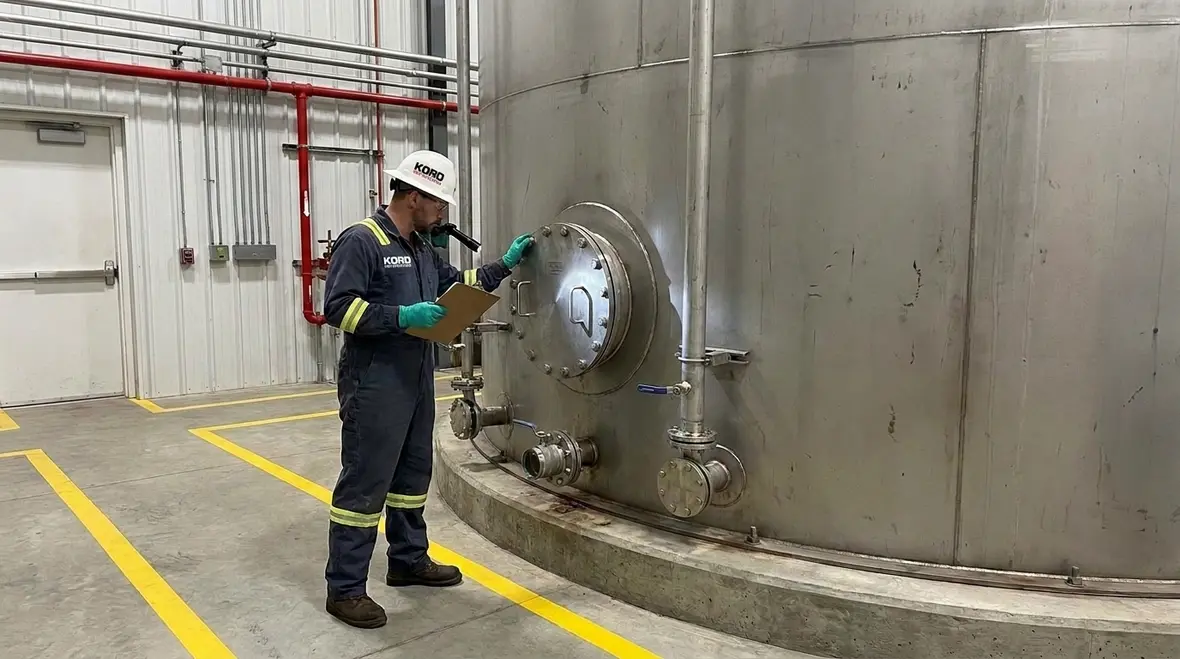
NFPA 30 Section 24.14: Openings for Tanks Inside Tank Buildings
Quick Answer
N F P A 30 Section 24.14 tank openings inside buildings governs how openings around tank penetrations, hatches, piping, and closures manage flammable liquid hazards within tank buildings. It focuses on limiting vapor escape, maintaining reliable closures, and ensuring components remain serviceable through installation, inspection, and maintenance.
The requirements in NFPA 30 Section 24.14 tank openings inside buildings are not just paperwork. They control ignition risk, vapor migration, and how quickly fire and smoke can develop when a tank or connected system releases flammable liquids. For commercial, industrial, and retail facilities with tank buildings, compliance depends on correct design details and disciplined inspection and maintenance.
Facilities reviewing these requirements often also benefit from strengthening their broader fire suppression system inspection and maintenance approach, especially where flammable liquid hazards and special hazard protection overlap.
What Section 24.14 is trying to prevent
When flammable liquid tanks sit inside tank buildings, the space becomes part of the hazard control strategy. Any opening that enables uncontrolled vapor movement, airflow pathways to other building areas, or failure-prone penetrations can undermine the tank building concept. NFPA 30 Section 24.14 tank openings inside buildings targets openings that can become routes for vapor escape or ignition propagation.
In operational terms, it means facilities must treat penetrations as high risk interfaces. Tank openings can be formed by:
- Manways, hatches, and closure devices
- Piping penetrations and hose connections
- Vent and vapor handling interfaces
- Electrical and instrumentation conduits passing through tank building boundaries
- Access points that remain sealed during normal operation
Facilities that pass initial installation reviews can still fail later when gaskets deteriorate, seals are bypassed, or repairs introduce incompatible materials.
Where the rule applies in real tank building layouts
NFPA 30 Section 24.14 tank openings inside buildings applies where a tank building contains tanks and associated systems that require openings. The scope effectively captures “interface points” that connect the tank interior to the tank building atmosphere or that connect the tank building to other spaces.
Common practical compliance hotspots include:
- Penetrations through walls and floors: pipe sleeves, flanges, seals, and patch details around penetrations.
- Openings around tank appurtenances: manways, gauge openings, and closures that are frequently opened for routine operations.
- Temporary conditions: construction work, tank outages, maintenance activities, and seasonal equipment changes where closures are not returned to compliant configurations.
- Connections that change frequently: transfer lines, sampling ports, and flexible hose runs that introduce new sealing requirements.
Commercial and retail locations often underestimate how often these interfaces are touched by maintenance teams. Even small adjustments can alter closure alignment, seal compression, and leak tightness.
How compliance is demonstrated: closures, sealing, and integrity
Compliance typically depends on the ability to maintain controlled conditions around tank openings. Inspectors look for evidence that openings remain properly sealed and that closures perform as intended.
Closure mechanisms that must remain reliable
Facilities commonly use manway covers, bolted hatch plates, gasketed lids, and threaded caps. Each closure must maintain its seal under the facility’s expected conditions, including temperature swings and vibration. Over time, gaskets harden, flange faces corrode, and fasteners loosen.
Penetration sealing details that fail in the field
Penetration sealing often fails when:
- Wrong gasket material is used during maintenance replacements
- Sealants are applied inconsistently or without compatibility with the stored product
- Pipe sleeves are installed without a complete sealing plan at the building boundary
- Adapters and field fabricated modifications change the intended fit-up
- Repairs introduce gaps or misalignment that allow vapor migration
Operational discipline during tank access and outages
For facilities that must open hatches for gauging, cleaning, or inspection, compliance becomes procedural. A sound procedure addresses:
- Who is authorized to open tank openings and how work permits control the duration
- Verification steps that confirm closures are returned to the correct configuration
- Documentation of returned-to-service checks, including visual seal condition and fastener verification
- Immediate corrective action when a seal shows damage or improper alignment
Because NFPA 30 Section 24.14 tank openings inside buildings relies on ongoing integrity, Kord Fire Protection supports facilities with inspection planning, documentation readiness, and maintenance coordination to keep critical opening interfaces in a compliant state.
Inspection and maintenance: what “good” looks like
Inspection activities should not stop at a surface check. For NFPA 30 Section 24.14 tank openings inside buildings, the objective is to verify that closures and seals remain functional and that there are no unintended pathways for vapor escape or ignition risk.
Field inspection elements to include
- Closure condition: gasket integrity, cover alignment, missing hardware, and proper tightness indicators.
- Penetration interface condition: evidence of shrinkage, cracking, corrosion, or gaps around sleeves and patch points.
- Condition of appurtenance openings: caps on unused ports, functioning of required covers, and identification of capped versus operating connections.
- Recent maintenance verification: confirmation that repairs used approved parts and that modified assemblies match original intent.
- Visual pathway check: signs of seepage, staining, or vapor residue around openings.
Maintenance planning that reduces failure
A defensible maintenance strategy includes compatibility controls. Seal materials and repair components must match the flammable liquid properties and operating environment. Facilities also need a repeatable workflow for:
- Controlled parts procurement and substitution approval
- Training for technicians handling tank openings
- Post maintenance verification checks and records retention
- Replacement intervals based on observed degradation and manufacturer guidance
Facilities that operate across shifts benefit from a standardized checklist that prevents last minute “temporary sealing” from becoming a long-term condition. Kord Fire Protection helps teams align fire and safety compliance routines with the reality of commercial maintenance cycles.
For broader context on how NFPA 30 regulates flammable liquids and how tank building risk controls connect to openings, refer to: How NFPA 30 regulates flammable liquids.
Common noncompliance patterns and how to correct them
Audit findings frequently point to avoidable issues. The following patterns show up across industrial and commercial environments.
1) Gaskets and seals not compatible or not properly seated
Even when a closure looks intact, degraded gasket chemistry can cause gradual leakage. Corrective action typically includes removal, inspection of mating surfaces, gasket replacement with approved material, and verification of correct compression.
2) “Capped for now” openings during maintenance
Temporary caps and improvised closures can persist after the maintenance window. Corrective action is to implement a tracked closure return-to-service step with documented verification.
3) Field modifications around penetrations
Repair work can introduce gaps, misalignment, or new penetration geometries that were never part of the original hazard control plan. Corrective action typically requires engineered review or approved retrofit details for sealed interfaces.
4) Incomplete reconnection after outages
After cleaning, inspection, or tank component service, closures may remain unsecured or incorrectly tightened. Corrective action includes procedure enforcement and post work checks tied to the tank building risk profile.
Kord Fire Protection works with facility teams to identify where these patterns occur operationally and to build practical inspection and maintenance coordination that supports ongoing compliance with NFPA 30 requirements relevant to tank openings inside buildings.
Frequently Asked Questions
Conclusion and next step
NFPA 30 Section 24.14 tank openings inside buildings requires disciplined control of closures and penetrations, not one time installation. Facilities should validate gasket and seal integrity, prevent temporary work from becoming permanent, and standardize post maintenance verification. Kord Fire Protection can support your team with inspection planning, compliance focused maintenance coordination, and documentation readiness to help you reduce risk and maintain audit confidence. Contact Kord Fire Protection to schedule a compliance review.

Join Our Newsletter!
Get the latest fire safety tips delivered straight to your inbox From our Newsletter.



