
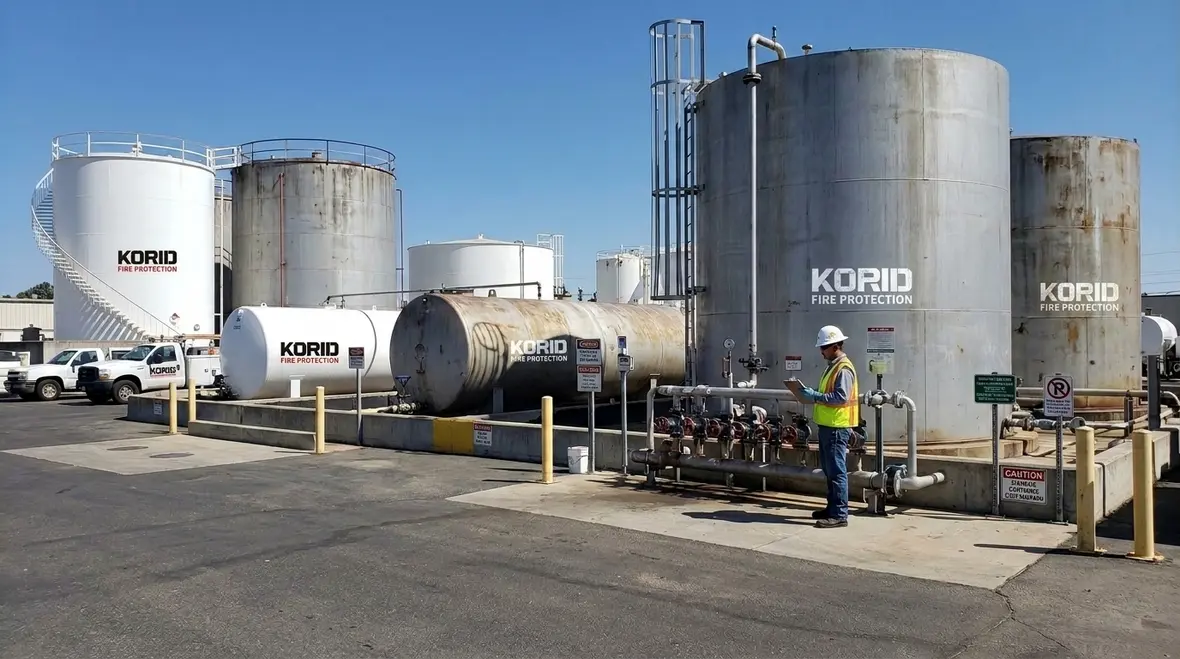
NFPA 30 Section 21.1 Scope: Requirements for All Storage Tanks
Quick Answer
NFPA 30 Section 21.1 scope all storage tanks by establishing baseline safety requirements that apply across tank types, occupancies, and storage arrangements. The section sets the expectation for consistent design, installation, inspection, and operational control measures that reduce fire and explosion risk.
Facilities managing broader flammable liquid hazards can also benefit from Kord Fire Protection’s guidance on layered fire protection for flammable liquids, especially where tank storage ties into transfer areas, containment, and site-wide suppression planning.
What NFPA 30 Section 21.1 scope all storage tanks actually means
NFPA 30 Section 21.1 provides the foundation for how facilities manage fire risk from flammable and combustible liquid storage. In practice, the “scope” language matters because it determines whether a tank asset falls under the standard’s tank-related requirements and how the facility must document compliance. For commercial, industrial, and retail sites, this becomes an operations and maintenance issue, not just a design issue.
Early compliance failures typically occur when tanks are added, relocated, reclassified, or modified without confirming that Section 21 applies to the new configuration. NFPA 30 Section 21.1 scope all storage tanks, so facilities must treat every qualifying tank as part of one consistent safety program covering risk controls, inspection routines, and management of change.
Which tank assets fall under the scope for all storage tanks
Commercial fire risk does not care about purchase order categories or asset tags. If a tank stores a flammable or combustible liquid within the conditions covered by NFPA 30, the facility must evaluate it under the tank requirements framework.
Common facility scenarios that trigger a compliance review
New or replacement tank installation, including underground and aboveground configurations.
Repairs, alterations, or upgrades that affect shell integrity, piping connections, vents, relief systems, or corrosion protection.
Changes in product classification, concentration, or intended use that may alter hazard levels and required safeguards.
Temporary tanks used for seasonal operations that may still require the same baseline tank safety controls.
Changes to secondary containment arrangements, drain routing, or spill control systems that influence fire exposure and vapour migration.
Practical takeaway for compliance managers
Facilities should maintain an up-to-date inventory that links each tank to its product, service conditions, protection systems, and inspection status. That inventory becomes the operational “map” needed to prove that NFPA 30 Section 21.1 scope all storage tanks was applied consistently across the site lifecycle.
Core requirements that drive day to day fire safety performance
Scope provisions become meaningful only when the site applies controls that prevent ignition sources, manage release control, and limit fire growth. NFPA 30 Section 21.1 scope all storage tanks by requiring a baseline approach that supports the rest of the tank and storage provisions in NFPA 30.
Inspection and verification expectations
A typical compliance program for storage tanks includes:
Documented inspection intervals for tank components and associated systems.
Verification of venting arrangements, flame arresting features where applicable, and unobstructed pathways for vapour control.
Operational checks for overfill protection and level monitoring systems.
Ongoing maintenance of corrosion protection measures and inspection records supporting integrity management.
Review of gaskets, seals, fittings, and connections for leakage risk.
Operational controls that reduce probability of release ignition
Even when mechanical safeguards exist, operations can still create risk through poor transfer practices or inadequate housekeeping. Facilities commonly strengthen procedures around:
Safe filling and transfer controls, including supervision during product delivery.
Conformance of hose and connection interfaces, including compatibility and coupling condition.
Control of ignition sources in areas where vapours may accumulate.
Spill response readiness to contain and manage released liquid before vapour generation escalates.
Where facilities commonly struggle with Section 21 scope compliance
NFPA 30 tank scope requirements often fail during transitions. The most frequent problem is not ignorance, but inconsistent implementation across departments and service contractors.
Top compliance failure points seen in commercial and industrial facilities
Tank boundary confusion: facilities fail to define what is considered part of the tank system, including piping, vents, and appurtenances, leading to missed inspection coverage.
Out of date documentation: inspection records do not match installed equipment after modifications or “like for like” swaps that actually change performance.
Maintenance gaps on venting and relief pathways: obstructions from stored materials, damaged screens, or improper fitment.
Corrosion protection drift: coatings degrade, cathodic protection schedules slip, and integrity checks do not reflect actual risk.
Secondary containment management issues: drains not returned to correct routing, containment not cleaned, or inadequate capability to manage incident scenarios.
Commercial reality check
Retail, industrial plants, and commercial fuel and chemical handling sites often operate under tight downtime constraints. That increases the chance that maintenance work becomes time pressured and documentation becomes incomplete. A strong scope process ensures every tank, regardless of where it sits on the site, receives consistent attention.
How Kord Fire Protection supports ongoing NFPA 30 compliance
NFPA 30 Section 21.1 scope all storage tanks is only as strong as the site program behind it. Kord Fire Protection helps commercial facilities implement practical compliance systems that match the operating environment, not just the paperwork.
Kord Fire Protection provides inspection, testing, and maintenance support designed to keep tank protection systems reliable. This includes supporting record accuracy, identifying common deterioration and obstruction risks, and helping facilities plan corrective actions that reduce downtime and repeat issues.
For additional context on how NFPA 30 addresses flammable liquid hazards across the storage lifecycle, Kord Fire Protection recommends reviewing: how NFPA 30 regulates flammable liquids.
Facilities looking at storage-specific suppression planning may also want to review foam fire suppression for fuel storage areas, which fits naturally with tank farms, containment zones, and transfer risk management.
Operational checklist: verify scope coverage for all storage tanks
Facilities can reduce audit findings by using a repeatable internal check aligned to NFPA 30 Section 21.1 scope all storage tanks.
Confirm the tank inventory is current, including product, capacity, classification basis, and location.
Verify that all tank appurtenances are included in inspection coverage, not only the tank shell.
Check vent and relief pathway conditions for obstructions, damage, and improper configuration.
Confirm overfill and level controls function as designed and are included in maintenance schedules.
Review integrity and corrosion protection records against the installed system.
Validate containment and spill management readiness, including drainage routing control.
Ensure management of change includes fire safety impact review before commissioning modifications.
Frequently Asked Questions
Next step: If your site has existing tanks, upcoming upgrades, or recent product or configuration changes, contact Kord Fire Protection for a compliance review aligned to NFPA 30 Section 21.1 scope all storage tanks. Kord Fire Protection can help verify inspection coverage, identify high risk failure points early, and keep documentation audit ready while reducing operational disruption.

Join Our Newsletter!
Get the latest fire safety tips delivered straight to your inbox From our Newsletter.



