
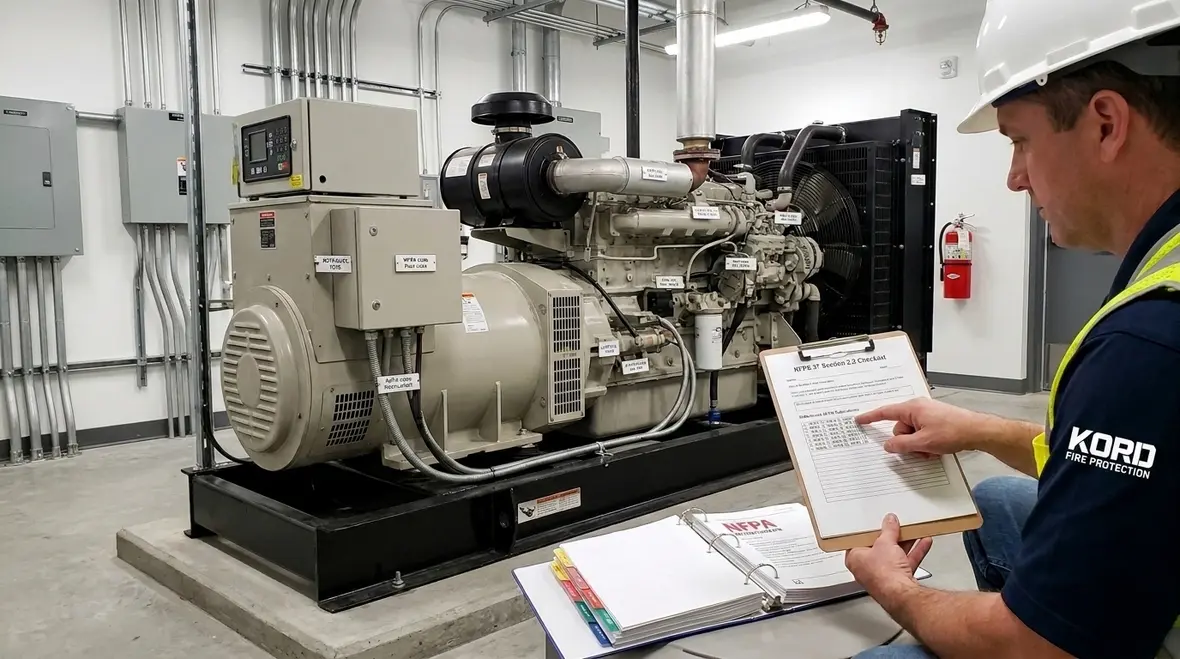
NFPA 37 Section 2.2: Every NFPA Code Cited by the Stationary Engine Standard
Quick Answer
NFPA 37 Section 2.2 requires compliance teams to identify and follow every NFPA Code and publication referenced by the Stationary Engine Standard. This cross referencing affects design, installation, inspection, testing, maintenance, and recordkeeping across commercial engine systems.
Why NFPA 37 Section 2.2 matters in real facilities
Commercial facilities that operate stationary engines rarely fail due to one obvious missing item. More often, the compliance gap appears when a referenced NFPA Code requirement gets overlooked during commissioning, periodic inspections, or component replacement. NFPA 37 Section 2.2 acts as a compliance map: it tells the enforcing authority and the facility that the Stationary Engine Standard does not stand alone. The governing obligations include every NFPA Code cited by the standard, including documents that may cover combustion safety, fuel handling, ventilation, electrical installation safeguards, detection and protection systems, and operational practices.
For facilities, this means the NFPA 37 list of referenced NFPA publications becomes an operational checklist, not a drafting artifact. Engine rooms, generator enclosures, industrial pump skids, and retail backup power areas must be managed as integrated life safety and fire protection systems.
That is also why many teams pair standards review with broader fire protection services in Southern California so inspection planning, deficiency correction, and documentation support stay connected instead of drifting into separate workflows.
What Section 2.2 actually requires
NFPA 37 Section 2.2 specifies that all NFPA Codes cited by the Stationary Engine Standard apply as part of the standard’s requirements. From a compliance standpoint, this turns “referenced-by” language into “required-by” obligations. Fire protection and safety teams must therefore do three things consistently:
- Identify every referenced NFPA publication tied to the equipment and installation configuration in scope.
- Apply the referenced provisions to the design, installation, operation, testing, and maintenance of the stationary engine system.
- Maintain documentation showing that required inspections and tests occurred and that deficiencies were corrected.
In practice, the most common failure point is not the initial installation. It is the long term maintenance cycle. Components change, contractors rotate, and documentation gets fragmented. Section 2.2 forces continuity by requiring the same referenced standards to remain part of the facility’s ongoing compliance posture.
How compliance teams use the NFPA 37 list of referenced NFPA publications
Facilities typically create one of two processes. The most effective is an “end to end” verification workflow that connects requirements to hardware and test methods.
Operational verification approach for engine rooms and generator enclosures
Commercial and industrial occupancies frequently use stationary engines for standby power, process loads, or critical infrastructure. A practical workflow links Section 2.2 referenced documents to specific system elements such as:
- Fuel delivery and shutoff arrangements
- Combustion air and exhaust pathways
- Electrical components and connection practices
- Fire protection features (where required by the referenced documents)
- Safety devices, alarms, and operational interlocks
Each item in the NFPA 37 list of referenced NFPA publications should be translated into “inspect, test, verify, record.” That translation is where many facilities lose time and money. Without that mapping, vendors may perform work but fail to generate the evidence the authority having jurisdiction expects.
Common commercial compliance challenges
NFPA cross references create predictable issues in the field:
- Scope drift: The engine system is upgraded, but the referenced documentation review does not repeat.
- Maintenance gaps: Testing procedures follow vendor checklists but not the referenced NFPA requirements tied to fire safety functions.
- Record fragmentation: Inspection reports exist, yet they do not cite the applicable referenced provisions.
- Equipment substitutions: Replacement parts can alter heat transfer, electrical classification, or separation requirements.
These gaps are avoidable when the referenced NFPA Code obligations become part of the facility’s preventive maintenance and inspection program.
For sites where pumps, controllers, and support equipment all live in the same compliance universe, a related read on proactive maintenance for fire pump system reliability fits naturally into the same long term strategy.
Inspection and testing: where referenced standards typically drive requirements
NFPA 37 Section 2.2 effectively broadens what “compliance testing” means. Instead of stopping at engine run checks, facilities must verify the fire safety and emergency readiness functions that the cited NFPA Codes govern.
What inspectors and AHJs look for
Across commercial, industrial, and retail sites, the evidence package matters. Facilities should expect questions around:
- Whether required documentation exists for the initial installation and for periodic checks
- Whether abnormal conditions are handled according to the referenced operational requirements
- Whether maintenance maintains the original protective design intent
- Whether testing records demonstrate that safety critical systems function as required
Failure points that show up during audits
Field reviews often uncover mechanical and procedural weaknesses such as:
- Inadequate housekeeping around engine components and exhaust systems
- Improper clearances after renovations or cable routing changes
- Unverified calibration or degraded safety device performance
- Gaps between “as built” conditions and current facility modifications
Because Section 2.2 ties the facility to the cited NFPA Codes, inspection findings should be written and tracked with references to the applicable cited provisions, not only the engine manufacturer’s service instructions.
Make NFPA 37 Section 2.2 manageable with Kord Fire Protection
Kord Fire Protection helps commercial facilities operationalize NFPA cross referenced requirements so compliance does not depend on tribal knowledge. Rather than treating NFPA 37 as a one time checklist, Kord aligns referenced standards with ongoing inspection, testing, documentation, and corrective action workflows.
For teams managing multiple assets, this prevents the most costly problem in maintenance cycles: performing tests that look correct but do not produce evidence that satisfies the governing NFPA Code obligations. For more information on how Kord approaches commercial life safety and fire protection compliance, visit Kord Fire Protection.
When an AHJ review happens, the goal is simple. The facility should show that the NFPA 37 list of referenced NFPA publications has been identified, the relevant requirements were applied, and the maintenance program keeps the system aligned over time.
If your program also touches pump readiness and documentation control, Kord’s fire pump inspection and testing services page is a helpful place to continue the thread.
Frequently Asked Questions
Conclusion and call to action
NFPA 37 Section 2.2 turns referenced NFPA Codes into enforceable requirements, so the facility must manage them as part of everyday operations, not as a document review exercise. Kord Fire Protection can help align engine related inspection and testing procedures with the referenced obligations, strengthen documentation, and reduce audit risk. Contact Kord Fire Protection to establish a repeatable compliance workflow for your stationary engine systems.

Join Our Newsletter!
Get the latest fire safety tips delivered straight to your inbox From our Newsletter.



