
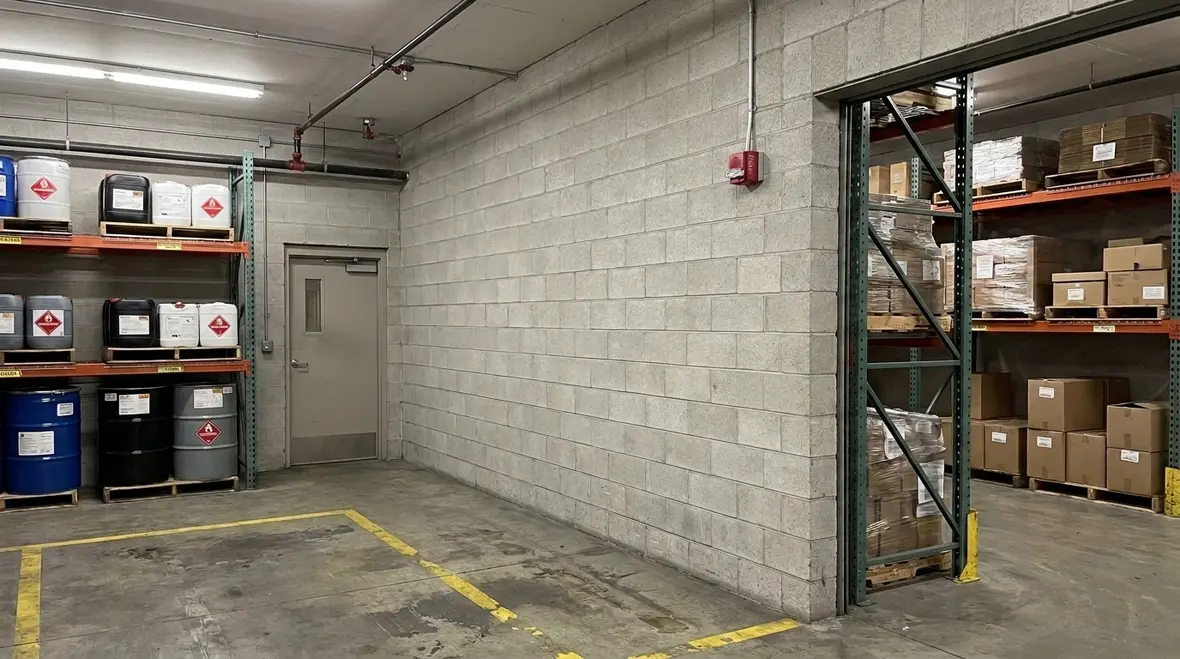
NFPA 30 Section 9.8: Control Areas and How They Set Storage Limits
Quick Answer
NFPA 30 Section 9.8 uses control areas to prevent fire and heat spread by limiting how much flammable or combustible liquid a facility can store in a defined portion of the building. The control area definition drives capacity calculations and the required protection performance, especially for ventilation, detection, and barriers.
If you want broader background before getting into the weeds, Kord Fire Protection’s NFPA 30 flammable and combustible liquids overview is a useful companion read that fits naturally with the control area discussion.
What does the NFPA 30 Section 9.8 control area definition do?
Commercial storage planning often fails at the same point: teams treat “maximum tank volume” as a standalone requirement instead of a system requirement. The NFPA 30 Section 9.8 control area definition creates the boundary for fire hazard separation. Within each control area, permitted quantities of flammable and combustible liquids depend on how the area is separated, constructed, and protected to manage fire growth and impingement.
In practice, a control area is not a convenient label. It is a compliance calculation input tied to physical enclosure, spacing, and the reliability of controls meant to slow fire spread long enough for occupants, firefighters, and installed fire protection systems to respond effectively.
How NFPA 30 control areas translate into storage limits
NFPA 30 Section 9.8 ties permitted storage limits to the ability of a defined area to restrict fire spread. The standard’s logic is simple: if a facility can confine a release and reduce fire exposure beyond its boundaries, the facility can allow higher quantities within that boundary. If confinement is weak or inconsistent, allowable capacity must drop or additional protections must be implemented.
Operational mechanics behind the limits
- Fire exposure control: Control areas are built to limit flame and radiant heat exposure to adjacent storage, buildings, or occupied areas.
- Barrier and containment performance: The control area concept depends on walls, floors, and openings that maintain separation performance during credible scenarios.
- Ventilation and vapor management: Many facilities store liquids that produce flammable vapors. Control area layout and ventilation strategy affect vapor accumulation and fire behavior.
- Emergency response feasibility: Installed detection, alarms, and fire suppression must be capable in the real world, not only on paper.
Facility planning reality checks
During commissioning and audits, inspectors often focus on the practical differences between design drawings and day to day operations. Common issues include incorrect physical boundaries, doors propped open, damaged wall penetrations, and storage practices that do not align with the marked limits for each area.
Control area boundaries: construction and separation that actually hold up
A control area is only as strong as its separations. In commercial, industrial, and retail occupancies, the “paper boundary” frequently breaks down due to renovations, rerouting of piping, and maintenance access needs.
Key boundary elements to verify
- Walls and rated assemblies: Penetrations must be sealed and maintained at the required performance level.
- Openings and doors: Door conditions, latching, and any fire door hardware must support the intended closure and barrier integrity.
- Floors and spill paths: Floor construction and curb or containment features influence how a release spreads across the control area boundary.
- Room layout constraints: Storage rack placement and aisle obstructions can change how heat and flames travel toward boundaries.
Common failure points
Typical field problems include nonconforming penetrations for electrical conduits, cable trays, and mechanical lines; poorly sealed sleeves; and changes in storage density after a project closes. These issues often go unnoticed until a partial remodel triggers a compliance review or an inspection finds discrepancies between the control area concept and the current condition of the space.
Protection systems and maintenance expectations inside a control area
Control areas are fire management zones. They do not replace properly designed fire protection. NFPA 30 strategies depend on installed systems operating as intended, including during the first minutes of a developing fire.
Systems typically tied to control area performance
- Detection and alarming: Reliable detection reduces the time between release, vapor ignition risk, and response.
- Suppression and fire control: Suppression performance must consider liquid fire characteristics and target surfaces.
- Ventilation controls: Ventilation arrangement affects vapor control and can influence whether fire behavior escalates.
- Emergency procedures: Staff must know what actions support control area intent, such as isolation steps and evacuation routes.
Maintenance that prevents drift out of compliance
Commercial sites frequently shift storage volumes and packaging types. Maintenance and inspection programs should explicitly tie to control area rules, not only general fire alarm or general sprinkler checks. A well managed program includes verifying that the physical boundaries remain intact, systems are tested at required intervals, and storage practices remain aligned with the permitted quantities per control area.
For additional context on how NFPA 30 regulates flammable liquids in commercial settings, see how NFPA 30 regulates flammable liquids.
It also helps to connect those storage rules with a broader protection strategy, especially when facilities need overlapping controls. Kord Fire Protection’s layered fire protection system for flammable liquids article is a natural next step for that discussion.
Compliance process: how facilities should measure and document control areas
Control area compliance succeeds when the facility can demonstrate repeatability: the same area definition used for initial engineering remains valid after routine changes. That means measurement, documentation, and change control must be managed like a safety critical system.
Recommended documentation and verification steps
- Confirm the control area boundary: Use the latest as built drawings and a field verification walkdown to confirm separations, openings, and spill paths.
- Map storage positions to the boundary: Document where liquids are stored relative to walls, doors, and racks. Storage density must match what the calculation assumes.
- Review operating conditions: Verify door behavior, housekeeping, and any routine activities that could defeat separation performance.
- Align inspection and testing records: Detection, suppression, and any related systems must be current, with findings corrected and documented.
Where auditors and inspectors focus attention
- Evidence that walls and penetrations have been maintained since the last approval.
- That door closures function consistently during operations and maintenance.
- That storage quantity markings or controls prevent exceeding the intended capacity per control area.
- That staff procedures and training match the physical design intent.
How Kord Fire Protection supports control area compliance over time
Control area rules are not a one time engineering exercise. Commercial facilities change through renovations, equipment swaps, and operational adjustments. Kord Fire Protection supports ongoing compliance by helping facilities maintain the physical boundaries and life safety systems that NFPA 30 relies on for storing flammable and combustible liquids.
In practical terms, Kord Fire Protection assists with routine inspection readiness, coordination of testing and maintenance, and field verification that storage practices remain aligned with control area capacity assumptions. This reduces inspection findings, prevents drift from approved conditions, and supports defensible documentation for audits and insurance reviews.
Start with a targeted gap assessment: Facilities can achieve faster resolution when the review focuses on the control area boundary elements, penetrations, door integrity, and system performance linked to Section 9.8.
Frequently Asked Questions
Conclusion and call to action
NFPA 30 Section 9.8 control areas set storage limits by tying permitted quantities to real physical separation and reliable fire protection performance. Facilities that only track storage totals without verifying boundaries, penetrations, door behavior, and system readiness risk noncompliance and unsafe conditions. Engage Kord Fire Protection to validate your control area layout, verify maintenance integrity, and support ongoing testing and documentation so your storage limits stay defensible year round.

Join Our Newsletter!
Get the latest fire safety tips delivered straight to your inbox From our Newsletter.



