
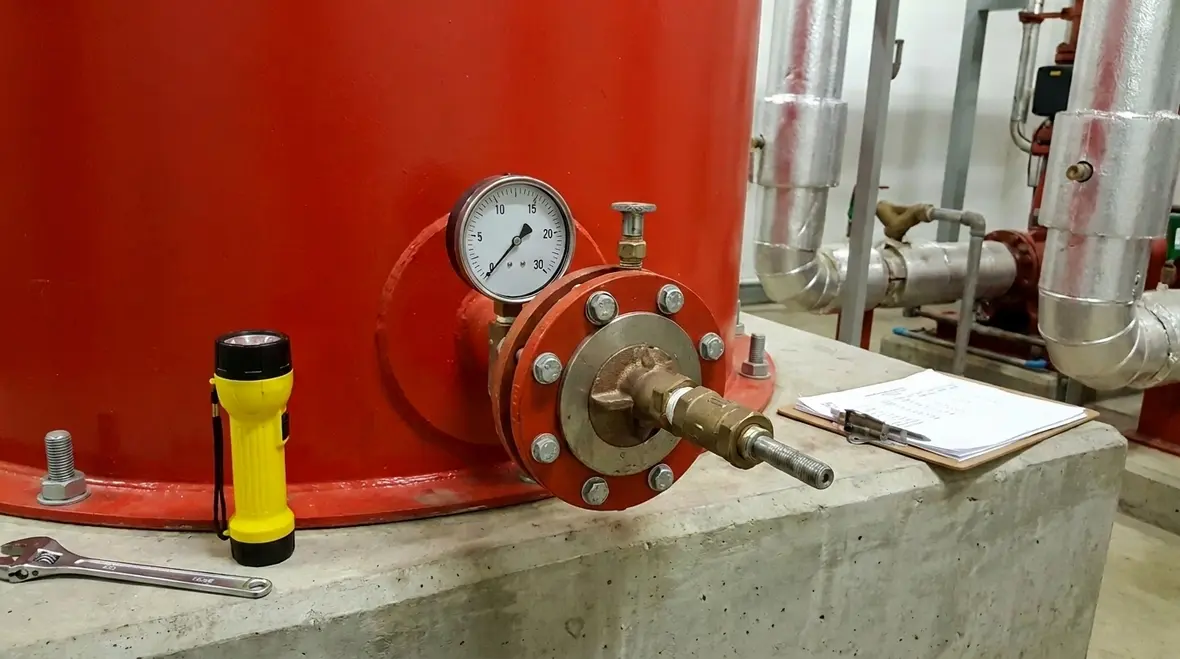
NFPA 22 Section 7.2: Pipe Connections and Fittings for Pressure Water Tanks
Quick Answer
NFPA 22 Section 7.2 governs how pressure water tank piping systems connect and how fittings are installed, supported, and maintained to preserve pressure integrity and system reliability. Compliance focuses on correct materials, connection methods, leak control, and inspection readiness across commercial facilities.
If your facility also needs broader inspection, repair, or testing support beyond tank connections, Kord Fire’s fire protection services in Southern California fit naturally into a larger compliance plan.
Why NFPA 22 Section 7.2 Matters for Pressure Water Tank Operations
Commercial water tank systems often look straightforward until a connection fails under real pressure, vibration, temperature change, or poor installation practices. NFPA 22 Section 7.2 addresses these risks by setting expectations for pressure water tank pipe connections fittings that protect system performance. When facilities follow these requirements, they reduce leakage, prevent flow restrictions, and support safe operation during fire emergencies.
In practice, facility owners and engineering teams must treat connections and fittings as life safety components. They are not “plumbing details.” They determine whether the tank delivers designed pressure and flow when the fire pump or tank system demands it.
For a broader compliance overview of how NFPA 22 regulates fire protection water tanks, refer to how NFPA 22 regulates fire protection water tanks.
Section 7.2 Scope: What Gets Controlled in Pressure Tank Plumbing
Section 7.2 focuses on the components that form the interface between the tank and the system piping, including the pipe connections and fittings used to maintain a reliable pressure boundary. Compliance typically requires a controlled approach to:
- Connection methods that prevent leakage under normal operating pressure and during system demand.
- Fitting selection that avoids internal obstructions and unintended pressure losses.
- Proper alignment, support, and installation to reduce stress on the tank nozzles and piping.
- Installation practices that limit corrosion and avoid galvanic reactions when dissimilar metals are used.
Commercial environments add additional stressors. Systems may see frequent maintenance access, vibrations from adjacent equipment, or temperature cycling from HVAC and building operations. Those conditions elevate the importance of correct installation and documented inspection.
Pipe Connections: Installation Practices That Prevent Leaks and Loss of Pressure
Many failures tied to pressure tanks trace back to connection execution rather than the original pipe material choice. NFPA 22 Section 7.2 expectations align with common engineering controls that fire protection contractors apply to achieve leak resistant, pressure stable assemblies.
Connection alignment and mechanical stress
Tank nozzles and connected piping require careful alignment. Misalignment can introduce bending loads at the nozzle, which can loosen fittings over time or create micro cracks. In commercial facilities, this becomes more likely during renovations when piping is re-routed or when trades do not coordinate tolerances.
Proper pipe support and restraint are essential. Supports must maintain the intended geometry through thermal expansion cycles and operational loads. When supports are missing or incorrectly spaced, vibration and movement translate into fatigue at joints and couplings.
Gasketed and threaded joint integrity
Where gasketed or threaded connections are used, the system must achieve reliable sealing. Pressure water tank applications are unforgiving; a small leak can become a large issue by increasing make up requirements, reducing effective pressure, and masking broader corrosion conditions.
Best practice controls include using compatible gaskets, confirming tightening procedures, and verifying installation cleanliness. Contaminants trapped at joints can prevent full gasket compression and lead to seepage that may only be visible during flow testing or after extended operation.
Couplings, unions, and serviceability
Connections often need to remain serviceable for inspection, testing, and repairs. Unions and removable joints can reduce downtime by enabling component replacement without excessive disassembly. Section 7.2 expectations support maintaining integrity while still allowing the facility to perform required maintenance actions.
However, serviceability must not be achieved by using fittings that compromise pressure performance or introduce internal flow restrictions. Selection and installation need to maintain the system’s design intent.
Fittings: Selection and Installation to Avoid Restriction, Corrosion, and Failure
The wrong fitting can introduce problems that only become visible during operational testing. For pressure water tank pipe connections fittings, compliance depends on both selection and installation quality.
Flow performance and internal obstructions
Fittings influence pressure losses through friction and turbulence. Restrictive configurations can reduce effective delivery and impact system performance during fire conditions. Facilities should confirm that fitting selection aligns with design calculations and the system’s intended flow path.
Material compatibility and corrosion control
Pressure water tank piping and fittings must resist corrosion in the environment they serve. Many commercial systems experience humidity, condensation, and intermittent wet conditions around tank rooms, pump rooms, and utility spaces.
Incompatible metals can create galvanic corrosion. Even when the tank itself performs well, corrosion at a fitting or joint can weaken the connection over time. Correct coating practices, compatible materials, and proper drainage considerations are key.
Thread engagement and joint preparation
Threaded fittings require correct thread engagement and joint preparation. Under engagement may not provide adequate sealing area, while over application of sealants can complicate future inspection or cleaning. Joint preparation quality also affects whether a fitting can be reinstalled without damage after maintenance.
Commercial maintenance teams must document any disassembly and reassembly steps and verify that the reinstalled fittings match the original specification or an approved equivalent.
Common Compliance and Maintenance Failure Points in Commercial Facilities
NFPA 22 compliance does not end at installation. Many failures occur after systems are commissioned, especially during renovations, component swaps, or “temporary” repairs that remain in service longer than intended.
Unauthorized substitutions during repairs
One of the most common risk drivers involves substituting non compatible fittings during emergency repair. Even if a fitting appears to “fit,” it may not meet pressure, material, or sealing expectations defined by the applicable standard and the system design.
Undocumented modifications
Commercial facilities often perform piping adjustments for layout changes. When modifications do not get documented, later inspections may miss that a connection or fitting no longer matches approved plans. This increases inspection time, complicates testing, and can delay corrective action.
Inadequate inspection readiness
Connections should remain accessible enough to inspect for leaks, corrosion, and support condition. Coverings, insulation removed incompletely, and blocked access reduce the ability to verify compliance during routine checks.
Facilities should also manage how inspection results get recorded. Clear records support maintenance planning and reduce the likelihood that connection issues remain hidden until a formal flow test reveals them.
How Kord Fire Protection Supports Ongoing Compliance for Section 7.2
Kord Fire Protection helps commercial facilities keep pressure water tank systems reliable through practical compliance support for pipe connections and fittings. The goal is not only meeting paperwork requirements, but verifying operational readiness and reducing connection related failure risk across the system lifecycle.
Typical service contributions include targeted inspection support, documentation of observed connection conditions, and coordination of corrective actions tied to pressure integrity. Kord Fire Protection also assists facilities that need to understand how NFPA 22 requirements apply to their specific tank configuration and installation practices.
When facilities prioritize ongoing maintenance, they prevent connection degradation from becoming an emergency response scenario.
Frequently Asked Questions
Get Professional Support for Pressure Tank Connection Compliance
Pressure water tank pipe connections fittings directly impact leak control, pressure stability, and fire system reliability. Facilities should not wait for test failures or visible seepage before addressing connection risk. Engage Kord Fire Protection to support inspection readiness, evaluate connection and fitting conditions, and plan corrective actions that maintain NFPA 22 compliance through ongoing maintenance and testing. Contact Kord Fire Protection today to schedule a compliance focused review.

Join Our Newsletter!
Get the latest fire safety tips delivered straight to your inbox From our Newsletter.



