
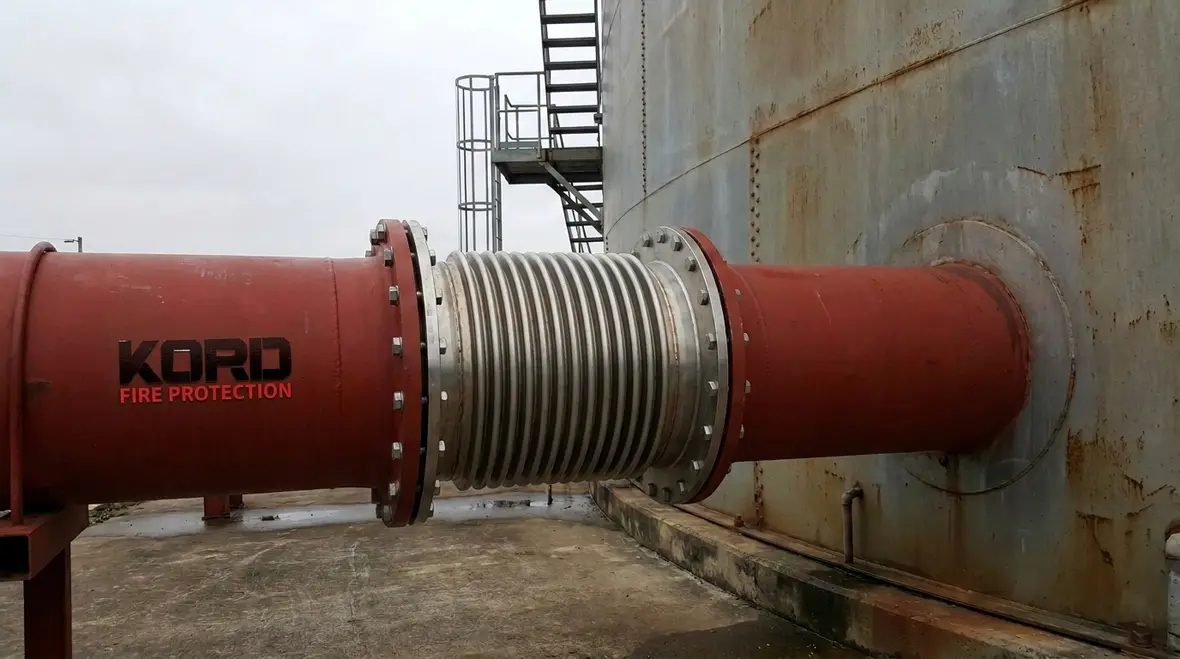
NFPA 22 Section 14.3: Expansion Joint Requirements on Water Tank Piping
Quick Answer: NFPA 22 Section 14.3 requires that water tank piping accommodate thermal growth, vibration, and alignment changes without overstressing components. Expansion joints, when used, must be selected, installed, and maintained to prevent leaks and ensure fire protection reliability across the tank system’s operating conditions.
For facilities reviewing tank compliance alongside broader system support, fire protection services in Southern California can help connect water supply reliability, inspections, maintenance planning, and corrective action tracking in a way that actually holds up in the field.
Why expansion joint selection matters for fire protection water tanks
Expansion joints in fire protection water tank piping must be treated as life safety components, not routine mechanical accessories. For facilities that operate in harsh cycles such as seasonal temperature swings, pump start stop events, and seismic or settlement movement, the expansion joints water tank piping requirements in NFPA 22 Section 14.3 drive how designers prevent binding, leaking, and premature joint fatigue. The compliance risk is practical: an improperly selected or maintained joint can fail silently through weeping, gasket deterioration, or movement restriction that forces stress into adjacent couplings and threaded connections.
Commercial, industrial, and retail facilities typically face inspections that look beyond the drawings. Inspectors and AHJs often expect consistent installation practices, measurable acceptance conditions, and documented maintenance history aligned with the water tank system’s hazard and occupancy risk.
What NFPA 22 Section 14.3 expects from expansion joints
NFPA 22 Section 14.3 focuses on ensuring that water tank piping remains functional under conditions that create movement. The intent centers on preventing excessive stress, maintaining alignment, and avoiding leakage at joints and fittings that connect to the tank. While the exact configuration depends on the tank piping layout and design basis, the core compliance expectations typically include:
Proper type selection based on expected movement and service conditions such as water temperature, pressure, and normal surge conditions.
Correct installation including alignment and orientation so the joint can accommodate movement rather than transfer stress to nearby piping.
Compatible connections with the rest of the piping system to maintain strength and leak tightness at rated conditions.
Maintenance and inspection readiness so joints remain operational over time, with access for visual verification and functional checks when applicable.
From a fire safety standpoint, the most critical failure mode is loss of integrity during demand. A small leak or partial binding may reduce effective system performance or introduce corrosion that accelerates deterioration of adjacent components.
How movement, misalignment, and thermal cycling create failure points
Expansion joints experience the combined effects of thermal expansion, hydraulic forces, and mechanical movement. In tank piping systems, these stresses often concentrate at interfaces such as flanged connections, threaded couplings, and anchors or guides that limit movement.
1) Thermal growth without proper accommodation
When piping runs warm and cool through operating cycles, straight runs and improperly spaced anchors can force the piping to “fight itself.” If an expansion joint is missing, undersized, or installed without correct precompression or travel alignment, the joint may act as a rigid connector. That shifts stress to the next fittings and seals, causing gasket extrusion, weeping at flange faces, or cracking in brittle components.
2) Restrained movement leading to binding
Expansion joints must be free to perform within their designed stroke limits. Common commercial installation issues include mismatched pipe supports, incorrect guide placement, and construction tolerances that leave the joint partially constrained. Binding typically becomes apparent during system operation when the joint movement is restricted. Visual signs can include uneven bellows condition, accelerated wear marks, or abnormal pipe strain near the joint.
3) Vibration and pump surge effects
Even when thermal movement is moderate, pump start stop cycles can introduce vibration. If the joint design and restraint scheme do not account for dynamic effects, fatigue can develop in bellows or flexible elements. The result may not show immediately. Over time, the joint may leak under pressure rather than fail catastrophically, which creates a compliance and operational challenge because the system can appear “mostly fine” while degrading.
Installation practices that support inspection and long term reliability
Meeting the intent of expansion joints water tank piping requirements depends on controlled installation, not only product selection. Facilities that have recurring inspection findings often share the same operational patterns: inconsistent contractor practices, limited access for verification, and weak documentation of set points and as-built conditions.
Anchor, guide, and alignment coordination
Expansion joints work with the support system. Correct pipe alignment, anchor placement, and guide function ensure that the joint absorbs movement instead of transferring stress. During commissioning, piping should be checked for strain at connections and for proper joint position relative to the design stroke limits. Any field modifications should trigger a recheck of movement allowance, especially where multiple joints exist in a run.
Connection compatibility and leak tightness
Leak tightness must be maintained at the joint and at the interfaces around it. This includes verifying that gasket materials and flange surfaces align with water service and pressure rating. In practical terms, inspectors frequently look for evidence that connections were assembled cleanly, torque practices were followed, and that there is no visible distortion, corrosion, or improper coupling engagement.
Access planning for ongoing inspection
Even when NFPA 25 or a facility maintenance plan governs periodic testing, expansion joints should remain reachable for inspection and documented observations. Concealed joints under insulation or behind locked enclosures often reduce the ability to perform visual verification and can delay corrective action after early warning signs appear, such as moisture accumulation, corrosion staining, or support settlement.
Inspection, testing, and maintenance expectations for commercial facilities
Expansion joints in fire protection water tank piping require a maintenance approach that matches their risk profile. Commercial facilities often combine preventive maintenance with readiness checks, and the expansion joint program should include clear trigger points for evaluation.
What to inspect during routine maintenance
Visual condition of bellows, flexible elements, and surrounding pipework for wear, corrosion, deformation, or signs of leakage.
Support integrity including anchor and guide condition, settlement, and evidence of strain near the joint.
Flange and gasket condition such as staining, seepage, and uneven joint alignment.
Evidence of movement beyond limits through inspection observations and review of any system disturbances such as abnormal pump behavior.
Common failure signatures that lead to noncompliance
Many repeat inspection issues come from predictable patterns:
Seepage or wet insulation indicating a slow leak at the joint or adjacent flange faces.
Misalignment evidence near the joint, including stress marks or deformation on nearby fittings.
Corrosion acceleration where leakage and trapped moisture exist, reducing long term reliability.
Maintenance documentation gaps that prevent verification of inspection frequency and corrective actions.
To streamline compliance for ongoing operations, Kord Fire Protection helps commercial owners and facility teams align expansion joint checks with their fire protection water tank program. This includes readiness planning, documentation workflows, and corrective action support so inspection outcomes reflect actual system condition, not just design intent.
Compliance strategy: connect NFPA 22 requirements to full tank system design
Expansion joints only function correctly when integrated into the full water tank system design, including tank configuration, piping layout, and operational behavior. For additional context on how NFPA 22 regulates fire protection water tanks and how these provisions interact with system components, review: How NFPA 22 Regulates Fire Protection Water Tanks.
Using that system level perspective helps teams avoid isolated fixes. If the piping supports or the tank inlet and outlet arrangements do not support designed movement, replacing an expansion joint alone may not solve the underlying stress and leakage driver.
Frequently Asked Questions
Call to action
Ensure your expansion joints water tank piping requirements are met with a documented inspection and maintenance plan backed by fire protection expertise. Kord Fire Protection can help your facility evaluate installation conditions, identify stress and leak risks, and align corrective actions with NFPA 22 expectations for reliable water tank performance. Contact Kord Fire Protection to schedule a compliance focused review and ongoing service plan.

Join Our Newsletter!
Get the latest fire safety tips delivered straight to your inbox From our Newsletter.



