
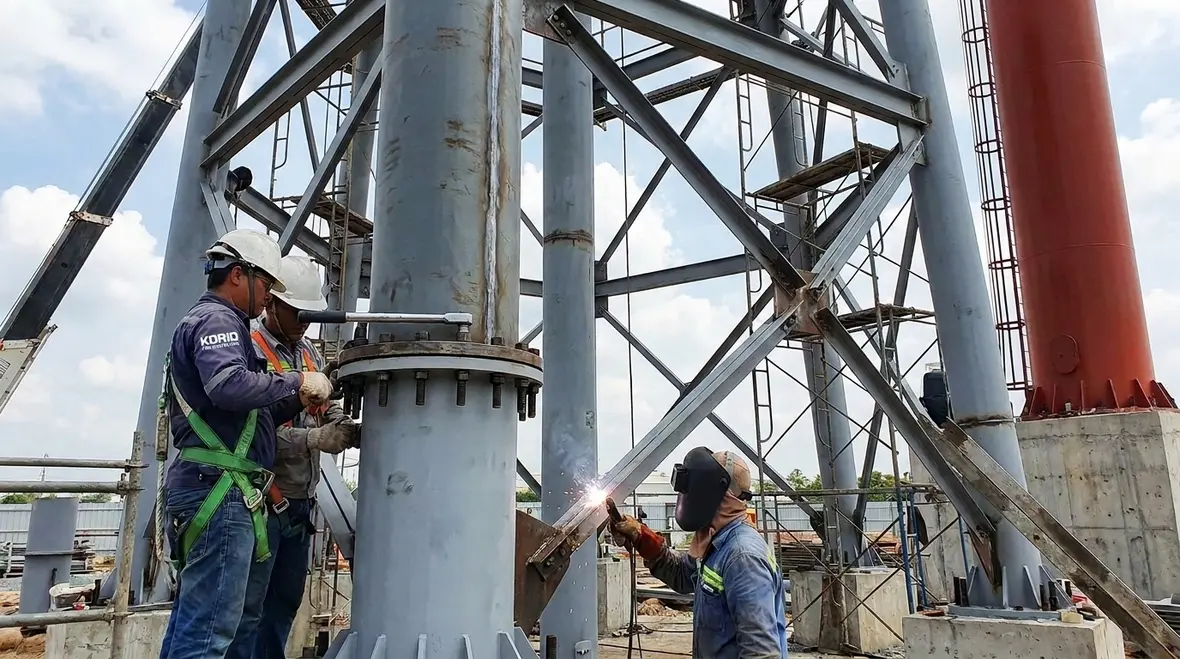
NFPA 22 Section 13.6: Workmanship Standards for Steel Tank Towers
Quick Answer
NFPA 22 Section 13.6 sets workmanship standards for constructing steel tank towers so the system can perform as intended during fire protection demand. These requirements address material quality, fabrication, welding and bolting practices, alignment, and corrosion protection to reduce failure risk and inspection problems.
If your team is planning broader water based system support, fire protection services in Southern California can help connect tower related issues with inspection, repair, maintenance, and documentation across the rest of the system.
Why workmanship requirements steel tank towers matter in real fire scenarios
In commercial fire protection systems, tank towers support fire protection water storage by providing the elevation, structural stability, and correct routing of piping and appurtenances. Even minor workmanship defects can create cascading operational issues: misalignment that stresses piping, poor weld quality that later corrodes or cracks, or installation shortcuts that reduce tower stiffness and stability. Those conditions can delay supply when it matters most and trigger repeat inspection failures, corrective maintenance, and increased downtime.
From a compliance standpoint, NFPA 22 does not treat tower construction as purely structural work. It links tank tower readiness to the water system performance objectives. Facilities that maintain high inspection pass rates tend to treat workmanship requirements steel tank towers as a system reliability requirement, not as a fabrication formality.
What NFPA 22 Section 13.6 typically expects during tower construction
Section 13.6 workmanship standards for steel tank towers focus on how components get made, assembled, and finished so they maintain integrity throughout the system life. While the exact language should always be confirmed against your edition of NFPA 22, commercial practice aligns around the same core outcomes:
Materials and fabrication quality: Steel selection and fabrication processes must support long term performance, including strength, dimensional stability, and resistance to deterioration.
Structural assembly correctness: Towers must be assembled to the required geometry and load path so they resist the forces created by wind, seismic events, and tank contents.
Joining methods that maintain integrity: Welding, bolting, and related joining must meet quality expectations so there are no weak points or stress concentrations.
Surface preparation and protective finishing: Corrosion control and coating integrity must be maintained so the tower does not lose thickness, section strength, or fastener integrity over time.
For facilities that operate under tight schedules, the practical challenge comes when tower fabrication and installation are outsourced to multiple vendors. Compliance gaps often appear at interfaces: field welding done without consistent controls, rushed alignment during erection, or coating touch ups performed without matching the original system.
Common workmanship failure points that lead to inspection noncompliance
Workmanship issues typically show up later as corrosion problems, alignment problems, or mechanical stress symptoms. The following are frequent real world failure points that correlate with tower workmanship deficiencies.
1) Weld quality and post weld condition
Defective welds, poor joint preparation, or inadequate control of heat and penetration can lead to cracks, incomplete fusion, and hidden discontinuities. Even when a weld appears visually acceptable, the long term risk increases if the joint is not properly finished and protected. During inspections, surface rust patterns around weld seams often provide early indicators.
2) Bolting practices and fastener integrity
Improper torqueing, missing fasteners, mismatched hardware, or incorrect bolt installation can compromise tower stiffness and stability. Over time, vibration and thermal cycling can loosen connections. Inspections can reveal inconsistent bolt condition, deformation, or coating breakdown at fastener interfaces.
3) Alignment errors that stress the water system piping
Steel tank towers connect to supporting piping and appurtenances. If components are misaligned during erection, the piping can experience bending stress during load conditions. This can accelerate fatigue, create leaks, or impair flow. Workmanship requirements steel tank towers are indirectly enforced through system performance because misalignment can cause repeated corrective maintenance and impaired operation.
4) Coating and corrosion protection defects
Coating damage from fabrication handling, field cutting, and grinding can leave bare steel exposed. When protective systems are not reapplied to the correct thickness and surface profile, corrosion develops rapidly. Commercial facilities often see this problem at weld locations and field joints, where patching is done quickly and inconsistently.
5) Inadequate surface preparation and cleanliness
Contamination, mill scale, and improper blast profile can prevent coatings from adhering. The result is premature coating failure and rust blooms. From a compliance perspective, repeat coating failures create recurring inspection triggers and escalate maintenance cost.
Operational and maintenance link: workmanship affects system performance
Workmanship standards on steel tank towers influence how the fire protection water system performs during demand and how easily the facility can maintain compliance afterward. The tower supports several critical functions:
Elevation and flow reliability: Structural integrity and alignment preserve the design elevation that supports water delivery performance.
Leak prevention: Tower assembly quality affects the condition of connected piping, valves, and fittings.
Inspectable accessibility: Correct workmanship supports safe access paths and durable mounting points so maintenance work can be performed reliably.
Corrosion control: Protective finishing reduces tower deterioration and helps prevent failures that can affect system uptime.
Facilities planning upgrades or new installations should also consider how NFPA 22 regulates water storage performance. For further context on compliance and system behavior around fire protection water tanks, review: How NFPA 22 regulates fire protection water tanks.
How to achieve compliance in the field: controls that reduce risk
Achieving workmanship requirements steel tank towers depends on practical jobsite controls, not only on drawings. Commercial facilities that succeed typically implement documented verification steps before the tower is closed in and painted.
Pre construction and fabrication verification
Confirm material traceability: Maintain documentation for steel grade, certification, and heat numbers.
Define welding procedures: Require welding procedure controls aligned with project requirements and qualification standards.
Set inspection hold points: Plan for inspection before coating and before final assembly cover plates go on.
Field erection controls
Alignment measurement and documentation: Capture measurements during erection and confirm tolerances prior to final tightening.
Controlled touch up and coating system matching: Verify field repair methods match the original coating system, including surface prep and thickness targets.
Fastener quality assurance: Use controlled hardware procurement and document torqueing or installation parameters where applicable.
Post construction inspection preparation
Before turnover to operations, facilities should ensure workmanship related evidence is present. That includes records of joint completion, coating repairs, and any required nondestructive examination results when used by the project scope. This improves defensibility during inspection audits and reduces downtime caused by late corrective action.
Where Kord Fire Protection supports commercial compliance
Kord Fire Protection helps commercial, industrial, and retail facilities reduce inspection risk by integrating workmanship verification awareness with ongoing system testing, documentation, and maintenance support. For fire protection water storage systems, the tower is not an isolated asset. It supports valves, piping, and flow performance that must remain reliable year after year.
For facilities managing multi building portfolios, Kord Fire Protection also supports consistent compliance processes across sites, helping ensure corrective work does not drift from location to location after renovations or tower repairs.
Frequently Asked Questions
Call to action
If your facility uses steel tank towers for fire protection water storage, treat NFPA 22 Section 13.6 workmanship standards as a reliability and inspection readiness requirement. Engage qualified fire protection professionals early, verify tower construction and repair documentation, and maintain ongoing testing and maintenance to prevent workmanship related failures. Contact Kord Fire Protection to support compliance planning, system follow up, and continuous readiness across your sites.

Join Our Newsletter!
Get the latest fire safety tips delivered straight to your inbox From our Newsletter.



