
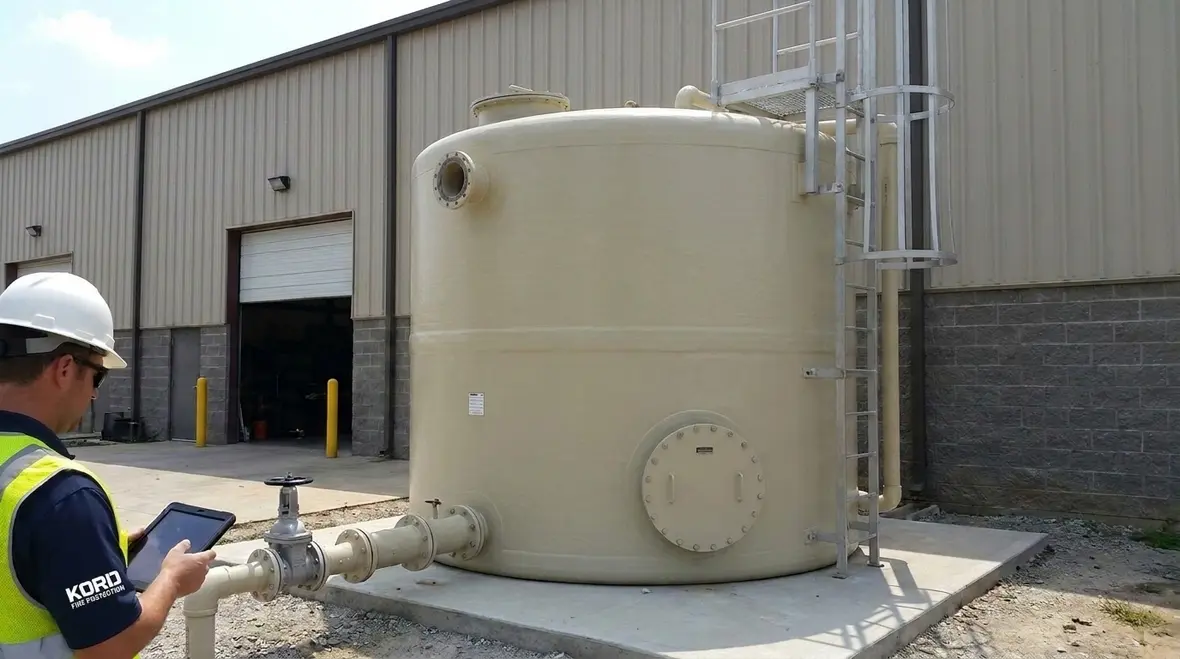
NFPA 22 Section 11.3: Specification Requirements for FRP Water Tanks
Quick Answer
NFPA 22 Section 11.3 sets engineering and material criteria for specifying FRP water tanks used in fire protection systems. The requirements address tank design, components, workmanship, installation documentation, and acceptance considerations to reduce leakage risk and ensure reliable firefighting water supply.
If you’re reviewing broader system support needs alongside tank compliance, Kord Fire Protection’s fire protection services fit naturally with inspection readiness, maintenance planning, and deficiency correction.
Why FRP water tank specification requirements matter in the field
FRP water tank specification requirements directly influence whether a commercial facility can reliably deliver fire protection water when system demand occurs. In practical terms, specification failures show up as premature liner damage, inaccurate connection details, uncontrolled curing and installation practices, and acceptance gaps during commissioning.
NFPA 22 Section 11.3 supports consistent tank performance across building types, but compliance still depends on how owners and installers translate the standard into procurement, submittals, and inspection routines. Kord Fire Protection often helps facilities close the loop between design intent and field verification, especially where retrofit constraints or multi-vendor installations increase risk.
What NFPA 22 Section 11.3 requires before procurement
Section 11.3 centers on how the tank gets specified, not just what it looks like. Facilities should treat these inputs as contract language that drives the rest of the lifecycle: fabrication controls, installation tolerances, and documentation for acceptance.
1) Tank materials and compatibility
Specifications need to define the FRP construction approach and ensure compatibility with the intended water quality and system chemistry. This matters because FRP performance is sensitive to resin selection, reinforcement structure, and exposure conditions that can accelerate degradation at joints, penetrations, and fittings.
2) Design basis for operating conditions
FRP water tank specification requirements must cover design assumptions that reflect actual site conditions. Installers often encounter variations in foundation conditions, pump suction head, and temperature profiles. When the spec does not clearly address operating range and allowable loads, it becomes difficult to verify whether the tank will remain structurally stable through normal system cycles and maintenance draining.
3) Critical component definition
NFPA 22 aligned specifications typically require that all tank interfaces get defined in advance: inlets and outlets, inspection openings, vents, overflow or drain features, and any access hardware. The highest risk areas usually involve penetrations and connection locations where sealing performance depends on correct installation procedures and product matching.
How specifications prevent common FRP tank failure points
Many field issues trace back to missing or vague specification requirements. The following are common failure points commercial teams can prevent by tightening FRP water tank specification requirements before construction begins.
Penetrations, couplings, and sealing interfaces
Penetrations represent discontinuities in the FRP barrier. When specs fail to require compatible sealing systems and installation verification, the tank can develop slow leaks, moisture intrusion, or localized delamination around fittings.
To manage this risk, specifications should include clear acceptance criteria for sealing materials, installation method statements, and inspection access for post-install verification.
Foundation and support assumptions
FRP tanks depend on correct support to limit flexural stresses and avoid stress concentrations. If specifications do not explicitly align tank design with the foundation plan, facilities often see settlement-related movement, joint stress, and uneven loading that reduce service life.
Vent and air management details
Vents and air release pathways influence fill and drain behavior. Poorly specified or incorrectly installed venting can cause air binding, abnormal pump operation, and operational delays during fire event conditions or maintenance cycles.
Coating, liner, and surface preparation requirements
Where a liner or protective system exists, specifications must define surface preparation and allowable conditions for installation and curing. In commercial and retail facilities, shutdown schedules can pressure contractors to accelerate steps, increasing the chance of incomplete curing and reduced adhesion.
Documentation and acceptance: what reviewers look for
Specification requirements only protect a facility if the project team captures proof during fabrication, installation, and commissioning. Commercial compliance reviewers typically seek a clear documentation package that demonstrates the tank matches the approved basis of design.
Submittals that should show up in the project file
- Material and construction descriptions that align with the approved tank design
- Design and fabrication documentation for FRP components
- Interface details for penetrations, inlets, outlets, vents, and drains
- Installation instructions and recommended inspection points
- Commissioning and acceptance expectations for leak testing and functional checks
Inspection steps during installation
Facilities benefit from planning inspections at the right times, especially before cover-up stages and final alignment. Kord Fire Protection supports commercial sites with compliance-focused reviews and testing coordination, helping teams verify that field conditions match submittals and that critical interfaces get inspected while access remains available.
Operational checks after commissioning
Beyond leak checks, commissioning should confirm that the tank supports expected hydraulic behavior for the fire protection system. That includes verifying fill and drain operation, confirming vent performance, and ensuring that alarms or controls linked to tank level and supply operation do not create unintended failure modes.
Common compliance challenges in commercial and industrial facilities
Real-world compliance often fails due to process breakdowns rather than missing technical data. The most frequent challenges include:
- Retrofit constraints: Existing slabs, limited access, and unknown foundation conditions can compromise support and alignment if the specifications do not account for field verification.
- Multi-vendor delivery: Tank fabricators, plumbing contractors, and electrical or control integrators sometimes work from different documents, leading to mismatched connection interfaces and incomplete documentation.
- Maintenance planning gaps: FRP systems still require inspection and functional checks. If the spec does not identify maintenance access and routine inspection expectations, future compliance becomes more difficult and more expensive.
- Acceptance timing: When testing occurs too late, repairs become disruptive and may require rework that changes the original install conditions.
For broader context on how NFPA 22 regulates water tank installations and ongoing compliance considerations, review: How NFPA 22 regulates fire protection water tanks.
Best-practice specification approach for FRP water tank specification requirements
Facilities can reduce risk by converting NFPA 22-aligned requirements into a practical procurement and acceptance workflow. The goal is to ensure that the FRP tank performs under fire protection duty while remaining verifiable through inspections.
Recommended procurement checklist
- Require tank specifications that explicitly address materials, construction, and all interface components used in the system.
- Demand submittals that include installation instructions, required seals and compatible hardware, and identified inspection locations.
- Include acceptance criteria for leak testing, vent functionality, and confirmation that connections match the design intent.
- Require maintenance access provisions for inspection openings and operational verification points.
Operational maintenance considerations
Even when a tank passes initial acceptance, service life depends on routine checks that confirm the tank remains watertight and operationally ready. Kord Fire Protection helps commercial facilities maintain compliance by supporting testing and inspection planning across system life, not only at project closeout.
Frequently Asked Questions
Next step for commercial compliance
If your facility is installing or upgrading an FRP fire protection water tank, secure engineering-ready FRP water tank specification requirements early and plan inspections that verify critical interfaces before cover-up. Contact Kord Fire Protection to support compliance reviews, commissioning coordination, and lifecycle testing so your system performs reliably when it matters most.

Join Our Newsletter!
Get the latest fire safety tips delivered straight to your inbox From our Newsletter.



