
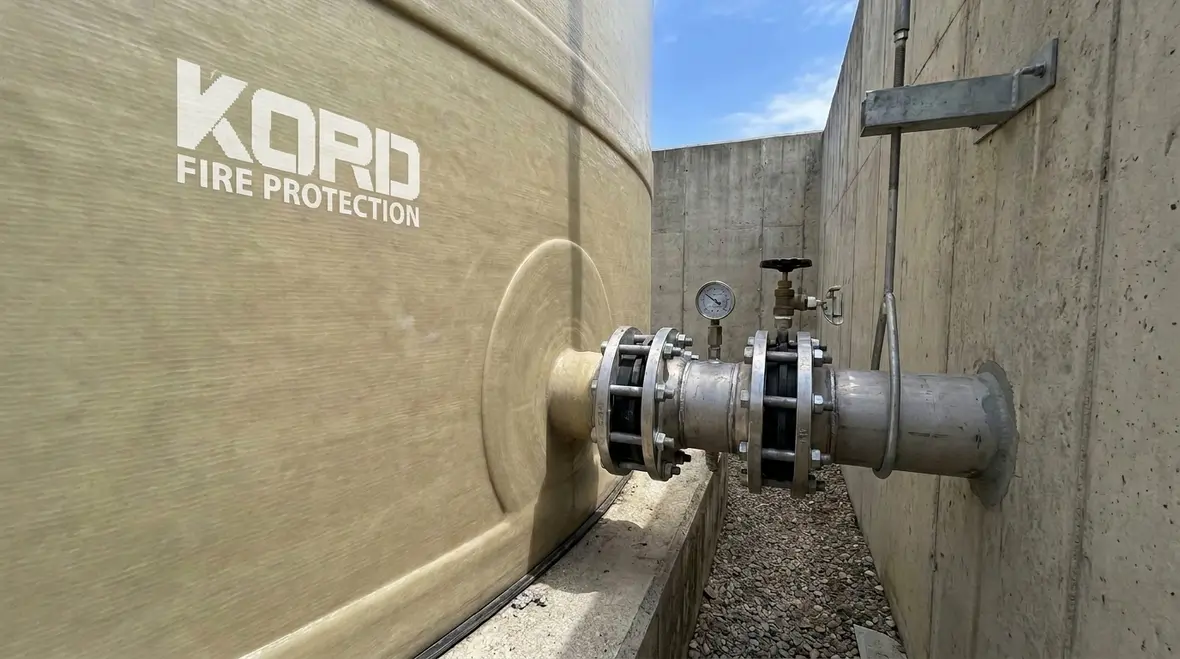
NFPA 22 Section 11.7: Pipe Connection Requirements for FRP Water Tanks
Quick Answer
NFPA 22 Section 11.7 sets the acceptance expectations for how piping connects to FRP fire protection water tanks. It focuses on leak control, mechanical security, corrosion and compatibility protection, and inspection-ready installation details. Facilities must verify workmanship, materials, and ongoing maintenance to remain compliant.
For facilities already managing pump performance and inspection schedules, Kord Fire Protection’s fire pump inspection and testing services fit naturally into the same compliance mindset, especially where tank connections and downstream fire service reliability need to stay in sync.
Why Section 11.7 matters for commercial FRP tanks
Commercial, industrial, and retail facilities often treat tank plumbing as routine work. NFPA 22 Section 11.7 corrects that assumption by requiring pipe connections that withstand service conditions and do not compromise system performance. For FRP water tanks, the connection is a frequent failure point because it combines dissimilar materials, vibration, thermal cycling, and long-term exposure to water chemistry.
When owners and maintenance teams do not manage the installation details, the system can drift out of compliance before anyone notices. Common outcomes include seepage around penetrations, gasket or seal degradation, misalignment between piping and tank nozzles, and corrosion or incompatibility at transition areas. These risks directly affect the FRP water tank connection requirements evaluation during plan review, commissioning, and recurring inspection.
What NFPA 22 Section 11.7 expects at tank penetrations
Section 11.7 concentrates on pipe connections where the system transitions from external piping into the FRP tank structure. In practice, compliance is proven through engineered alignment, approved fittings, and controlled sealing methods that prevent water loss and structural compromise.
1) Mechanical support and alignment
Pipe loads must not transfer into the FRP tank nozzle in a way that causes stress, cracking, or coating breakdown. NFPA 22 trade compliance typically requires rigid control of alignment and robust support of branch piping so connection torque and pipe movement do not stress the tank wall. Operationally, installers should verify that the piping can be connected without forcing the flange, threaded connection, or coupling into place.
Common noncompliant conditions include “draw-in” during gasketed connections, undersupported pipe runs, and the absence of pipe guides or hangers near the tank. These conditions may pass initial pressure testing but fail later due to fatigue or thermal cycling.
2) Approved sealing methods around penetrations
At the point where piping enters the tank, the seal must remain intact after commissioning. Sealing strategies often rely on manufacturer-approved gaskets, coupling systems, or compression devices designed for submerged service and the specific water chemistry used in the facility’s fire protection system.
A key compliance challenge arises when field teams substitute seal materials to “fix” a fit problem. Even minor deviations in gasket durometer, flange finish, or seal geometry can lead to seepage that appears after a few pump cycles.
3) Material compatibility and corrosion control
FRP tank components and connection hardware must work together in wet conditions. Inconsistent material selection around nozzles, unions, and flanges can create corrosion cells at the interface, or chemical incompatibility that accelerates gasket aging. Where metal components connect to FRP structures, the facility should follow approved transition details and manufacturer guidance for compatible fasteners, coatings, and sealing products.
In the field, corrosion often starts below insulation lines or behind access covers where inspection is delayed. That is why compliance is not just an installation event; it is an ongoing verification process.
How pipe connections get evaluated during compliance and inspections
NFPA 22 compliance is demonstrated through repeatable inspection outcomes. Inspectors look for consistent workmanship and evidence that the connection design prevents leakage, deformation, and unsafe conditions.
Look for inspection-ready documentation
Facilities typically maintain: submittals showing connection details, product data for seals and fittings, installation checklists, and test records. A strong compliance package reduces friction during Authority Having Jurisdiction reviews and internal audits.
Commercial operations also benefit from maintenance logs that show who inspected the connection, when they inspected it, and what they found. This matters because the most expensive failures usually occur after maintenance cycles are missed.
Field inspection focus points
During walkdowns, technicians typically verify:
- Connection alignment and absence of strain on tank nozzles
- Condition of gaskets, bolts, couplings, and accessible transition hardware
- No visible seepage or residue around penetrations
- Proper support and restriction on nearby piping to prevent movement
- Integrity of coatings or protective liners at transition points
Seepage indicators are not always active leaks. Residual staining, mineral deposits, or damp insulation can be enough to trigger corrective action before performance degrades.
Operational failure points that trigger noncompliance
Even when drawings appear correct, connection failures usually come from process breakdowns. The following issues commonly show up in commercial facility service histories.
Improper torque and gasket compression
Overtightening can deform gaskets and compromise sealing surfaces. Undertightening can allow slow leakage under pump pressure. Both conditions may escape early detection if leak observation stops at initial commissioning.
Incorrect pipe movement control
Thermal expansion, vibration from adjacent equipment, and pump start stop cycles can move piping over time. If anchors, hangers, and guides are not installed correctly, the connection can experience repeated stress at the FRP penetration.
Substituted materials during repairs
Maintenance teams may replace a gasket or fitting without confirming compatibility with FRP and the intended sealing method. This substitution can create chemical incompatibility, shortened seal life, and an increased chance of seepage at the tank penetration.
Delayed inspection of concealed transitions
Connections inside equipment rooms, under pipe covers, or in confined vault spaces often remain uninspected. When technicians do not plan access points, failures progress until a leak becomes obvious, increasing repair time and risk.
For a deeper understanding of how NFPA 22 regulates fire protection water tanks and related system controls, refer to this guide on how NFPA 22 regulates fire protection water tanks for context on design intent and compliance drivers.
Best practices for installing and maintaining FRP tank connections
Owners and facility teams reduce risk by treating pipe connection work as a controlled safety-critical task. The goal is repeatable installation quality and inspection clarity for the life of the system.
Installation controls that prevent future failures
- Verify tank nozzle and pipe alignment before final tightening. Avoid forcing connections.
- Use only manufacturer-approved seals, gaskets, and connection components designed for submerged fire service.
- Support piping independently so tank penetrations do not carry pipe weight or dynamic forces.
- Document torque values, gasket selection, and test outcomes where applicable.
- Confirm coatings and corrosion protection at transition points after final fit up.
Maintenance practices that support ongoing compliance
- Schedule periodic inspections of accessible connection hardware and nearby pipe support systems.
- Monitor for early seepage indicators such as staining, dampness, or mineral deposits.
- Reconfirm seal and connection integrity after valve work, piping modifications, or pump upgrades.
- Keep maintenance staff trained on “no substitution” rules for seals and compatible materials.
- Maintain inspection records to demonstrate compliance readiness during AHJ reviews.
Kord Fire Protection supports commercial facilities with practical compliance verification through inspection, testing support, and maintenance planning that reduces downtime and prevents connection-related failures from escalating.
When to involve fire protection specialists
Specialist involvement becomes essential when facilities face penetrations, system alterations, or recurring connection leakage. Kord Fire Protection provides on-site technical coordination that aligns installation and maintenance methods with the intent behind FRP water tank connection requirements.
Engage a qualified team when:
- There is any leak history around tank penetrations
- Piping rerouting or valve replacements require connection disturbance
- Inspections reveal cracking risk, misalignment, or degraded sealing components
- The facility must demonstrate compliance readiness to an AHJ or insurance reviewer
Frequently Asked Questions
Get connection compliance support before small issues become system risks
If your commercial facility has FRP tank connection penetrations, a recent repair, or any history of seepage, request an inspection and compliance review. Kord Fire Protection can help confirm that your installation details align with NFPA 22 expectations and that your maintenance program catches early failure indicators. Contact Kord Fire Protection to schedule a technical site review and documentation check.

Join Our Newsletter!
Get the latest fire safety tips delivered straight to your inbox From our Newsletter.



