NFPA 2001 Section 3.3: Total Flooding vs. Local Application
Quick Answer: NFPA 2001 Section 3.3 sets out two clean agent suppression methods: total flooding, which fills an enclosed hazard area to protect the whole space, and local application, which targets a specific fire risk directly. The right choice depends on the hazard, enclosure, airflow, and business needs. For teams planning a compliant system, clean agent fire suppression services can help connect the standard to real world design, installation, and ongoing support.
In NFPA 2001, the core idea is simple enough, even if the details like to dress up in a hard hat. It covers clean agent fire suppression systems that protect people, assets, and operations without leaving a messy residue. In the world of general definitions, Section 3.3 matters because it separates two very different approaches: total flooding and local application. That split shapes design, performance, and compliance for industrial, retail, and commercial sites. It also affects how a facility prepares for detection, discharge, hold time, nozzle placement, shutdown planning, and future maintenance.
Although the terms sound straightforward, the practical difference is much bigger than it first appears. One method protects the whole room. The other protects the hazard itself. That single distinction changes the engineering path, the room requirements, and the kinds of assets each system protects best. In other words, Section 3.3 may live in the definitions area, but it quietly tells the rest of the design process how to behave. Definitions rarely get applause, but in this case they deserve at least a polite nod and maybe a coffee.
If you want more context on how the standard fits broader system design, Kord Fire also has a useful resource on NFPA 2001 guidelines for clean agent fire suppression systems. It pairs well with this Section 3.3 discussion because the definitions only make full sense once you see how they influence actual suppression strategy.
What NFPA 2001 Section 3.3 Means in Plain English
Section 3.3 defines the terms that guide how a clean agent system works. A total flooding system protects an entire enclosed space by discharging agent until the design concentration is reached. A local application system, on the other hand, aims the agent at the actual fire risk, such as a machine, tank, or process area.
That difference sounds small. However, it changes everything from nozzle placement to room tightness. A total flooding setup needs a controlled enclosure, while local application depends on precise aim and coverage. In short, the system must match the hazard, not the other way around. The fire does not care about the paperwork, but the inspector certainly will.
Why the definitions matter so early
The reason these definitions matter so early in planning is that they affect almost every downstream decision. Detection method, release sequence, cylinder sizing, piping arrangement, and post discharge expectations all connect back to whether the system is protecting a room or a hazard. A team that picks the wrong method at the start can end up redesigning half the system later. That is a very expensive way to discover that vocabulary matters.

When Total Flooding Makes Sense
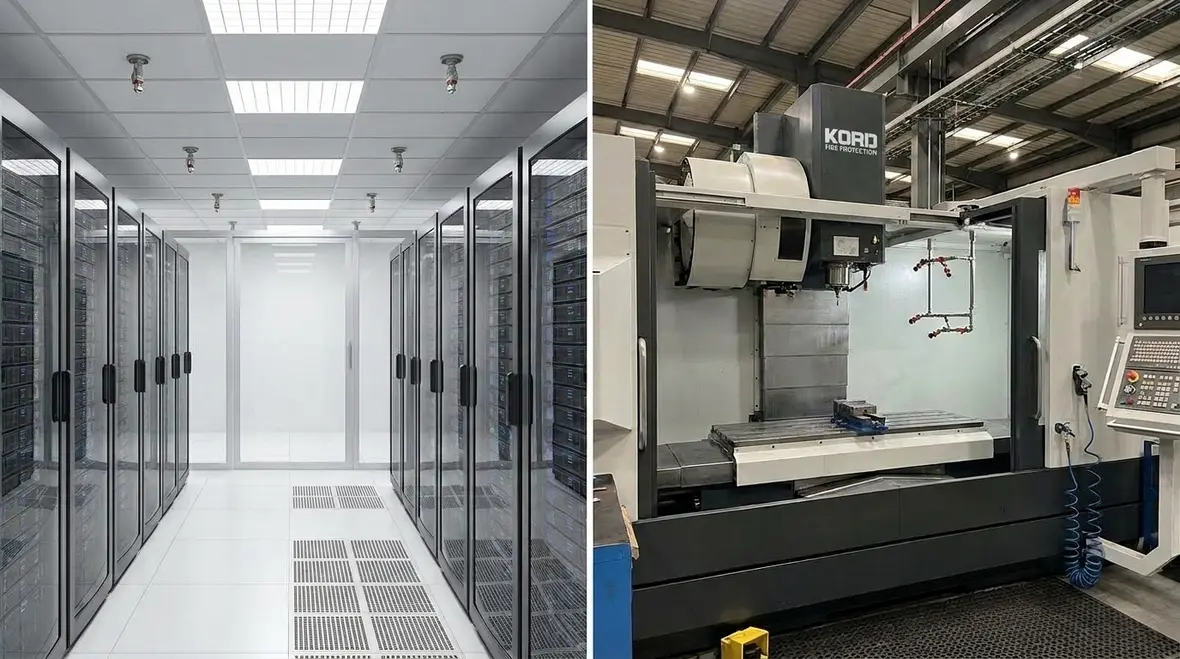
Total flooding works best when a room can hold the agent long enough to suppress the fire. It suits spaces like server rooms, switch rooms, control rooms, archive areas, and other critical zones where the whole enclosure must be protected.
Because the system protects the full space, it can stop hidden fire spread in cabinets, corners, and ceiling voids that may not be easy to reach with a point based method. Moreover, it helps protect high value equipment with less water damage than traditional systems. That said, the room must be sealed well enough to retain the agent. Otherwise, the gas can escape faster than a movie villain at the first sign of trouble.
Best fit factors for total flooding:
- Closed or sealable rooms
- High value electrical or data assets
- Need for fast, clean suppression
- Low tolerance for downtime
What designers evaluate before choosing it
Before selecting total flooding, designers usually examine enclosure volume, leakage paths, door function, ventilation shutdown, ceiling configuration, and whether the room contains sensitive equipment that cannot tolerate residue or water. Occupant safety and egress also remain part of the discussion because the room is being filled to a target concentration, not just lightly misted and wished the best. The method works beautifully when the enclosure supports it, but it is not a magic trick that can ignore physics.
This is why critical spaces often pair clean agent design with related planning around room integrity. Kord Fire’s discussion of clean agent suppression system and room integrity testing is especially relevant here because hold time is not a side detail. It is part of whether the strategy succeeds at all.

When Local Application Is the Better Choice
Local application suits hazards that sit in open or semi open areas. It targets a specific fire source rather than the entire room. This makes it a strong option for machinery, dip tanks, printing lines, turbines, spray booths, and other process equipment used across industrial and commercial sites.
Unlike total flooding, local application does not rely on enclosing the whole area. Instead, it focuses the agent where the fire starts and where heat release is likely to rise. Therefore, the system must be designed with exact discharge patterns, distances, and coverage in mind. A slightly off nozzle here is not a small mistake. It is the difference between control and chaos, and nobody needs that kind of drama before morning tea.
Best fit factors for local application:
- Open or partially open hazards
- Large process equipment
- Specific fire risk zones
- Areas where full enclosure is not practical
Why precision matters more than enclosure
With local application, the conversation shifts away from room sealing and toward geometry. Designers need to understand where the fire is likely to originate, how flames may travel, whether air movement could disturb agent discharge, and how the hazard layout affects shadowing. The system is only as good as its coverage of the actual risk. If part of the hazard falls outside effective discharge, the plan can look neat on paper while underperforming in the moment that counts.
This method can also be attractive when businesses cannot justify protecting an entire room but still need a fast clean response at the point of highest risk. That focused protection often supports continuity for production lines or process equipment where an outage can snowball into missed schedules, delayed deliveries, and many phone calls that nobody enjoys.

How to Compare the Two Methods in a Site Assessment
| Total Flooding | Local Application |
| Protects the entire room or enclosure | Protects only the hazard area |
| Needs a sealed space | Works in open or exposed settings |
| Often used for critical electrical or data rooms | Often used for machinery and industrial processes |
| Focuses on agent hold time | Focuses on discharge pattern and coverage |
During assessment, the designer should check enclosure size, leakage, ventilation, asset value, occupancy, and shutdown impact. Then the team can decide whether the site benefits more from full enclosure protection or direct hazard coverage. In many facilities, the answer is not obvious on day one. That is where expert review saves both money and headaches.
A practical site assessment also considers how the facility operates when everything is normal, not just when everything is on fire. Does the area have constant airflow. Are doors left open during production. Will equipment keep moving after alarm activation. Can processes be shut down quickly. These operational questions influence whether total flooding or local application will actually work in the field instead of merely sounding impressive during a meeting.
Why Design Details Matter for Compliance and Performance
NFPA 2001 is not about guesswork. It depends on clean agent concentration, nozzle layout, room integrity, and hazard type. Therefore, the system must be engineered from the start, not patched together later like a cable job after a long weekend.
For total flooding, enclosure integrity testing often becomes a key step. If the room leaks too much, the agent may not stay long enough to suppress the fire. For local application, the system must aim at the risk with enough density and coverage to control the flame path. In both cases, poor design can reduce performance and create compliance issues.
Moreover, many facilities face mixed use spaces, tight uptime demands, and complex plant layouts. So the fire protection plan must support real operations, not just a drawing on a screen. That means documentation, commissioning, testing, and maintenance all deserve attention, because a good concept still needs disciplined execution.
Compliance is a design outcome, not a last minute add on
One of the most common mistakes in suppression planning is treating compliance as something to tidy up at the end. In reality, compliance is built through decisions made from the first survey onward. Hazard classification, enclosure evaluation, discharge calculations, and equipment placement all feed into whether the finished system performs as intended and stands up to review. Trying to fix a weak design later usually costs more, takes longer, and creates the sort of meeting notes everyone wants to forget.
How Kord Fire Protection Supports Facilities
Kord Fire Protection can become a vital partner for industrial, retail, commercial, and facility operators that need a clean agent strategy matched to the actual risk. Their team can help assess the hazard, compare suppression methods, and build a system that fits the site rather than forcing the site to fit the system.
They can support:
- Site inspections and risk review
- System design and engineering input
- Installation and commissioning
- Testing, inspection, and maintenance
- Compliance support for ongoing operation
Because clean agent systems protect business continuity as much as property, this kind of support matters. A well planned system can reduce damage, shorten downtime, and help protect people and assets. In the real world, that is not just fire protection. That is operational survival with a cleaner finish.
For facilities that protect sensitive electronics or mission critical spaces, Kord Fire also covers related topics such as clean agent fire suppression for server rooms and mission critical fire suppression with clean agent systems. Those resources give helpful context when a project team is trying to connect standard language with the actual environments being protected.
FAQ
Choose the Right Clean Agent Strategy
NFPA 2001 Section 3.3 gives facilities a clear path: protect the whole enclosure or target the hazard directly. The right choice depends on the site, the risk, and the business impact of downtime. A well chosen approach supports both fire safety and operational continuity, which is exactly what businesses hope for when they invest in clean agent protection.
For industrial, retail, and commercial operations, Kord Fire Protection can help turn that choice into a practical, compliant, and reliable solution. If the goal is better protection with less guesswork, the next step should be a professional site review and a suppression strategy built around how the facility actually works.

Join Our Newsletter!
Get the latest fire safety tips delivered straight to your inbox From our Newsletter.