
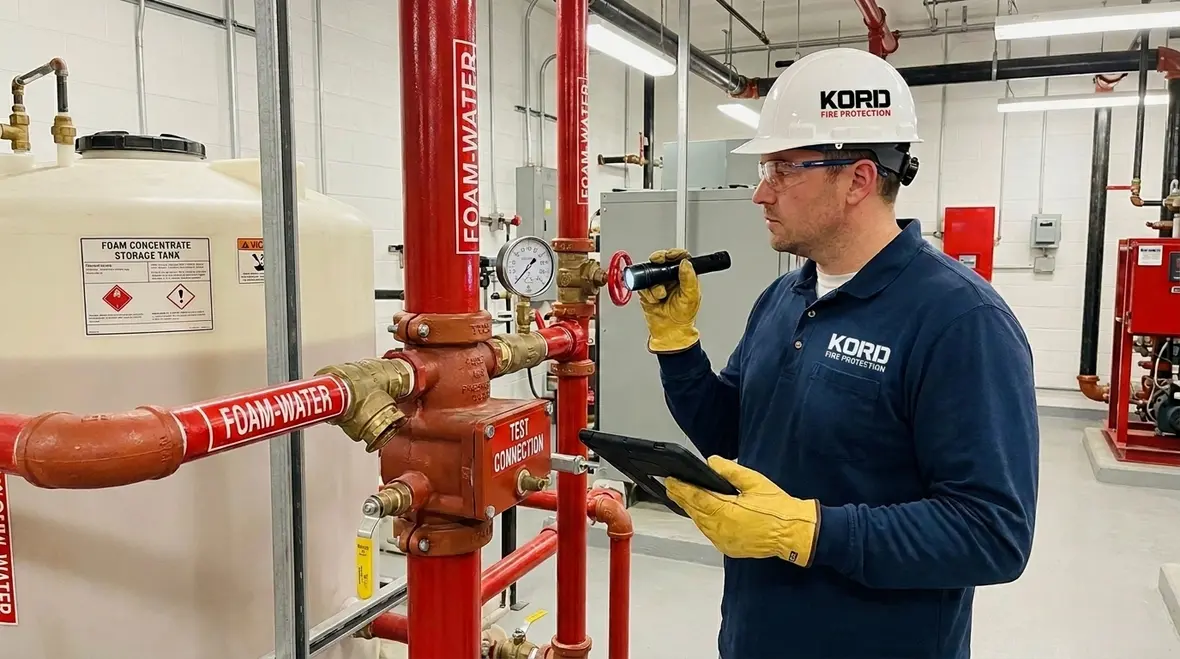
NFPA 16 Section 9.1: Inspecting, Testing, and Maintaining Foam-Water Sprinkler Systems
Quick Answer
NFPA 16 Section 9.1 requires documented inspection, testing, and maintenance for foam-water sprinkler systems to ensure reliable foam concentrate delivery, correct concentration, and proper sprinkler operation. ITM focuses on maintaining system integrity, verifying foam proportioning performance, and addressing common failure points like concentrate degradation and impaired hardware.
For facilities coordinating broader suppression support, Kord Fire Protection also provides fire suppression system services that fit naturally alongside foam-water sprinkler inspection, testing, and maintenance.
What Section 9.1 actually demands for foam-water sprinkler ITM
NFPA 16 is the governing standard for installation, use, and maintenance of foam-water sprinkler systems. In commercial buildings, foam-water systems often support higher-hazard spaces where plain water or standard sprinkler discharge does not achieve the required firefighting performance. ITM foam-water sprinkler systems NFPA 16 Section 9.1 establishes the ongoing process for confirming that the system remains in the condition assumed by the design.
In practice, compliance is not just “annual flow and visual checks.” Section 9.1 expects a structured program that verifies key performance factors: water supply readiness, foam proportioner operation, foam concentrate condition, valve and actuator health, system labeling and condition, and continued capability to produce correct foam characteristics during a demand.
Where Section 9.1 fits in the inspection and testing lifecycle
Section 9.1 operates as the operational backbone for foam-water sprinkler systems. Facilities implementing ITM typically manage three parallel tracks:
- Inspection to confirm the system appears ready for service and all components remain accessible, unobstructed, and in the expected physical state.
- Testing to verify system operation and performance against acceptance criteria relevant to foam production and delivery.
- Maintenance to correct deficiencies, replace aging components, clean internal assemblies, and restore the system to its intended performance condition.
Commercial, industrial, and retail facilities often face a recurring compliance challenge: foam systems include additional hardware and stored concentrate that can degrade over time, while normal sprinkler ITM practices do not always capture foam-specific failure modes. A well-run ITM program identifies and mitigates these issues early, reducing the probability of failed discharge or incorrect foam generation when the system is needed.
For an overview of NFPA 16 requirements and practical implementation guidance, refer to Kord Fire Protection’s NFPA 16 standard resource.
Inspection: what inspectors look for during ongoing readiness checks
In Section 9.1 style ITM programs, inspection begins with a reality check. Foam-water systems frequently rely on components that experience mechanical wear, vibration, waterborne corrosion, and concentrate aging. Inspectors document observable conditions and verify that the system can operate within the designed parameters.
1) System components and physical readiness
- Foam proportioning equipment (for example, foam concentrate proportioners or related metering devices) is inspected for leaks, correct positioning, accessibility, and signs of contamination or corrosion.
- Valves, actuators, and control accessories are inspected for proper labeling, correct configuration, and physical integrity. Stiction, damaged linkages, and valve packing issues can delay operation.
- Concentrate storage containers or tanks are inspected for condition, secure mounting, and evidence of deterioration or contamination.
- Pipework and connections are inspected for obstruction, damage, improper supports, and visible water or concentrate leakage.
2) Documentation, signs, and operational knowledge
Inspection also includes verifying that the facility maintains accurate records, system identification, and up to date operating instructions. Many foam-water system failures are indirect: the equipment operates as built, but the facility cannot quickly confirm concentration targets, component status, or correct maintenance history.
Kord Fire Protection typically helps customers reduce this risk by maintaining a compliance-ready documentation trail that aligns inspection findings with testing outcomes and corrective actions.
Testing: how ITM verifies foam-water system performance
Testing under Section 9.1 focuses on verifying that the system performs as required when actuated. For foam-water systems, this means the foam proportioning process must produce foam at the correct concentration and delivered in the expected manner.
Key foam performance checks facilities must plan for
- Proportioner verification to confirm that the metering function produces the required foam concentration during water discharge conditions.
- Foam concentrate condition checks to address degradation, contamination, or changes in foam performance over time. Concentrate aging can reduce effectiveness even when the mechanical equipment remains functional.
- Flow and actuation confirmation to ensure the system’s control and water delivery path initiates properly. Impaired control valves or delayed actuation can create partial discharge or unacceptable performance.
Common failure points found during testing
Commercial facilities frequently encounter patterns that show up during foam-water testing:
- Concentration drift caused by metering wear, calibration drift, or system modifications that were not reflected in maintenance records.
- Impaired valves due to corrosion, packing leaks, debris in strainer elements, or delayed mechanical response.
- Contamination of foam concentrate or internal piping from water quality issues, sediment, or improper handling during maintenance events.
- Incorrect acceptance condition assumptions when facilities lack the design basis information needed to compare results to acceptance targets.
Because these failure points are system-specific, effective ITM foam-water sprinkler systems NFPA 16 programs require technicians familiar with proportioning hardware, concentrate handling, and the operational intent of the foam system.
Maintenance: returning the system to intended performance
Maintenance actions under Section 9.1 typically follow inspection and testing findings. The goal is not only to fix the immediate symptom but to restore the system to the performance condition it had when it was accepted.
What maintenance usually includes
- Cleaning and flushing where contamination or sediment affects proportioner metering and flow stability.
- Adjustment and recalibration of proportioning components when test results show variance from expected foam concentration.
- Replacement of worn or deteriorated components such as seals, diaphragms, strainers, and other hardware exposed to waterborne stress or concentrate contact.
- Foam concentrate management that addresses storage conditions, shelf life limits, and replacement based on verified performance and maintenance schedules.
- Restoring labeling and control configuration to keep the system operable and maintainable over time.
Operational discipline matters
A frequent compliance risk is treating foam-water sprinkler systems like ordinary wet systems. Foam systems introduce concentrate handling, proportioning calibration, and foam quality considerations. Facilities that adopt a consistent corrective action workflow reduce downtime and avoid repeating failures after short repair intervals.
Kord Fire Protection supports commercial owners and facility managers by coordinating maintenance actions with testing evidence, ensuring that corrective work aligns with acceptance criteria and does not introduce new variables into the foam-water delivery process.
How to plan ITM foam-water sprinkler systems NFPA 16 for real facility operations
ITM success depends on logistics as much as technical competence. Commercial and industrial sites often have production schedules, retail customer operations, and strict access requirements. A practical ITM plan addresses scheduling, system downtime considerations, and documentation discipline.
Build a compliance-ready ITM calendar
- Schedule inspections to capture early deterioration and changes after tenant fit-outs or piping modifications.
- Plan testing to minimize disruption while still enabling measurable verification of concentration and actuation performance.
- Use a corrective action register that tracks issue, root cause, corrective work, and retest requirements.
Control system configuration changes
Even minor piping or valve changes can affect proportioning performance. Facility change management should include a review step to confirm that any modification remains compatible with the foam-water design and ITM acceptance criteria.
Need a baseline for your NFPA 16 program?
If your organization is building or updating its foam-water sprinkler ITM program, starting with the standard’s overall framework helps. Use NFPA 16 standard guidance from Kord Fire Protection to align your maintenance plan, documentation, and system readiness strategy with the expectations commonly assessed during compliance reviews.
Frequently Asked Questions
Get Section 9.1 ITM aligned with your facility risk
Foam-water sprinkler systems require more than routine sprinkler checks. Owners need a structured ITM plan that verifies foam concentration capability, corrects hardware and concentrate issues, and maintains audit-ready documentation. Kord Fire Protection supports commercial, industrial, and retail facilities with compliance focused inspection, testing, and maintenance that aligns with NFPA 16 expectations. Contact Kord Fire Protection to assess your current program, identify gaps, and build an evidence driven ITM schedule.
If your team also manages pump readiness as part of a larger water-based protection strategy, Kord Fire Protection’s fire pump inspection and testing services offer helpful context for building a more complete maintenance program.

Join Our Newsletter!
Get the latest fire safety tips delivered straight to your inbox From our Newsletter.



